Most rehearsals fail before the ceremony even starts. Not because anyone’s being difficult — because nobody’s clearly in charge. The officiant thinks they’re running it, the mother of the bride thinks she’s running it, the best man is still parking, and the couple are standing at the front wondering why forty minutes have passed and nobody has walked down the aisle yet.
Knowing how to run a wedding rehearsal properly is one of the quiet skills that separates a professional planner from a well-meaning friend with a clipboard. A good rehearsal takes the ceremony out of everyone’s imagination and puts it into their bodies — where to stand, when to move, who cues what. Do it well and the real ceremony feels calm and practised. Skip it or wing it and you’ll be solving the same problems live, in front of every guest.
Here’s how experienced planners run a rehearsal from booking the slot to the final “see you tomorrow” — including a sample timeline you can adapt for your own clients.
Why wedding rehearsals fall apart (and how to stop it)
Rehearsals go sideways for a handful of predictable reasons. Once you can name them, you can design them out:
- No one is clearly in charge. If you don’t say “I’m running this,” the loudest voice in the room will.
- Officiant and planner roles are blurry. The officiant owns the ceremony content; you own the logistics — positions, timing, cues and movement. Agree that split before the day, not in front of the bridal party.
- Late arrivals. You can’t practise a processional with half the processional missing.
- Too many opinions. Every aunt has seen a wedding. Your rehearsal is not a workshop — it’s a run-through of decisions that have already been made.
- Nothing written down. If the order of the processional only lives in someone’s head, it will change three times in an hour.
Every one of those is a planning problem, not a rehearsal problem. Which is exactly why the rehearsal is covered as part of ceremony coordination inside the Certificate in Wedding Planning — the work that makes it easy happens weeks earlier.
Before the rehearsal: book the slot and confirm the officiant
Lock in the venue time early
Many venues — churches especially, but also busy function venues — run back-to-back events, and the space may not be free when your couple assumes it is. Ask for the rehearsal slot when you confirm the ceremony booking, get it in writing, and ask what access you’ll actually have. Can you set out chairs? Will the aisle be marked? Is there another event packing down around you? If the ceremony site isn’t available, rehearse somewhere with a similar layout and mark out the aisle length with whatever you’ve got.
Confirm the officiant’s role in the rehearsal
Some officiants love to lead the rehearsal; some prefer to turn up, walk through their part and leave. Some religious venues have their own coordinator with firm rules. Find out in advance. A short call a week or two out — “here’s how I usually run it, how would you like to work together?” — removes nearly all the awkwardness on the night.
Send the call time — and make it earlier than you need
Tell everyone the rehearsal starts fifteen minutes before it actually does. Put it in the group message, in the couple’s hands, and in your own run sheet. Late arrivals are the single biggest time thief, and a buffer costs you nothing.
Who needs to attend the wedding rehearsal?
Keep the guest list for the rehearsal as tight as the couple will allow. You need:
- The couple
- The officiant (or at least a clear handover of their part)
- Everyone who walks in the processional — attendants, flower kids, ring bearers, whoever is escorting the couple
- Readers and anyone performing during the ceremony
- Ushers, so they know seating rules and reserved rows
- Parents or family members who have a role, even a small one
- The musician or DJ, if they can make it — otherwise, a clear cue plan
Partners of the bridal party, curious cousins and the photographer’s friend don’t need to be there. Fewer people means fewer opinions and a faster run-through. If extra people come anyway, give them seats and a job: sit in the front rows and be the audience.
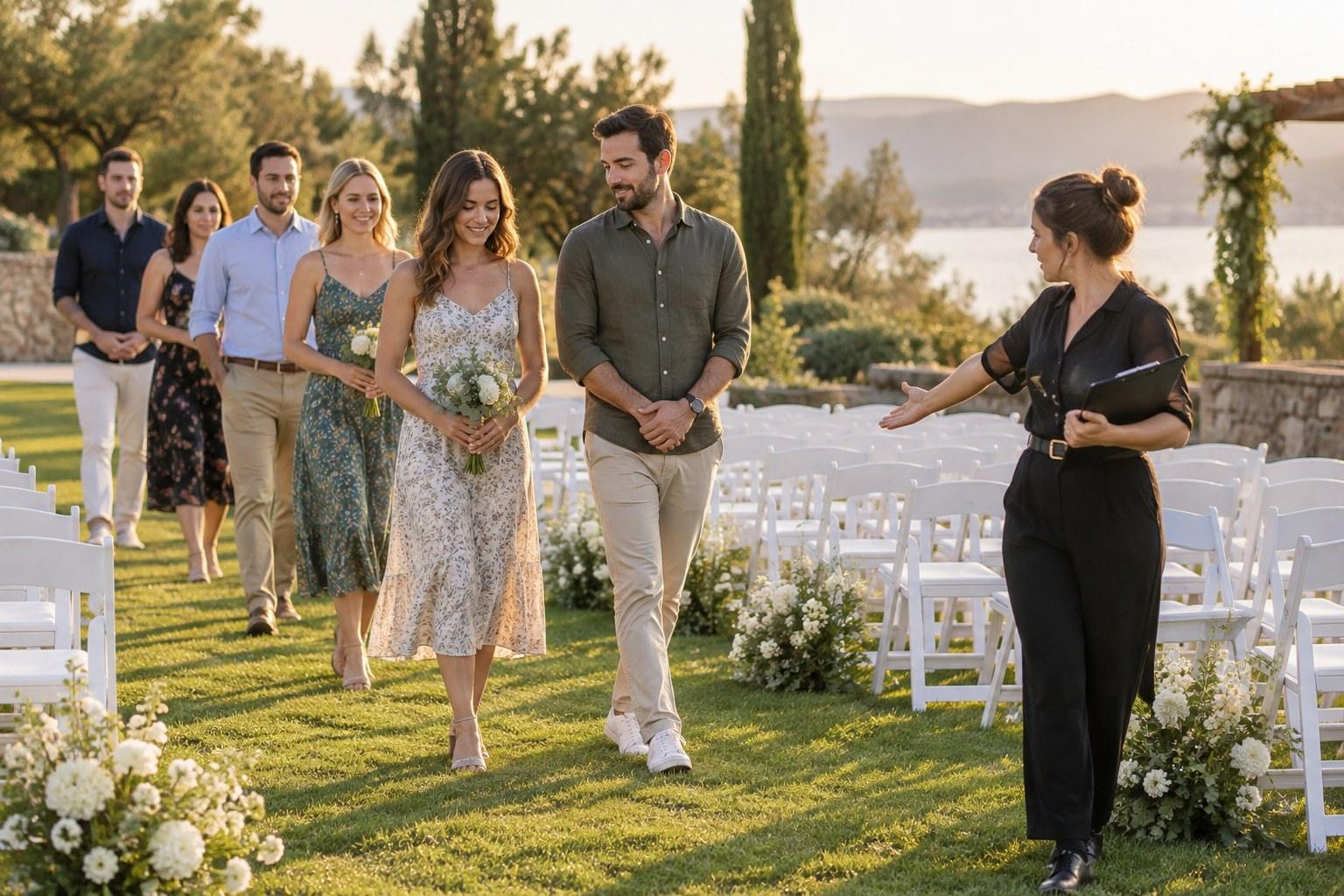
How to run a wedding rehearsal: the run sheet
This is the order that works. Adapt the details to the ceremony, but keep the sequence — it builds from standing still to moving, which is how people actually learn it.
1. Arrival and welcome — take charge immediately
Gather everyone, introduce yourself and the officiant, and say plainly what’s about to happen and how long it’ll take. “We’ll run the whole ceremony twice, and you’ll be out in under an hour.” That one sentence settles the room and quietly establishes who’s leading.
2. Roles and positions at the front
Start at the end. Put everyone where they’ll stand during the ceremony — the couple, the officiant, the attendants on each side, readers in their seats. Adjust for photos now: nobody blocking the couple’s faces, attendants angled slightly in, enough space for the photographer’s line of sight. Take a quick photo on your phone so you can reset it later.
3. Processional order and spacing
Now send everyone back to the start and line them up in the confirmed order. Show them the spacing — typically you release the next person once the one ahead reaches a set marker, like a particular row of chairs. Tell them where to peel off at the front and which side they go to. Walk pace: slower than they think, but not a funeral march.
4. Practise the walk twice
Once to learn it, once to own it. The first run is always messy — someone forgets their side, someone walks too fast. That’s the point. The second run, with music if you can manage it, is where it clicks. Resist the urge to do it five times; you’ll lose the room.
5. Ceremony moments: readings, rings, signing
You don’t need to rehearse every word. Walk through the moments that involve movement: when readers stand and where they go, who holds the rings and how they’re handed over, when the bouquet gets passed off, and how the signing works — who signs, where the table is, and who the witnesses are. Let the officiant give the verbal cues and make sure everyone hears them.
6. The recessional
Couple first, then attendants paired up, then family. Tell them exactly where to go once they leave the aisle — and make sure it’s somewhere out of sight and close by, so you can gather them for photos without hunting for anyone.
7. Photo positions and family groups
If there are formal family photos after the ceremony, read out the list at the rehearsal so people know they’re on it and not to wander off to the bar. Give one reliable family member the job of rounding people up.
Sample wedding rehearsal timeline
Here’s a tight rehearsal timeline you can adapt. Timings are a guide — a small ceremony will move faster, a large bridal party slower.
| Time | What happens | Who leads |
|---|---|---|
| 0:00 | Arrivals, name check, welcome and overview | Planner |
| 0:05 | Roles explained; everyone placed in ceremony positions at the front | Planner |
| 0:15 | Walk through ceremony moments — readings, rings, signing | Officiant, with planner on movement |
| 0:25 | Recessional practised; exit point confirmed | Planner |
| 0:30 | Processional line-up, spacing and first walk-through | Planner |
| 0:40 | Full ceremony run-through with music cues | Planner and officiant |
| 0:50 | Photo list read out, handouts given, day-of confirmations | Planner |
| 0:55 | Wrap — everyone leaves knowing their call time | Planner |
Cueing music with the musician or DJ
Music cues are where ceremonies wobble. Confirm with the musician or DJ beforehand exactly which track plays for each part — guest seating, processional, the couple’s entrance, signing, recessional — and what the physical cue is for each change. A nod from you? The officiant’s words? The last attendant reaching the front?
If they’re at the rehearsal, run the second walk-through with the real music so everyone hears where the track changes. If they’re not, play the tracks from your phone and give them a written cue sheet ahead of the day. Either way, one person — usually you — gives the cues. Never leave it to “whenever it feels right.”
Handling divorced parents and sensitive family dynamics
Ask the couple privately, well before the rehearsal, what the real dynamics are. Who’s walking whom? Who sits in the front row? Is there a step-parent involved? Are there people who shouldn’t be positioned side by side? Decide all of it in advance and write it into the plan — the rehearsal is not the moment to negotiate who escorts the bride.
On the night, present positions as settled facts, warmly and without explanation. “Mum, you’ll be seated here; Dad, you’ll be across the aisle here.” If tension surfaces, move it aside quietly — “Let’s chat about that after we finish” — and keep the group moving. Your calm is the thing everyone borrows.
Kids and pets at the wedding rehearsal
If a flower child, ring bearer or dog is in the ceremony, they need to be at the rehearsal — and they need a handler who isn’t in the bridal party. Rehearse their walk early while attention spans are fresh, show them exactly where to go at the end (usually straight to a parent in the front row), and have a backup plan if they refuse on the day. Small kids often behave differently with a full crowd watching. For pets, check the venue allows them and agree who takes them away once their moment is done.
How long should a wedding rehearsal take?
Aim to be done within an hour. Beyond that, attention drops and people start freelancing. The trick to keeping it tight is simple: decisions are made before the rehearsal, not during it. If someone raises a new idea — a different reading, a surprise song — note it and take it to the couple afterwards. The rehearsal is for practising the plan, not rewriting it.
What to hand out and confirm at the end
Before anyone heads to dinner, give out a one-page timeline for the day and a contact list showing who to call for what — including your number. Then confirm out loud:
- Each person’s arrival time and location on the day
- Who’s bringing the rings, the marriage paperwork and any readings
- Who’s handling buttonholes, bouquets and personal flowers
- Where the bridal party goes after the recessional
- Your contact details, and who to go to if they can’t reach you
That final five minutes is what turns a rehearsal into a genuinely smoother wedding day. If you want to take ceremony coordination further — into how the rehearsal sits alongside styling the ceremony space itself — our Certificate in Wedding Styling covers the design side, and the Advanced Certificate in Wedding Planning, Styling and Business brings planning, styling and the business together. For the full planning process — rehearsals, run sheets and day-of systems included — start with the Certificate in Wedding Planning. 💍
How to run a wedding rehearsal: FAQs
Who runs the wedding rehearsal — the planner or the officiant?
Usually both, with clear roles. The officiant leads the ceremony content and verbal cues; the planner runs logistics — positions, processional order, spacing, music cues and timing. Agree the split with the officiant before the rehearsal, and follow any rules the venue has.
When should the wedding rehearsal be held?
Most commonly the day before the wedding, so it’s fresh in everyone’s mind. What matters most is availability of the ceremony site and the key people — book the slot with the venue as early as possible.
How many times should you practise the processional?
Twice is usually enough — once to learn the order and spacing, and once as a full run-through with music. More than that tends to drain energy rather than add confidence.
Does the whole bridal party need to attend the rehearsal?
Yes — anyone who walks, stands at the front, reads, performs or has a job in the ceremony should be there. If someone genuinely can’t attend, walk a stand-in through their part and brief the absent person directly afterwards with a written summary.
What should a planner bring to a wedding rehearsal?
Your run sheet, the confirmed processional order, printed day-of timelines and contact lists to hand out, the music cue sheet, the family photo list, and something to mark positions if the site isn’t set up. A phone speaker for music is handy if the musician or DJ can’t attend.