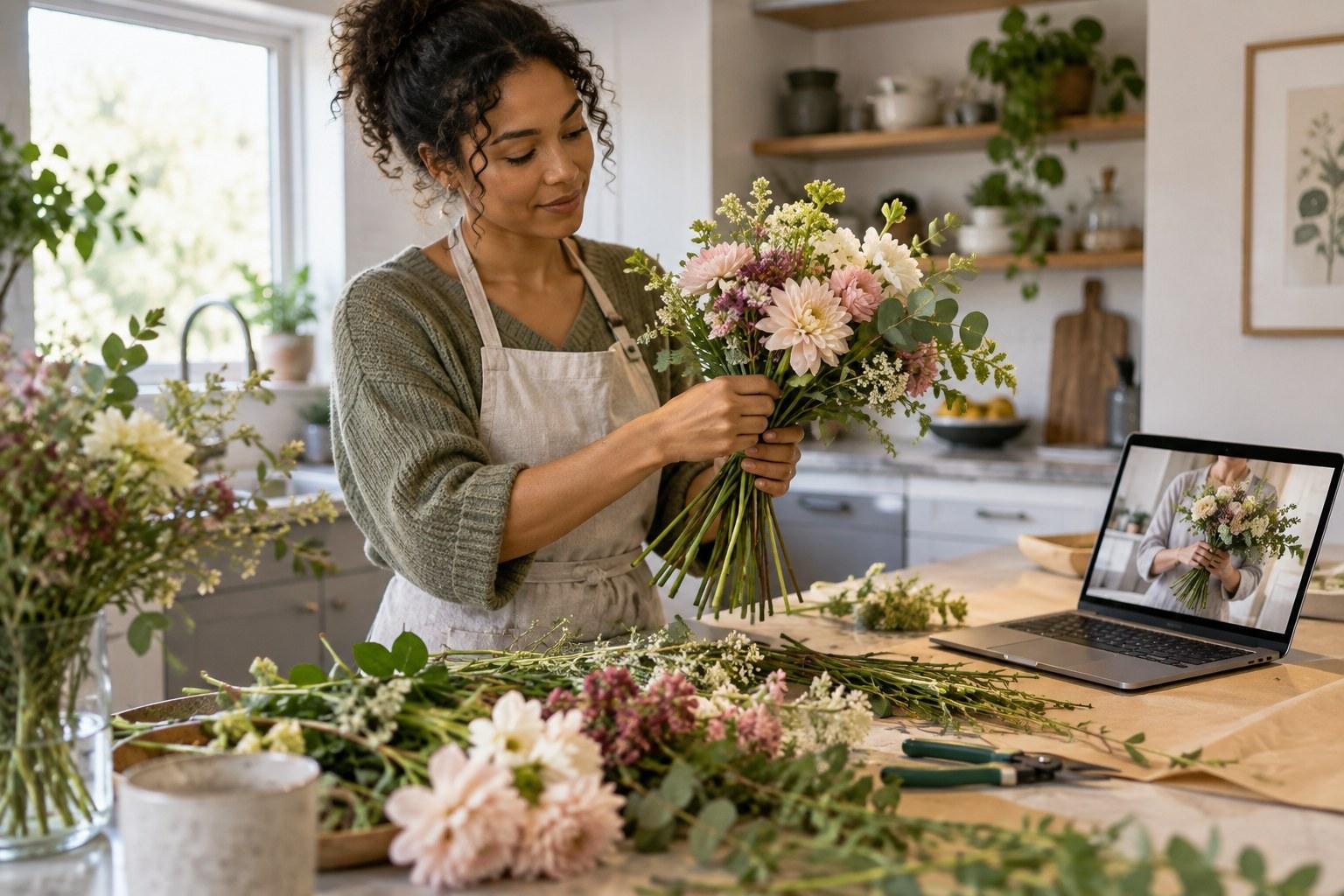
Can you learn floristry online? Yes — you can learn the design principles, mechanics, flower care and business side of wedding floristry online, but you build hand skills by practising with real stems alongside it. That’s the catch, and it’s a good one: the theory travels through a screen beautifully, and the muscle memory comes from your own bench.
If you’ve been wondering whether online floristry training is “real”, or whether you need to quit your job and enrol somewhere full-time to ever make a bridal bouquet for money, this is the honest answer. Below: what online learning does brilliantly, what you absolutely have to practise physically, how to set up a home practice routine, and where books, courses and real-world experience each fit.
Can you learn floristry online? The short answer
Floristry is two skills wearing one apron. The first is knowledge — why a design works, which flowers hold up out of water, how to price a wedding so you don’t lose money on it. The second is hands — the feel of a spiral coming together, wire tension, how hard you can push a stem before it snaps.
Online learning is excellent at the first and a brilliant coach for the second. What it can’t do is hold the stems for you. So the real question isn’t “can I learn floristry online?” — it’s “will I actually practise while I learn?” If the answer is yes, online is a genuinely practical route into wedding floristry, especially if you’re fitting study around work, kids or a career change.
What online floristry courses do really well
Let’s give screens their credit. A well-built online floristry course teaches a lot of things better than a busy one-off workshop can.
- Design theory. Balance, proportion, focal points, movement, negative space — the vocabulary that turns “pretty” into “intentional”.
- Colour. How to build a palette from a couple’s brief, why some combinations sing and others go muddy, and how to talk about colour with clients.
- Proportion and scale. Bouquet size against the dress and the person carrying it, centrepiece height against sightlines, installation scale against the room.
- Recipes. Breaking a design into stem counts so you can order accurately and repeat a look.
- Mechanics demos. Watching a spiral, a wired buttonhole or a foam-free installation built close up — from an angle you’d never get standing at the back of a classroom.
- Rewatchable lessons. Missed a step? Rewind. Want to watch the binding point five times? Go for it. Nobody sighs at you.
- Business and pricing logic. Quoting, markups, ordering, wastage, contracts, consultations — the part that decides whether floristry is a hobby or an income.
That last point matters more than most beginners realise. Plenty of talented florists struggle because nobody taught them how to price a wedding. It’s exactly why the Certificate in Floral Design pairs design and mechanics with the commercial side of wedding work — so you finish with both a portfolio and a way to get paid for it.
What you must practise with real flowers
Here’s the bit nobody can do for you. These skills only stick when your hands have done them — many, many times.
Conditioning and flower care
You can learn the rules online — clean buckets, fresh cuts, stripping foliage below the waterline, treating woody and soft stems differently. But you only learn how a particular rose or hydrangea behaves by conditioning it, watching it over a few days and noticing what drooped and what didn’t.
Wiring and taping
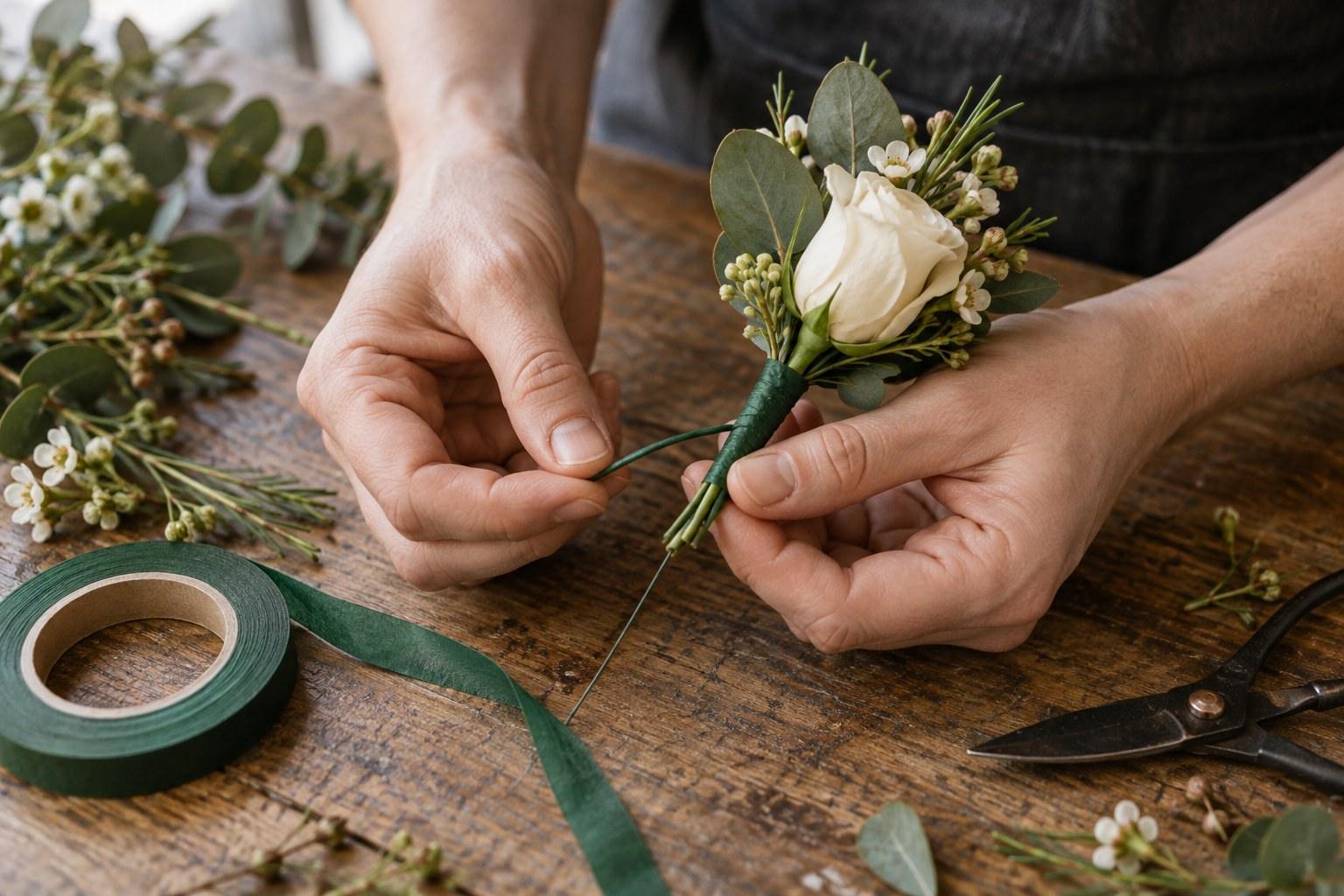
Buttonholes, corsages and flower crowns live or die on wiring. Gauge choice, how tightly to tape, how to keep it neat and light — that’s tactile. Your first ones will be clunky. Your twentieth won’t.
Bouquet spirals
The hand-tied spiral is the classic beginner wall. You’ll watch it look effortless on screen, then pick up stems and feel them fight you. That’s normal. The spiral clicks through repetition, not understanding — so practise it until it’s boring.
Installations and large pieces
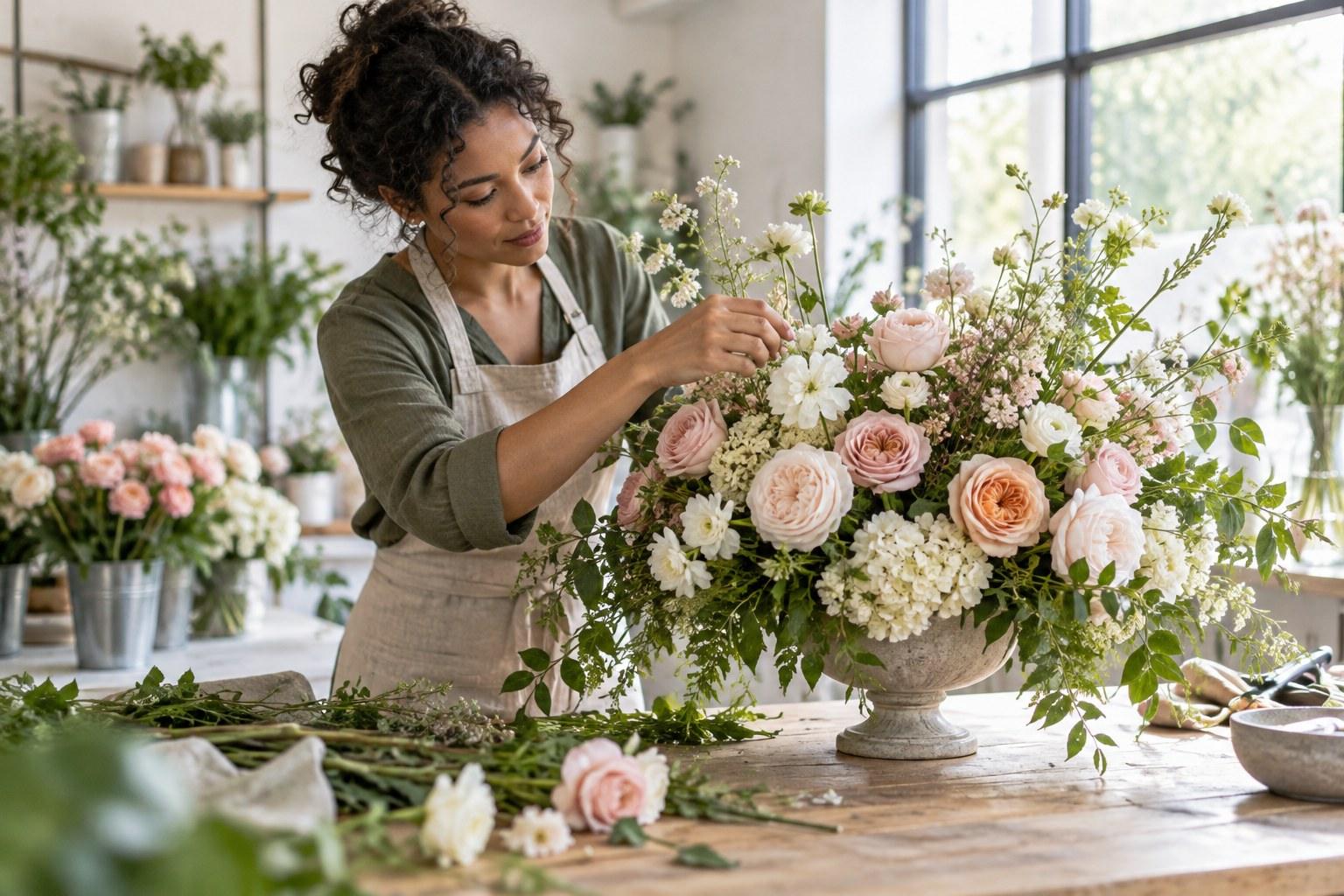
Arches, hanging pieces and big statement arrangements involve weight, structure and safety. Learn the mechanics and planning online, then build at a scale you can manage at home before you ever promise one to a client.
How to practise floristry at home while you learn online
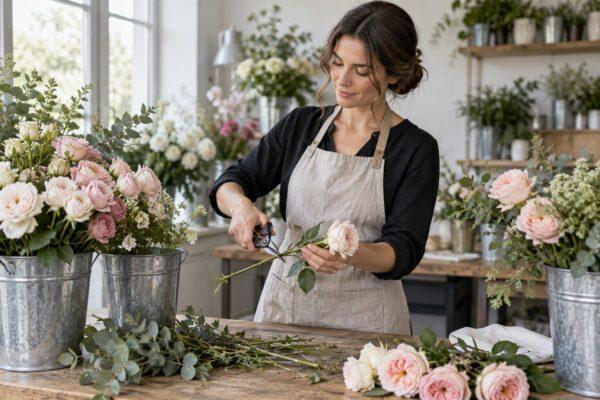
You don’t need a studio. You need a bench, a bucket, sharp snips and a routine. Here’s a simple setup that works:
- Buy seasonal stems. Local markets, growers or your supermarket — seasonal flowers are usually easier on the budget and teach you what’s actually available when couples book.
- Practise one technique a week. Week one, conditioning. Week two, a spiral. Week three, a wired buttonhole. Depth beats dabbling.
- Rebuild the same design more than once. Take it apart, recondition, do it again. Your second attempt teaches you more than your first.
- Photograph everything. Front, side, back, top. Good light, plain background. You’ll spot proportion problems in photos you miss in person — and you’re quietly building a portfolio.
- Keep a practice log. Which stems, what recipe, what went wrong, what you’d change. This becomes your personal reference library.
Done consistently, this is how online floristry training turns into real ability. The lessons tell you what good looks like; the bench is where you get there.
Floristry books vs online courses: which should you start with?
Honestly? Both have a place, and they do different jobs.
A book is a brilliant reference and a low-cost way to start. You can read it on the train, flag pages, and come back to it when you’re stuck on a quote at 10pm. The Wedding Florist’s Handbook ebook by Jac Bowie is written for exactly this — it’s part of an 8-book series covering planning, styling, floristry and the business side, all on the Wedding Academy books page. Not sure yet? Grab a free sample chapter and see if the approach suits you.
A course adds what a book can’t: structure, a sequence that builds skill on skill, assessments that make you actually do the work, feedback on what you’ve made, and a certificate at the end. If you’re planning to charge for wedding flowers, that accountability is often the difference between “I’ll get to it” and a finished portfolio.
Ways to learn wedding floristry, compared
| Learning method | Best for | Limitations |
|---|---|---|
| Books and ebooks | Low-cost start, reference, theory, business basics, revisiting topics on demand | No feedback on your work; easy to read and never practise |
| Free videos and social media | Inspiration, quick technique glimpses, trend spotting | No structure, mixed quality, gaps in mechanics and pricing |
| Online certificate course | Structured learning, assessments, feedback, a certificate, business and pricing logic, studying around your life | You must source flowers and practise at home yourself |
| In-person workshops | Hands-on technique with someone correcting you in real time | Usually short and topic-specific; fixed dates and location |
| Assisting a local florist | Real wedding pace, processing big orders, setup and pack-down, industry contacts | Theory isn’t explained; you learn their way, not every way |
The strongest path usually combines them: a book for reference, a course for structure, home practice for hands, and real weddings for pace.
How to get real-world floristry experience
Online study plus home practice gets you skilled. Real weddings get you ready. A few ways to bridge the gap:
- Assist local florists. Wedding florists often need extra hands for big Saturdays — processing, conditioning, loading the van, setup and pack-down. Offer to help, show up on time, and be useful. You’ll learn more in one busy wedding weekend than you expect.
- Join styled shoots. Collaborating with photographers, stylists and venues gives you portfolio images, practice at scale and relationships with the suppliers who’ll later refer you.
- Do friends-and-family pieces carefully. A small, simple job — a bouquet, a few table pieces — is a great step. Just be honest about your experience and don’t take on more than you can deliver.
- Learn the styling side too. Florals sit inside a bigger design. Understanding the whole look — tablescapes, colour stories, venue styling — makes you far more valuable. The Certificate in Wedding Styling is a natural companion if you want to offer both.
Is learning floristry online right for you?
Online floristry training suits you if you’re self-motivated, you want to study around existing commitments, and you’re happy to source stems and practise on your own schedule. It’s a strong fit for career changers, creatives adding florals to an existing wedding business, and anyone who wants the business knowledge as much as the design skills.
It’s harder if you know you’ll only practise when someone is standing next to you. If that’s you, pair online study with in-person workshops or assisting — not instead of the course, but alongside it.
And if you’re thinking bigger than flowers — running a full planning and styling business — the Advanced Certificate in Wedding Planning, Styling and Business covers the wider picture. For florals specifically, start with the Certificate in Floral Design and build from there. 🌸
Learning floristry online: FAQs
Can you really learn floristry online?
Yes. You can learn design principles, colour, mechanics, flower care and the business side of wedding floristry online. You build the hand skills by practising with real flowers at home alongside your lessons — the course shows you how, your bench is where it sticks.
Do you need a qualification to be a wedding florist?
Requirements vary by country and by the kind of work you do, so check what applies where you live. Even where a formal qualification isn’t required, structured training helps you work confidently, price properly and show clients you’ve invested in your craft.
Is a floristry book enough to get started?
A book is a great, low-cost starting point and a reference you’ll keep coming back to. What it can’t give you is structure, assessments, feedback on your work or a certificate — that’s where a course comes in. Many people start with a book or the free chapter, then move into a course.
What equipment do I need to practise floristry at home?
Start simple: sharp floral snips, clean buckets, floral wire and tape, binding twine or tape for bouquets, a few vessels and seasonal stems. Add a phone for photographing your work. You can build up specialist mechanics as you move into bigger pieces.
How do I get experience after learning floristry online?
Offer to assist local wedding florists on busy weekends, join styled shoots with photographers and stylists, and take on small, simple pieces for people you know. Photograph everything so your experience becomes a portfolio.
Ready to turn practice into a profession? Learn the design, mechanics and business of wedding flowers — at your own pace, from your own bench.