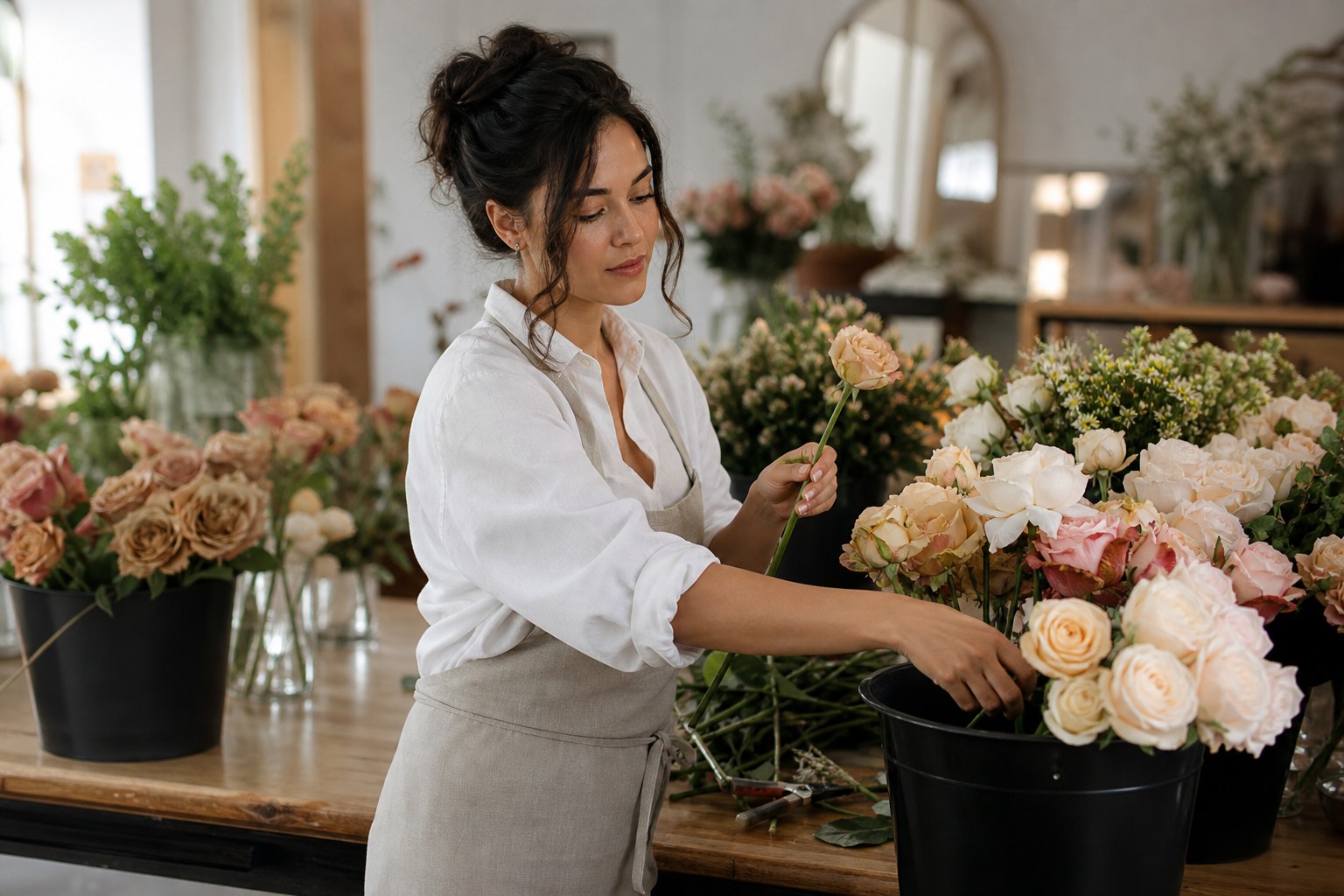
You keep buying flowers you don’t need. You’ve pulled apart a supermarket bunch to rebuild it properly. And somewhere between a friend’s bouquet and a Pinterest board you’ve saved eleven times, the question arrived: how do you actually become a wedding florist?
Here’s the honest version. Wedding floristry is not a hobby with a price tag attached. It’s a craft with mechanics, a supply chain, a cold chain and a costing model — and the florists who last are the ones who learned all four, not just the pretty part.
This is what the job really involves, what a good floral design course has to teach you, and how to go from “I love flowers” to a florist a planner will book twice.
What does a wedding florist actually do?
Design is maybe a quarter of it. The rest is logistics and craft.
A wedding florist takes a couple’s vague brief — “romantic, not too formal, whites and greens, but warmer” — and turns it into a concept, a stem-by-stem recipe, an order to a wholesaler, a conditioning schedule, a build plan, a delivery run, an on-site install and a pack-down. All of it timed so the flowers peak on the day and not two days early.
You are working with a product that starts dying the moment it’s cut, in heat, in wind, in a venue that gives you ninety minutes of access. That’s the reality nobody puts on the mood board — and it’s exactly why training matters more here than almost anywhere else in the wedding industry.
Do you need a qualification to be a wedding florist?
Legally, no. There’s no licence, no registration board, no exam standing between you and your first booking in Australia, the UK, the US or almost anywhere else. Anyone can call themselves a florist tomorrow.
Which is exactly why couples and planners look for other signals — training, portfolio, the way you talk about mechanics and seasonality. A floral design course doesn’t just teach you the craft; it gives you the vocabulary and the credential that get you taken seriously before you have thirty weddings behind you.
You’ll still need the grown-up things wherever you operate: a registered business, insurance, contracts, and a very clear substitution clause. More on that below.
The four skills every wedding florist has to master
1. Floral mechanics
Mechanics is the engineering underneath the flowers: how a piece is built so it holds its shape, holds its water and holds up through a full day. Chicken wire, reusable cages, pin holders, zip ties, armatures, weighting and rigging. Foam-free mechanics have gone from niche to expected, and if you can’t build sustainably you’ll lose the venues that ban foam outright.
Bad mechanics is the number one way a new florist gets publicly humiliated: an arch that leans into the aisle, a hanging installation that drips onto a head table, a bouquet that collapses in a hand by 4pm.
2. Conditioning and flower care
Conditioning is what separates florists who deliver flowers at their peak from florists who deliver flowers that were beautiful yesterday. Cutting angles and stem length, clean buckets and flower food, cool storage, which blooms drink hard and which ones sulk, what to open early with warm water and what to hold back on ice.
Learn this properly and your wastage drops, your margin rises and your flowers photograph better. It’s unglamorous and it’s the highest-leverage skill in the studio.
3. Design, colour and scale
Shape, movement, focal blooms, texture, negative space, and colour that reads correctly in candlelight and in a photographer’s files. Also scale — the thing that ruins more designs than any other. An arrangement that looks generous on your bench disappears in a barn with a nine-metre ceiling.
4. Pricing flowers so you actually make money
This is the one that ends careers. Most new florists quote by feel, forget wastage, forget the four hours of conditioning, forget the delivery van, forget the pack-down at 11pm, and end up funding someone’s wedding out of their own pocket.
Profitable florists cost every stem including breakage and shrinkage, price design time and labour separately from product, build recipes to a budget instead of a dream, and write substitution clauses so a market shortage isn’t their financial problem. None of that is intuition. All of it is teachable.
How to become a wedding florist: a realistic path
- Learn the craft properly. Structured training in mechanics, conditioning, design and costing — so you’re not paying for the lessons with someone else’s wedding day.
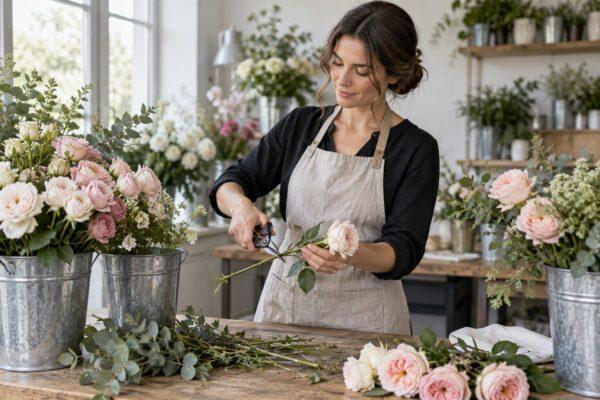
- Practise on a bench, weekly. Buy market flowers, build a bouquet, a buttonhole, a table arrangement. Photograph everything in good light.
- Assist a working studio. One install day teaches you more about timing and rigging than a month of scrolling. Say yes to bucket-washing.
- Build a portfolio you control. Styled shoots with a photographer, a stylist and a venue give you images before you have paid clients — and get you tagged in front of couples.
- Set up the business. Registration, insurance, contracts, wholesaler accounts, a pricing sheet, a booking process, a deposit policy.
- Take the small jobs. Elopements, micro weddings, ceremony-only packages. Small weddings are the safest place to make your first mistakes.
Two of those steps — the craft and the costing — are exactly what the Certificate in Floral Design is built to compress.
What to look for in a floral design course
Not all floristry training is equal. Before you hand over a card, check for these:
- Mechanics taught explicitly — including foam-free and large-scale installation methods, not just bench arrangements.
- Conditioning, storage and transport covered in detail. If it isn’t, the course is teaching you a hobby.
- Pricing and profit — costing per stem, labour, wastage, quoting and substitution clauses.
- Wedding-specific work — bouquets, buttonholes, ceremony structures, aisle and reception design, not general retail floristry.
- Video you can rewatch, so you can build alongside the demonstration at your own bench.
- Taught by people who do this for a living, with real weddings behind them.
- Self-paced and online, so you can train without quitting your current job.
Can you learn floral design online?
Yes — and for technique it’s arguably better. In a one-day workshop you get one demonstration and one attempt. Online, you can pause a spiral bouquet mid-build, rewind the taping, and watch an arch mechanic three times before you touch a stem. Then you practise with your own flowers, on your own bench, as many times as it takes.
What online can’t give you is install-day adrenaline. That comes from assisting. Do both.
Wedding florist or floral designer — and where the money is
The terms blur, but the work doesn’t. Retail floristry is walk-in, everyday, shop-bucket work. Wedding and event floral design is brief-driven: a concept, a colour story, personal flowers, ceremony structures, reception design and often large-scale installations that need rigging and a crew.
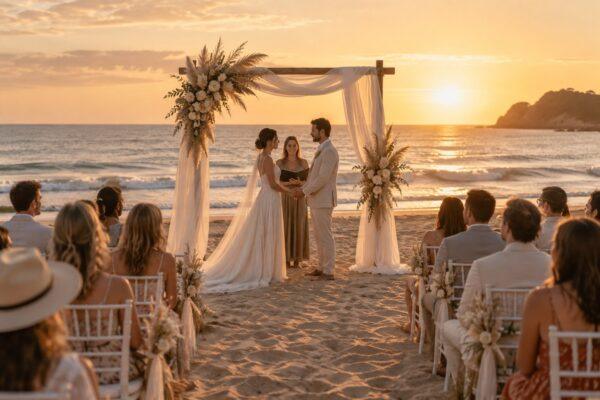
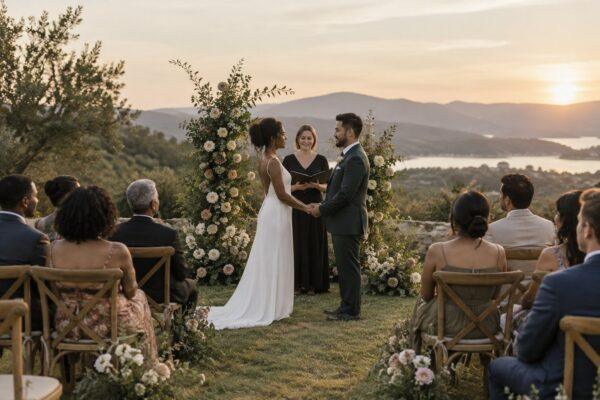
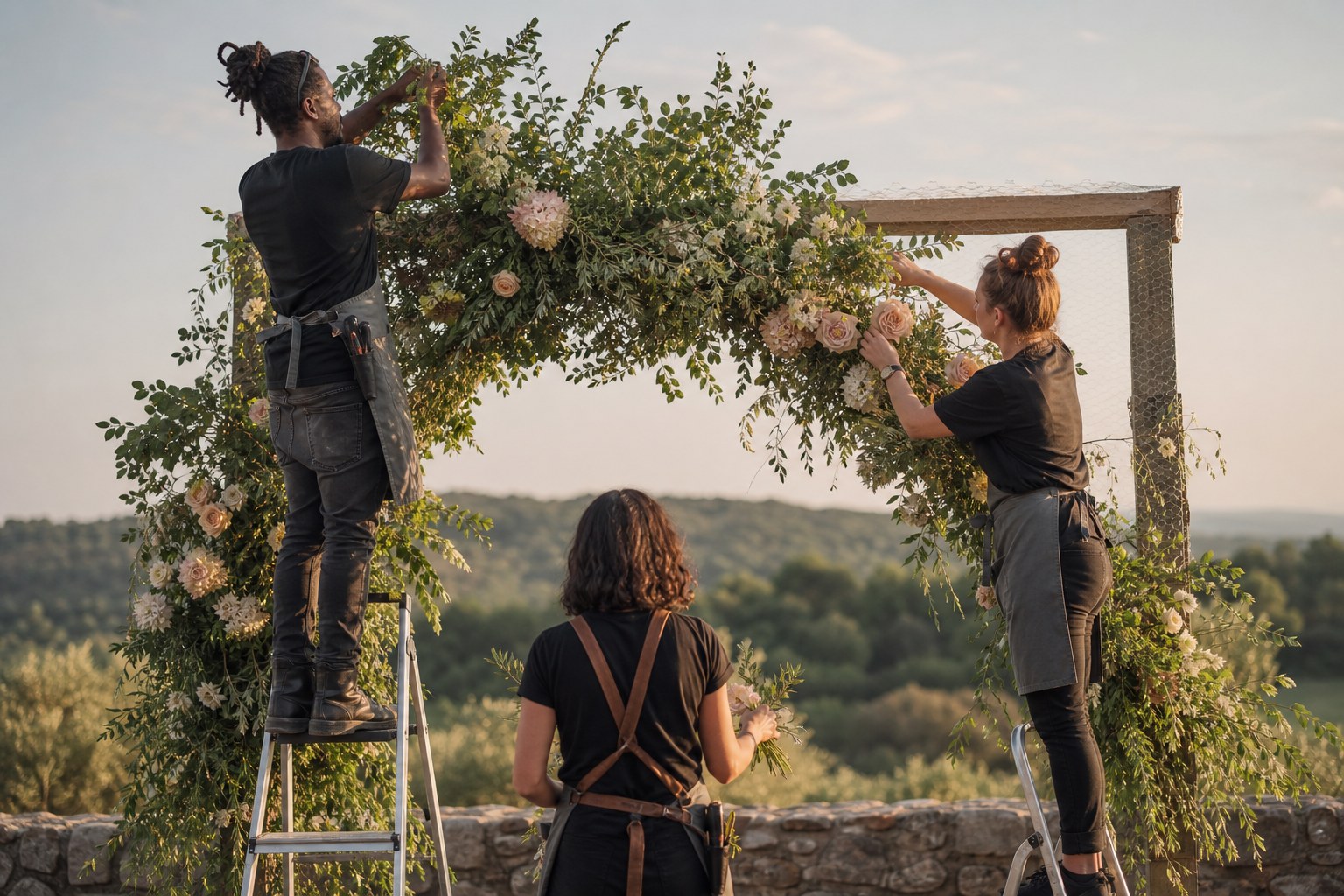
Installations are where the ambition sits — hanging clouds, meadow aisles, entrance moments — and also where the risk sits. They carry the biggest budgets and the biggest chance of something going wrong at height, in wind, an hour before guests arrive. Train for them before you sell them.

Why study floral design with The Wedding Academy?
The Certificate in Floral Design is an online, self-paced course built to turn flower-lovers into working wedding florists. You’ll cover the craft and the commercial side together:
- Floral fundamentals: flower types and seasonality, sourcing and wholesalers, tools and kit, conditioning and care
- Design theory: colour, shape, texture, proportion and building to a brief
- Mechanics: foam-free techniques, armatures, cages and wiring, and structures that survive a full wedding day
- Wedding flowers: bridal bouquets, buttonholes and personal flowers, ceremony and aisle design, centrepieces and reception styling
- Installations: arches, arbours, hanging and large-scale work — planning, rigging, build and pack-down
- The business: quoting, costing per stem, pricing your labour, contracts and substitution clauses, marketing to couples and planners
Study from anywhere in the world, at your own pace, around the job you haven’t quit yet — with a global community of wedding pros alongside you.
Want to widen your offer beyond flowers? Many florists pair it with the Certificate in Wedding Styling to sell full design packages, or the Certificate in Wedding Business & Marketing to get the enquiries flowing. If you want the full toolkit — planning, styling and business — look at the Advanced Certificate in Wedding Planning, Styling and Business.
Flowers forgive nothing. Learn the mechanics, learn the costing, and the artistry has somewhere solid to stand.
Floral design course FAQs
Do you need a qualification to become a wedding florist?
No. Floristry isn’t a licensed profession in Australia, the UK, the US or most of the world, so nobody can stop you taking bookings tomorrow. What stops you is the craft: mechanics, conditioning, colour and costing. A floral design course gives you those fast, and gives couples and planners a reason to trust you before you have a portfolio full of real weddings.
Can you learn floral design online?
Yes. Technique is taught brilliantly on video — you can pause, rewind and re-watch a bouquet spiral or an arch build as many times as you need, then practise with a bucket of supermarket blooms on your own bench. The Wedding Academy’s Certificate in Floral Design is 100% online and self-paced, and open to students worldwide.
How long does it take to become a wedding florist?
With a self-paced online course, most students work through the training in weeks to a few months depending on the hours they can give it. Getting genuinely fast and confident takes a season of real weddings on top — which is why most florists study first, then assist an established studio while they build their own bookings.
Is wedding floristry profitable?
It can be very profitable, and it can also quietly lose money — the difference is costing. Profit comes from knowing your true cost per stem including wastage, pricing your labour and design time rather than just marking up flowers, and building recipes that hit the brief without over-ordering. That’s a learnable skill, and it’s the part most self-taught florists skip.
What’s the difference between a florist and a floral designer?
In practice the terms overlap, but ‘florist’ often implies retail and everyday arrangements, while ‘floral designer’ implies event and wedding work: concept, colour palette, large-scale installations and mechanics that hold up outdoors for twelve hours. Wedding work is designed to a brief and a budget, not pulled from a shop bucket.
Your floristry career starts at your own bench.
Learn the mechanics, the conditioning, the installations and the pricing that make wedding flowers profitable. Online, self-paced, payment plans available — and you can start the first module tonight.