You already rearrange other people’s mantelpieces. You can spot a bad linen choice from across a room. The question isn’t whether you have the eye — it’s what you actually do in the next 90 days to turn it into paid work.
This isn’t another explainer on what a wedding stylist does. It’s the practical build: the skills, the portfolio you create from nothing, the styled shoot that gets you seen, and how you land and price your first paying client. Ninety days, no waiting to be discovered.
What skills do you need to become a wedding stylist?
Taste is the entry ticket, not the job. Stylists who get booked repeatedly have four things working together.
1. Design fluency you can explain out loud
Colour theory, proportion, texture, negative space, how light behaves in a room at 5pm in October. Anyone can pin a pretty photo. A stylist can look at a couple’s messy Pinterest board, find the one thread that’s actually them, and translate it into a coherent concept with a reason behind every choice.
2. Practical execution
Hanging installations. Draping fabric so it doesn’t sag by dinner. Knowing what a hire company charges for a bentwood chair. Weighting an arbour so a coastal breeze doesn’t redesign your ceremony. Beautiful concepts fail on logistics.
3. Client translation
Most couples cannot articulate what they want. Your job is to ask better questions, present a concept they didn’t know how to ask for, and hold the design line when someone suggests gold chargers on a raw linen palette.
4. Business mechanics
Quoting, contracts, hire margins, insurance, deposits. This is where talented stylists quietly go broke — they price the pretty and forget the four hours in a van and the two packing down at midnight.
You can teach yourself parts of this over several unpaid seasons, or compress it — which is exactly what the Certificate in Wedding Styling is built to do.
Start your first 90 days properly.
Online, self-paced and built around real jobs — concept, execution, portfolio and pricing. Start module one tonight.
Days 1–30: build the foundation and define your look
Month one isn’t about clients. It’s about becoming someone worth hiring.
Get trained — fast, not slowly
Pick a wedding styling course you can actually finish around your current job. Online and self-paced beats a multi-year qualification here, because this industry rewards a portfolio far more than a parchment. What you want: design principles, styling real venues, working with florists and hire companies, and the business side.
Define your signature before anyone else does
Generic stylists compete on price. Specific stylists get chosen. Pick a lane you love and can execute repeatedly:
- Warm minimal — raw linen, sculptural candles, tonal florals
- Modern romantic — softer palettes, layered textures, lots of glassware
- Editorial and architectural — strong lines, gallery venues, restrained colour
- Coastal or garden — loose seasonal blooms, outdoor logistics, natural light
- Intimate and destination — small guest counts, high detail, travel-ready kits
If small, high-detail weddings are your thing, the Certificate in Intimate, Micro & Destination Weddings pairs beautifully with styling.
Build the boring infrastructure now
Business registration. Public liability insurance — most venues ask for a certificate before they let you in the door. A simple contract. A one-page site with a gallery and an enquiry form. Instagram and Pinterest set up as a portfolio, not a diary.
Days 31–60: how to build a wedding styling portfolio with no clients
Here’s the loop every new stylist gets stuck in: no clients because no portfolio, no portfolio because no clients. Break it deliberately.
Run a styled shoot — properly
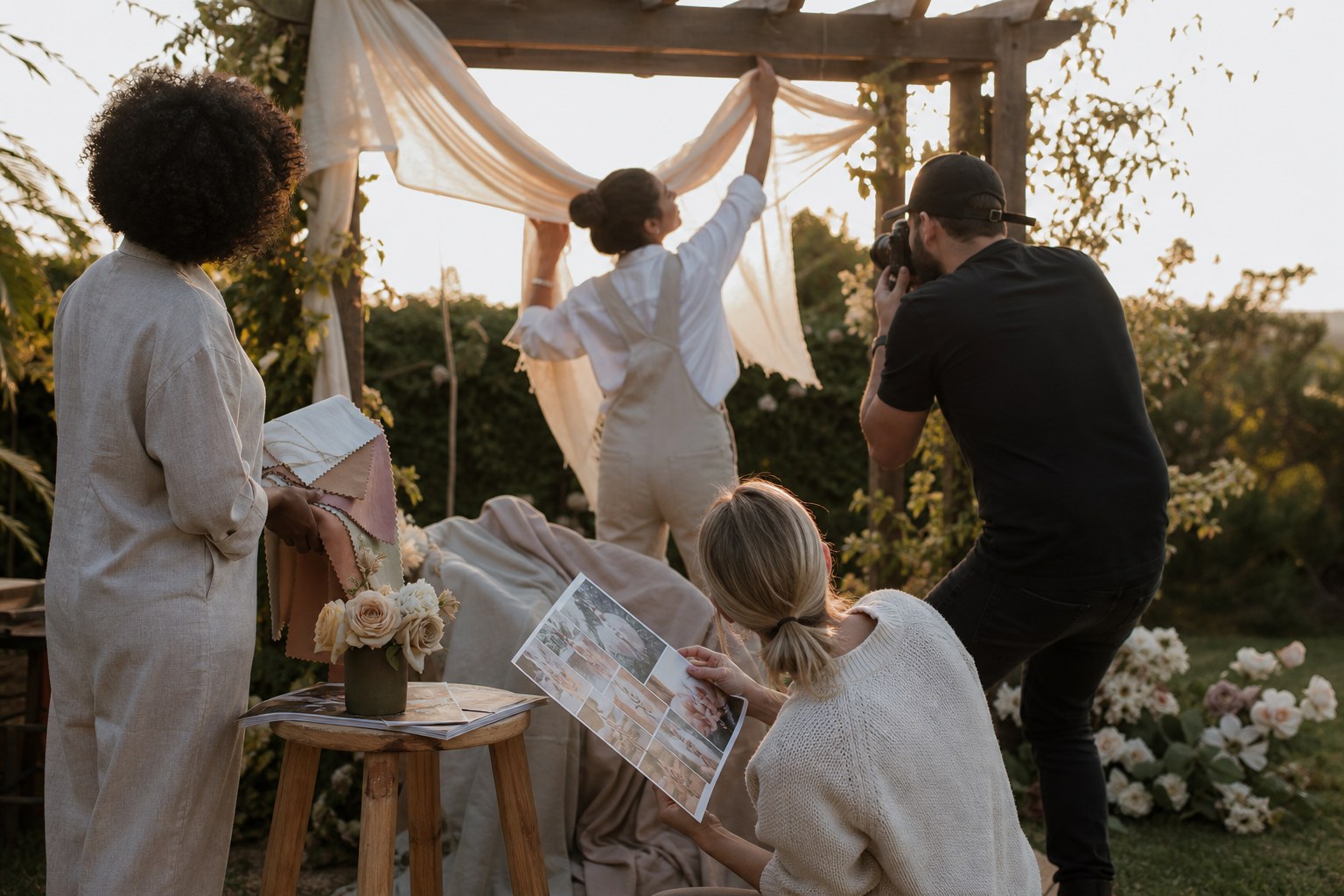
A styled shoot is a collaborative project where vendors contribute time and product in exchange for images. Done well, it produces portfolio work, vendor relationships and publication features. Done badly, it produces a cluttered table and three people who won’t reply to your emails again.
- Start with a concept, not a mood board dump. One idea, one palette, one narrative. Write it in a paragraph before you pin a single image.
- Build a real creative brief. Concept, palette, venue, shot list, timings, who brings what, who owns the images and how they’ll be credited.
- Recruit the right team. Photographer first — their work is what your portfolio becomes. Then florist, venue, hire company, stationer, HMUA, dress supplier, models.
- Be generous and specific. Vendors say yes to organised people with a clear vision and a deadline. They ignore vague DMs asking for “free flowers.”
- Style for the camera. Fewer objects, better ones. Details shots, wide shots, movement. Leave space in the frame.
- Deliver the images with credits to everyone involved, then submit to blogs with the full vendor list.
Two well-executed shoots — one moody, one light, different venue types — will do more for your bookings than a year of posting other people’s work.
Get real reps on real wedding days
Alongside shoots, assist. Help an established stylist or florist with set-up, take on-the-day styling for a friend’s wedding under a proper contract, or work bump-in for a hire company. Real weddings teach what a shoot never will: timing, wind, delivery access, and packing down in the dark.
Make your portfolio easy to say yes to
Curate hard — twelve outstanding images beat sixty average ones. Show cohesion so a couple sees your style, not your range. Write a short case study for each project: brief, concept, decisions. That’s what reads as professional rather than hobbyist.

Days 61–90: land and price your first paying client
Where your first client actually comes from
Almost never from an ad. In your first year, work comes from:
- Vendors you’ve worked beside. Photographers and florists refer constantly — your styled shoot team is your first sales team.
- Venues. Introduce yourself, bring images, be easy to deal with. Venues refer stylists who don’t damage walls or run late.
- Planners. Many planners sub-contract styling. Look at the Certificate in Wedding Planning if you want to understand how they work — or offer both services yourself.
- Pinterest and Instagram. Pinterest behaves like a search engine for engaged couples, and keeps working long after you post.
Package your services so people can buy them
Don’t offer “styling.” Offer clear tiers: concept-and-design only (mood board, palette, floor plan, supplier list the couple executes), full styling where you source, install and pack down, and on-the-day styling for couples who’ve bought their own pieces. Named packages make you look like a business, not a favour.
Price so the work is worth doing
Never quote a number that only covers the pretty part. Cost out every line: design hours, sourcing and supplier liaison, site visits, travel, hire items and your margin on them, install crew, bump-in and bump-out, van hire, breakages, insurance, admin. Then add profit — not a guilty little markup.
Two rules that save new stylists: charge a design fee separately from product, and take a non-refundable booking deposit with the balance due before the wedding, never after. Put both in the contract.
Then run the job like a professional
Signed contract and deposit. An approved written design proposal. A styling schedule with bump-in times cleared with the venue. A kit list, a pack-down plan, and your own photos on the day — the professional images take weeks and you need content now.
Skip the trial-and-error season.
Learn design, execution, styled shoots and pricing in one self-paced certificate — templates, ongoing training, a global community and payment plans available.
Do you need a qualification to be a wedding stylist?
No. Wedding styling isn’t a licensed profession anywhere in Australia, the UK, the US or New Zealand — nobody can stop you calling yourself a stylist tomorrow.
Which is the problem. With no barrier to entry, couples and venues look for signals instead: portfolio, professionalism, training. A wedding styling course won’t book your first client on its own, but it removes years of expensive guesswork — and gives you the pricing and contracts that keep a business alive long enough to get good.
What the Certificate in Wedding Styling covers
The Certificate in Wedding Styling is an online, self-paced course designed to make you a working stylist rather than a graduate. It takes you through the full arc of the job:
- Design foundations — colour, texture, proportion, light and building a concept that holds together
- Styling the wedding — ceremonies, tablescapes, installations, lounges and the details that photograph
- Sourcing and suppliers — hire companies, florists, prop sourcing and building your own kit
- Styled shoots and portfolio — how to concept, cast, run and publish a shoot that wins work
- The business of styling — packages, quoting, contracts, deposits and running the day itself
Want to add flowers to your offer? The Certificate in Floral Design is the natural next step. Want the whole business built at once — planning, styling and marketing? Take the Advanced Certificate in Wedding Planning, Styling and Business, or sharpen your enquiries with the Certificate in Wedding Business Marketing.
How to become a wedding stylist: FAQs
How do I become a wedding stylist with no experience?
Train first, then manufacture your own experience: run one or two styled shoots with a photographer and florist, assist an established stylist or hire company on real wedding days, and document everything as case studies. Experience isn’t given to you — you create it, then show it.
Do I need a qualification or licence to be a wedding stylist?
No licence is legally required in Australia, the UK, the US or most of the world. But with no barrier to entry, couples and venues rely on signals — portfolio, professionalism and training. A wedding styling course gives you credibility early and teaches the pricing and contracts most self-taught stylists learn the painful way.
How long does it take to become a wedding stylist?
A self-paced online wedding styling course can be completed in weeks to a few months around another job, and a first portfolio can be built inside a season with one or two well-run styled shoots. Most stylists are taking paid work well before they feel “ready.”
How much should I charge as a new wedding stylist?
Price from your costs, not from what feels polite. Cost out design hours, sourcing, site visits, travel, hire items and your margin, install and pack-down crew, breakages, insurance and admin — then add profit. Charge a design fee separately from products, and take a non-refundable booking deposit with the balance due before the wedding day.
What’s the difference between a wedding stylist and a wedding planner?
A planner runs logistics, budget, suppliers and the timeline. A stylist owns how the wedding looks and feels — concept, palette, décor, installations and on-site styling. Plenty of professionals do both, which is why many stylists add a planning qualification.
The stylists working this season aren’t more talented than you. They just started the ninety days.
Your first paid wedding starts here.
Join a global community of stylists trained by The Wedding Academy. Online, self-paced, open worldwide.