Ask any experienced planner what actually separates a smooth wedding from a stressful one and you will not hear “the flowers”. You will hear the timeline. ⏱️
A wedding day timeline is the spine of the entire event. It is the document that gets the hair and makeup team out on time, the ceremony started when the celebrant expects it, the food served hot, and the couple on the dance floor without anyone hissing about the cake. Build it badly and you spend the day firefighting. Build it well and you look like you are barely working.
Here is how to construct a run sheet that survives contact with a real wedding — the approach we teach in the Certificate in Wedding Planning.
Build the timeline backwards from the anchors
Beginners write timelines forwards from “8am: hair and makeup arrives” and then discover at the end that the ceremony has drifted forty minutes. Professionals work from fixed anchors outwards.
Your anchors are the things you genuinely cannot move:
- The ceremony start time, especially if it is religious, civil-registrar scheduled, or tied to a specific licence window.
- Sunset — this dictates your couple portraits and often your entire photography plan.
- Venue access in and venue curfew out, both usually contractual.
- Catering service times, which the kitchen sets, not you.
- Any culturally or religiously fixed moment in the day.
Place those first. Then build backwards from each one, adding travel and buffer. Everything else flexes around the anchors.
What goes in a wedding run sheet
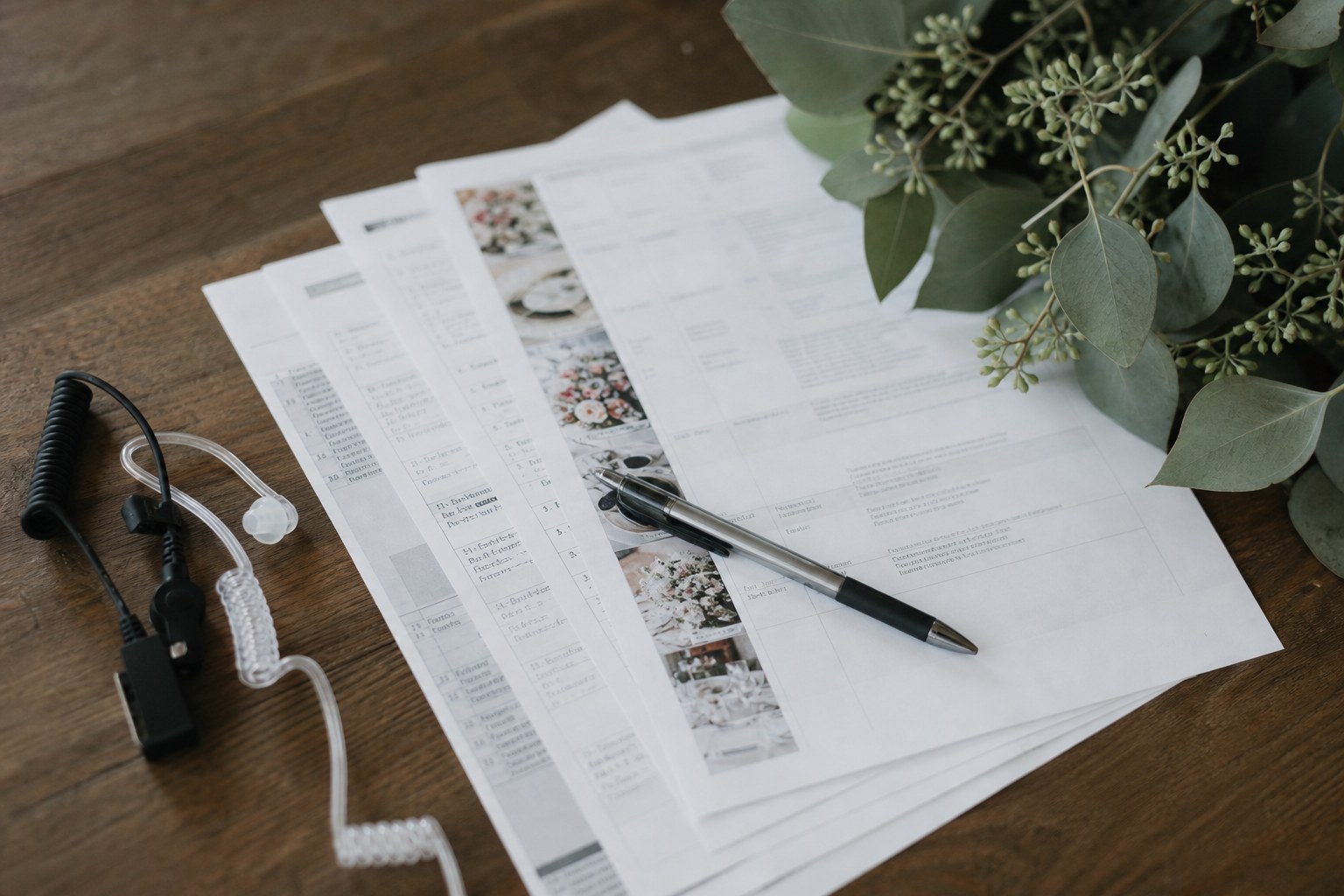
A good run sheet is boring, exhaustive and instantly readable at arm’s length in a dark corridor. Every line should answer three questions: what happens, when, and who owns it.
- Time — in a consistent format, at five or ten minute granularity.
- Action — written as an instruction, not a description. “Ushers begin seating guests” beats “guest arrival”.
- Owner — a named person or supplier, never “someone”.
- Location — which room, which entrance, which door.
- Notes — access codes, parking, load-in restrictions, dietary flags, the aunt who must be in the family photo.
Put a supplier contact list on page one, your own number on every page, and the wet-weather plan somewhere impossible to miss.
A realistic wedding day structure
Every wedding differs, but most full-day celebrations move through the same phases. Use this as a skeleton, not a template to copy blindly — the durations shift with guest count, venue layout and cultural traditions.
| Phase | What it covers | Where planners get caught out |
|---|---|---|
| Setup | Supplier load-in, styling, floral install, sound check | Venue access starting later than assumed |
| Getting ready | Hair, makeup, dressing, prep photography | Underestimating how long the final look takes |
| Guest arrival | Transport, ushering, welcome drinks | Guests arriving far earlier than invited |
| Ceremony | Processional, ceremony, signing, recessional | Signing and congratulations running long |
| Post-ceremony | Group photos, portraits, canapés, room turnaround | Group photo lists with no one to call names |
| Reception | Seating, service, speeches, cake, first dance | Speeches expanding to fill any available gap |
| Close | Last drinks, farewell, pack-down, supplier out | Curfew penalties and unstaffed pack-down |
The five places wedding timelines break
1. Getting ready runs late
It nearly always does. Ask the hair and makeup team for their own timings in writing, add a person’s worth of contingency, and schedule the couple to be ready earlier than strictly needed.
2. The room turnaround is impossible
If the ceremony and reception share a space, the turnaround is the single riskiest block of the day. Walk it with the venue, count the actual bodies available, and make the plan explicit in the run sheet — including who moves the chairs.
3. Group photos have no wrangler
Ten group shots sounds like ten minutes and takes forty without someone who knows the family. Assign a loud, willing relative from each side and give them the printed list.
4. Speeches expand
Give speakers a time limit and a running order in advance, and decide with the couple whether speeches sit before or between courses — the kitchen will have a strong opinion.
5. Nobody planned the pack-down
Hire returns, dry-cleaning, gifts, cake, leftover florals and someone’s grandmother’s cake stand. Put it in the run sheet with names attached, or it lands on the couple at midnight.
Building buffer that guests never notice
Buffer is not padding the day until it drags. It is protecting the transitions. Ten to fifteen minutes after getting ready, after the ceremony and before the first reception moment will absorb most real-world slippage. Keep the moments themselves tight — a ceremony that starts on time and a reception that flows is what people remember as “seamless”.
Also plan your recovery moves in advance. If you are thirty minutes behind at 4pm, what gets shortened? Decide with the couple beforehand, and you will make that call calmly instead of improvising in front of two hundred guests.
Distributing and running the timeline on the day
A run sheet nobody reads is decoration. Distribution matters as much as the document.
- Send the locked version to every supplier and the venue at the same time, two weeks out, as a PDF.
- Give the couple a simplified version with only their movements — they do not need the load-in schedule.
- Print copies. Phones die, signal drops in stone chapels and marquees.
- Brief the key people verbally the morning of: venue coordinator, photographer, band or DJ, celebrant, catering lead.
- Track against it quietly. Check in at each anchor and adjust early rather than announcing that you are running late.
For intimate weddings and destination celebrations, the same discipline applies with tighter margins and unfamiliar suppliers — the Certificate in Intimate, Micro & Destination Weddings covers running a timeline remotely and across time zones.
Where timeline skill takes your career
Timeline building is the skill couples cannot see in your portfolio and suppliers judge you on instantly. Get a reputation among photographers, caterers and venues for a clean run sheet and referrals follow — because you make everyone else’s job easier.
Our Certificate in Wedding Planning takes you through timelines, supplier management, contracts, budgets and on-the-day coordination step by step. If you also handle the look of the day, pair it with the Certificate in Wedding Styling.
Ready to run weddings that feel effortless? Learn the planning systems professionals use — online, self-paced, with tutor support and industry-recognised certification.
Frequently asked questions
What is a wedding day run sheet?
A run sheet is the minute-by-minute operational document for the wedding day. It lists every movement, delivery, supplier arrival, key moment and responsible person, and it is shared with suppliers and the venue so everyone is working from one version of the day.
What is the difference between a wedding timeline and a run sheet?
In practice they overlap, but a timeline is usually the couple-facing summary of when things happen, while the run sheet is the supplier-facing operational document with access times, contacts, load-in details and contingencies. Many planners produce both from the same master.
When should a wedding day timeline be finalised?
Draft it as soon as the ceremony time and venue access are confirmed, refine it after the final supplier confirmations, and lock it roughly two weeks out. Send the final version to every supplier and the venue at the same time so nobody is working from an old draft.
How much buffer should you build into a wedding timeline?
Build buffer at the known pressure points rather than spreading it thinly. Ten to fifteen minutes after getting ready, after the ceremony, and before the first formal moment of the reception absorbs most real-world slippage without making the day feel slow.
Who should receive the wedding run sheet?
Every supplier, the venue coordinator, the wedding party members with a job, and the couple. Send it as a PDF, not an editable document, and put your phone number at the top of every page.