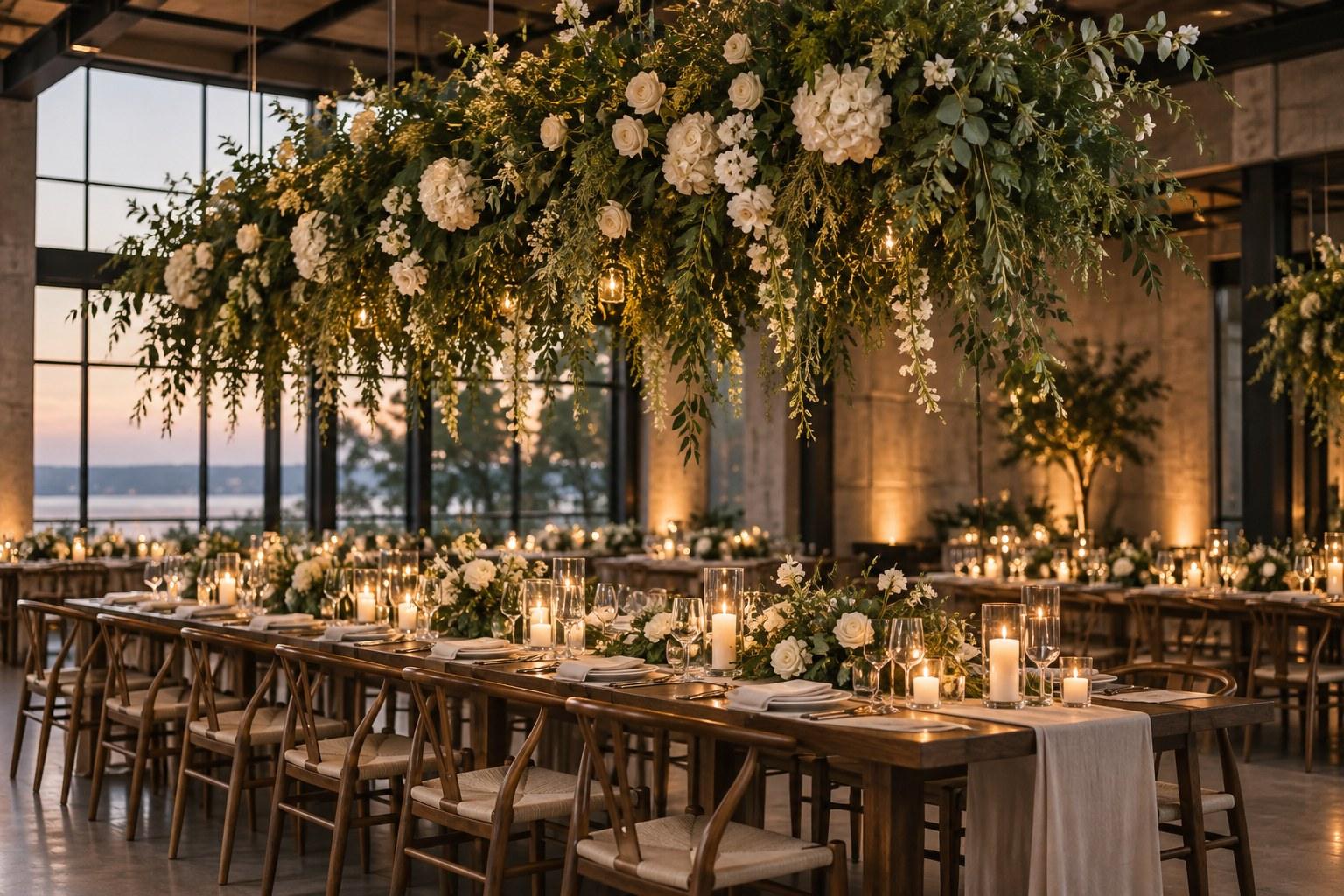
Guests notice the ceiling before they notice the centrepieces. They walk into the room, look up, and decide in about two seconds whether this wedding feels ordinary or unforgettable. That’s the power — and the pressure — of wedding ceiling installations.
They’re also where styling stops being pretty and starts being technical. Hanging anything above a room full of people means rigging points, load limits, fire rules, access equipment and a bump-out plan that works at midnight when everyone is tired. Get it right and the room looks effortless. Get it wrong and you’re the stylist explaining to a venue manager why there’s a cable tie on their heritage beam. 😬
Here’s how professional stylists plan, quote and deliver ceiling installations — from the first venue question to the last ladder carried out the door.
What counts as a wedding ceiling installation?
Anything you style above head height that changes how the room feels. The big families you’ll be asked about:
- Suspended florals and greenery — fresh blooms and foliage hung from frames, grids or beams, often running the length of long tables.
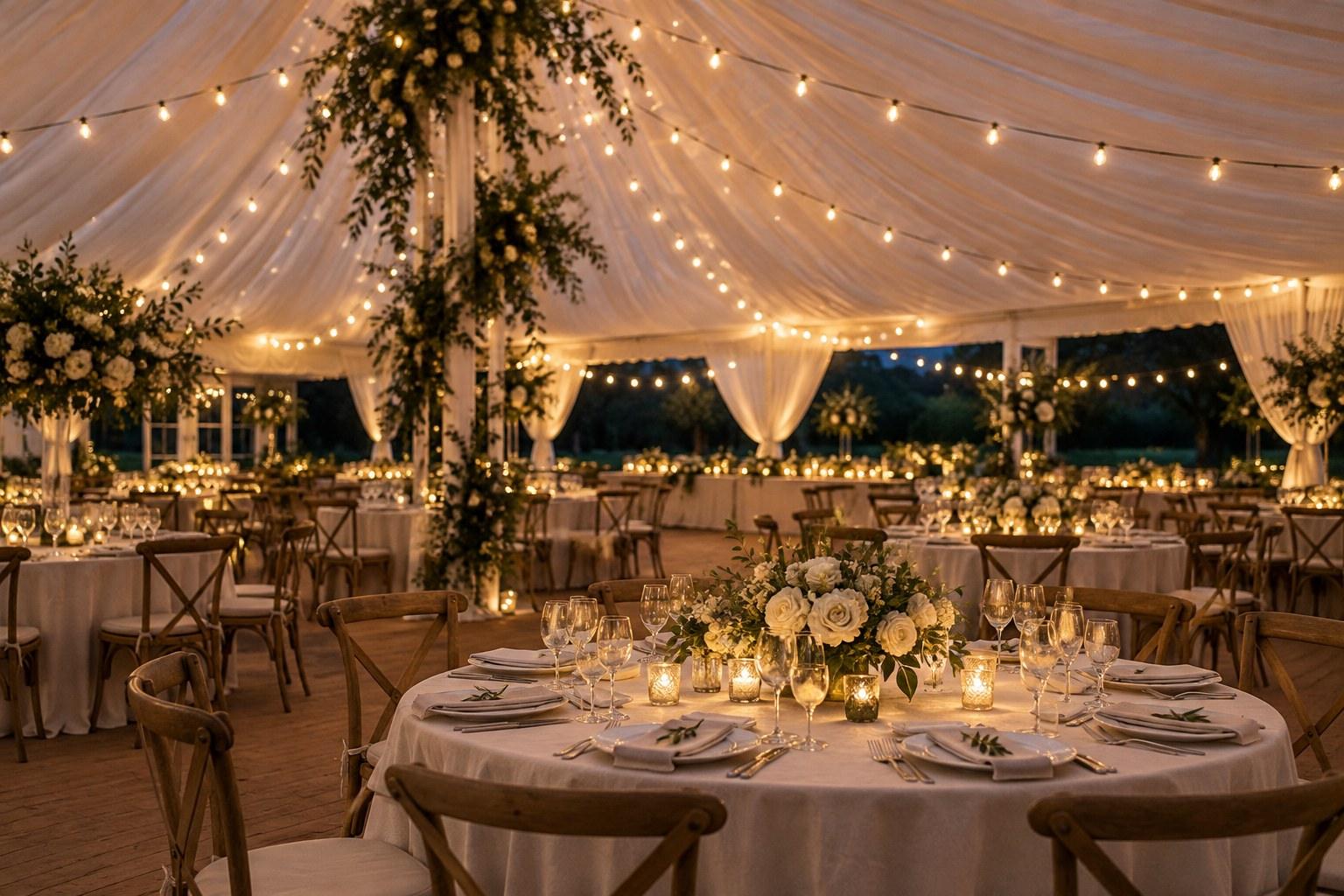
- Ceiling draping — fabric swags, canopies or full ceiling liners that soften a big room or hide an ugly one.
- Hanging lanterns and festoon lighting — the classic marquee and barn look, from overhead festoons to clusters of paper or rattan lanterns.
- Floating candle-look installations — suspended vessels or LED candles that give the glow of candlelight without the open flame.
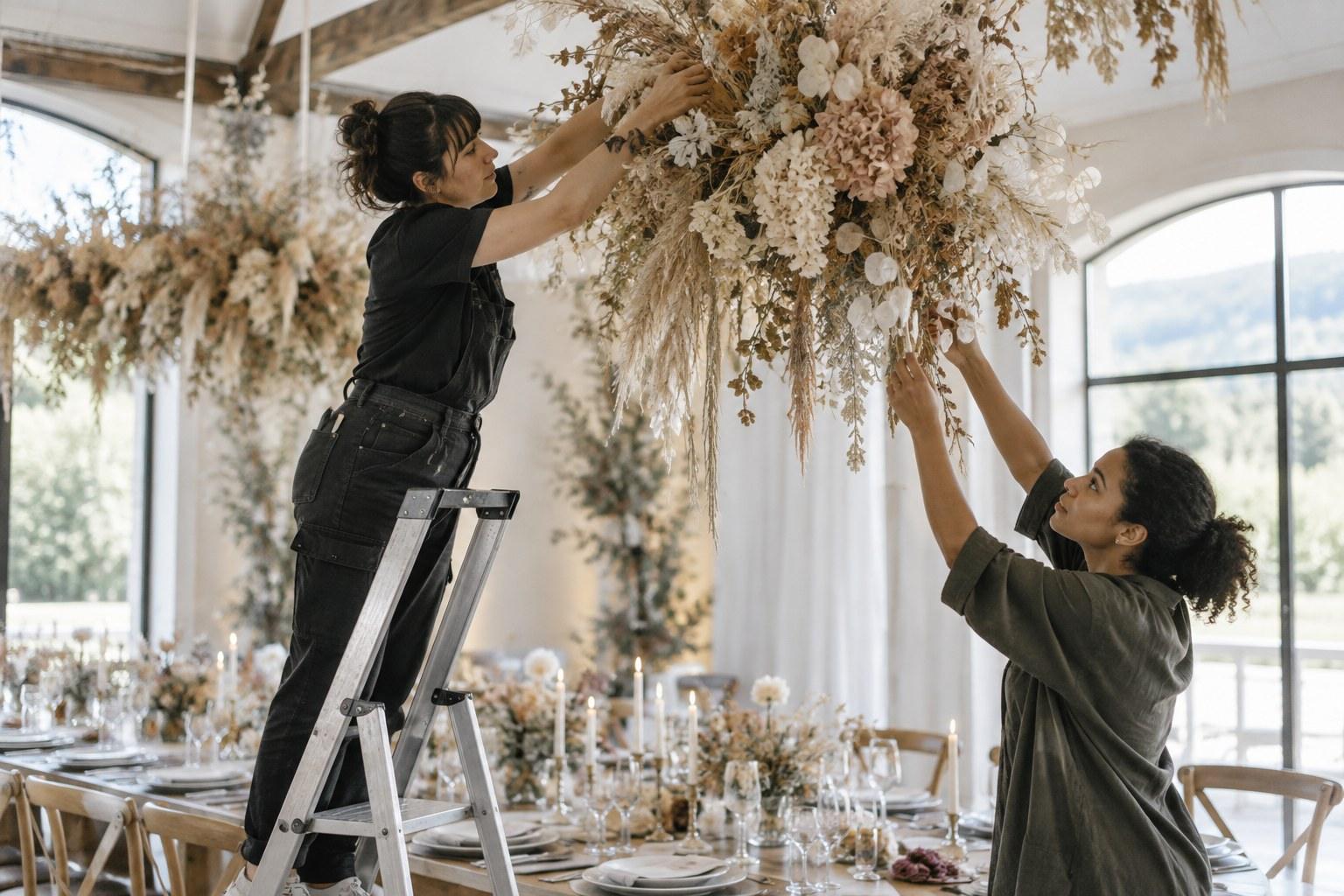
- Dried-flower clouds — pampas, preserved grasses and dried blooms built into soft, cloud-like forms that can be reused or sold on.
- Hoops and chandeliers — metal hoops dressed with foliage, statement chandeliers, or hoops wrapped with lights over a dance floor.
Every one of these looks different, but they share one truth: the design is only half the job. The other half is how it gets up, how it stays up, and how it comes down.
First questions to ask the venue about ceiling installations
Before you sketch a single thing, call the venue. Ceiling work lives or dies on information only they have. Ask these, and get the answers in writing:
- Where are the rigging points? Does the venue have approved points, a truss or a grid — or nothing at all?
- What is the ceiling height? Measure it yourself if you can. Height decides your access equipment and how far your installation drops.
- What are the load limits? Fresh florals, wet foliage and fabric are heavier than they look. The venue or a qualified rigger needs to confirm what each point can safely hold.
- What are the fire and safety rules? Many venues require flame-retardant fabrics and have rules about what can hang near lights, sprinklers or exits.
- Are open flames banned? If so, floating candle looks must be LED — no exceptions, no sneaky tealights.
- How much access and bump-in time do we get? Ceiling work usually needs to happen before tables are set. Is there another event the night before?
- Who is allowed to rig? Some venues insist on their in-house team or an approved production company. Find out before you promise anything.
The honest rule: always follow the venue’s requirements and your local safety regulations, and use qualified riggers for anything that needs them. You are a stylist, not a structural engineer — and the best stylists know exactly where that line sits.
Wedding ceiling installation types compared
| Installation type | Best for | Venue questions to ask |
|---|---|---|
| Suspended florals & greenery | Long tables, statement entries, lush garden-style receptions | Load limits per point? Can we hang over tables? Water and drip rules? |
| Ceiling draping | Large plain halls, marquees, hiding industrial ceilings or poor lighting | Flame-retardant fabric required? Existing fixings? Sprinkler and exit clearances? |
| Hanging lanterns & festoon lighting | Marquees, barns, outdoor courtyards, relaxed evening receptions | Power locations? Who installs electrics? Outdoor weather and wind rules? |
| Floating candle-look installations | Moody, romantic evening receptions and ceremonies | Open flame banned? (Assume LED.) Drop height above guests? |
| Dried-flower clouds | Boho and modern styling, reusable hire pieces, longer installs | Fire rules for dried materials? Bump-in the day before allowed? |
| Hoops & chandeliers | Dance floors, sweetheart tables, ceremony focal points | Single-point rigging available? Clearance for dancing guests and staff? |
Use this as your discovery checklist. If a venue can’t answer the third column, that’s your answer — scale the idea down or move it somewhere safer, like a freestanding frame.
How to work with riggers, production teams and florists
Big ceiling installations are team sport. Your job is to be the person who holds the vision and the paperwork, so everyone else can do their part properly.
Riggers and production companies
Bring them in early — at the concept stage, not the week before. Share your sketch, approximate dimensions and what materials you plan to use. Let them tell you what’s possible, what needs extra points, and what isn’t happening. Then build their requirements into your timeline: when they need the room, what equipment they’re bringing, and when they need it back for the pull-down.
Florists
If a florist is building suspended florals, agree who owns what. Who supplies the frame? Who builds the mechanics? Who climbs? Who strikes it? Fresh product needs hydration plans and a realistic sense of weight, which is why stylists who understand floral mechanics have a serious edge. If you want to build those skills yourself, the Certificate in Floral Design is the natural next step alongside styling.
The couple
Couples see the inspiration photo, not the scaffold tower. Walk them through what’s realistic for their venue — and why — before they fall in love with something that can’t be hung. Clear expectations now saves heartbreak later.
This kind of supplier coordination is exactly what we teach in the Certificate in Wedding Styling — because the visible magic depends on invisible systems.
Scale and proportion: matching ceiling installations to table layouts
The most common design error isn’t an ugly installation — it’s the wrong size installation. A beautiful cloud that looks huge in the studio can vanish in a tall room. A floral run that’s too low makes guests feel boxed in.
- Follow the floor plan. Long tables suit long linear installations directly above. Round tables suit clusters, hoops or a central feature.
- Respect sightlines. Guests need to see each other, the couple and the speeches. Keep drops well above head height and clear of where staff carry plates.
- Mind the walkways. Service paths, dance floors and exits need clear overhead space as well as clear floors.
- Balance with the tables. If the ceiling is the hero, simplify centrepieces. A dramatic ceiling plus tall centrepieces can feel crowded.
- Mock it up. Mark positions on the venue floor plan and check heights on a site visit. Photos lie about scale; tape measures don’t.
Lighting and ceiling installations: plan them together
Your ceiling and your lighting are one design, not two. Uplighting can make draping glow; pin spots can turn a floral installation into the hero of the room; festoons can be the installation all on their own.
Talk to the lighting supplier early. Agree where fixtures sit, where cables run and what should be lit — and what should stay soft. Remember photos too: a dark ceiling installation can disappear in evening images if nobody lights it. And if open flames are out, LED candles and warm-toned lighting are how you get that glow safely.
Budgeting wedding ceiling installations: think labour and access
Couples budget for materials. Professionals budget for time. When you quote, the product is often the smaller part of the cost — the real drivers are:
- Labour hours for building, hanging, adjusting and striking — usually with more than one person.
- Access — ladders, scaffold or lifts, and the qualified people to use them.
- Rigging by an approved or qualified provider, where needed.
- Venue timing — late-night bump-outs, early bump-ins or extra access days.
- Pre-build time in your studio before you ever reach the venue.
- Transport for frames, hoops and bulky dried pieces.
Itemise these so couples understand what they’re paying for. And if an installation is reusable — dried clouds, hoops, lantern clusters — that’s a hire asset you can offer again and again, which changes how you price it. Building a profitable styling business around assets like these is a big focus in the Advanced Certificate in Wedding Planning, Styling and Business.
Bump-out planning for ceiling installations
Everyone plans the bump-in. Fewer plan the bump-out — and that’s where stylists get caught. It’s late, the team is tired, and the venue wants the room back.
- Confirm the bump-out time in writing — and whether there are fees for running over.
- Book the same access equipment and the same qualified people for the strike as for the install.
- Clear the floor first. Guests and tables out before anything comes down overhead.
- Bring the right kit: bins, crates, labelled boxes for reusable pieces, and lighting if the venue drops the house lights.
- Leave it as you found it. Every cable tie, hook and fallen petal. That’s how you get invited back.
Common wedding ceiling installation mistakes
- Designing before asking. Promising a floral cloud before checking rigging points is the fastest route to a difficult conversation.
- Underestimating weight. Wet foliage, fresh blooms and layered fabric add up quickly.
- Ignoring fire rules. Non-compliant fabric or dried materials near heat sources can stop an installation on the spot.
- Squeezing the timeline. Ceiling work usually needs to happen before tables are set — plan the order of works, not just the start time.
- Going DIY on rigging. If it needs a rigger, use a rigger. No exceptions.
- Forgetting the strike. A great install with no bump-out plan still ends badly.
For the checklists, supplier language and step-by-step systems behind bigger installs, grab The Wedding Stylist’s Handbook ebook — it’s built to sit on your desk while you plan.
Ready to style above the guests?
Ceiling installations are where stylists earn their reputation. They take vision, but they also take clear venue questions, strong supplier relationships and calm logistics. The Certificate in Wedding Styling teaches you to design rooms that make guests look up — and to deliver them safely, on time and on budget.
Wedding ceiling installations FAQs
Do you need a rigger for wedding ceiling installations?
Often, yes. Anything heavy, hung over guests or attached to the venue structure should be assessed and installed according to the venue’s requirements and local safety rules — and that usually means a qualified rigger or the venue’s approved production team. Always check with the venue first.
How far in advance should you plan a ceiling installation?
Start at the concept stage, as soon as the venue is booked. You need time to confirm rigging points, load limits and access, brief riggers and florists, and lock in bump-in and bump-out times before you finalise the design with the couple.
Can you use real candles in a hanging installation?
Many venues ban open flames, and suspended flames over guests carry obvious risk. Check the venue’s rules — in most cases, LED candles give you the floating candle look safely.
What is the best ceiling installation for a marquee wedding?
Draping and festoon lighting are classic marquee choices because they soften the structure and add warmth. Always confirm with the marquee supplier what can be attached to the frame and how much weight it can take.
How do you price a wedding ceiling installation?
Price on labour and access, not just materials. Factor in pre-build, install and strike hours, team size, access equipment, rigging, transport and any out-of-hours venue time, and itemise them so the couple understands the value.