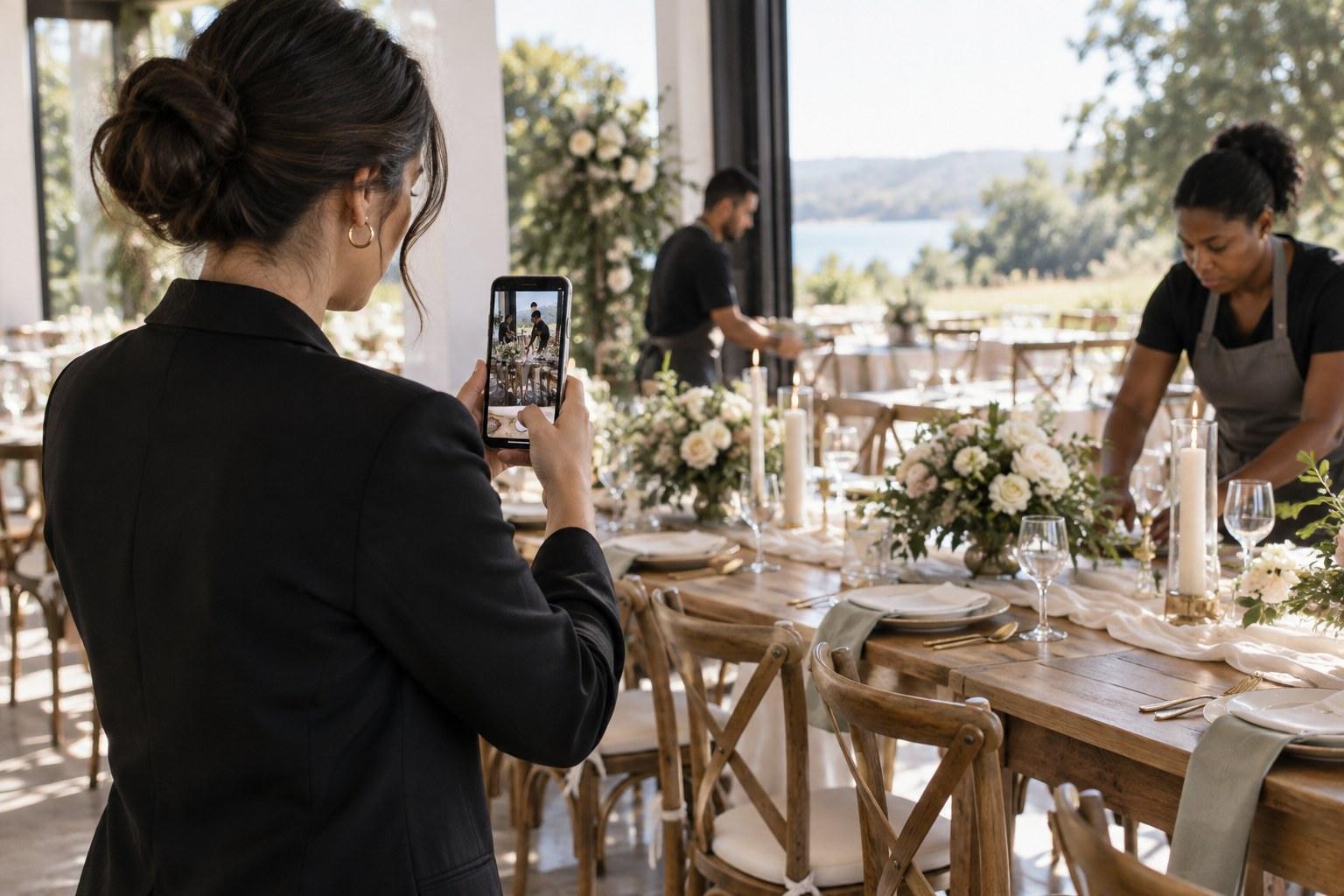
Testimonials aren’t the only proof that books clients. They matter — of course they do — but a couple scrolling your Instagram at 11pm isn’t only reading quotes. They’re looking for evidence. Evidence that you’re organised. That vendors like working with you. That you’ve actually done this before, and that you’ll still be calm when the ceremony chairs arrive forty minutes late.
That evidence is wedding planner social proof, and most of it is sitting in your camera roll right now. Set-up videos. Run sheets. The florist who tagged you last Saturday. The thank-you card stuck to your fridge. You just haven’t been treating any of it as marketing.
Here’s what to post instead of — and alongside — testimonials, how to capture it without being awkward, and where to put it so it actually turns enquiries into bookings. 💍
What counts as wedding planner social proof?
Social proof is anything that shows a stranger that other people already trust you. For a wedding planner, that’s broader than a five-star quote. It’s proof of work (you’ve done real weddings), proof of process (you know what you’re doing), proof of relationships (vendors and venues rate you) and proof of care (couples felt looked after).
Couples are hiring you for something they can’t test-drive. They can’t book a trial wedding. So every piece of visible proof lowers the risk in their head. Testimonials do one job — they let past clients speak for you. The rest of your social proof shows them, which is often more persuasive than telling.
One rule before we go any further: everything you post must be true. No fake reviews, no borrowed photos, no “featured in” badges for features that never happened, no inflated wedding counts. Couples talk, vendors talk, and the wedding industry is smaller than you think. Honest proof compounds. Invented proof eventually blows up.
Behind-the-scenes content: the easiest social proof for wedding planners
The polished photos belong to your photographer. The behind-the-scenes belongs to you — and it’s the content that proves you were actually there doing the work.
- Set-up time-lapses. Prop your phone in a corner during styling and let it run. An empty room turning into a reception in thirty seconds is proof nobody can argue with.
- Before and after room flips. Bare function room, then dressed tables. Same angle, same frame. Simple and wildly effective.
- Your emergency kit in action. The safety pins, the steamer, the spare phone charger. It shows couples you’ve thought of things they haven’t.
- “Day in the life” posts. Your morning walkthrough, vendor arrivals, the quiet five minutes before the ceremony. Couples want to know what a planner actually does all day — so show them.
Film vertical, film often, and don’t worry about perfect. Raw set-up footage reads as real, and real is the whole point.
Process posts: show couples how you work
A lot of couples don’t book a planner because they genuinely don’t understand what they’d be paying for. Process content fixes that, and it quietly proves you’re organised.
Share your timelines and run sheets — blurred
A screen-recorded scroll through a run sheet, with names, phone numbers and addresses blurred, says more about your professionalism than a paragraph of copy ever will. Same with a timeline, a vendor contact sheet or a supplier load-in schedule. Always blur personal details, and if the document could identify a couple, ask them first.
Explain one decision at a time
“Why I always schedule a buffer before speeches.” “How I plan a wet-weather backup.” “What I check in a venue contract.” Short, specific, useful. Each one shows a couple that you think ahead — and that’s exactly what they’re buying.
If you’d like a proper framework for turning your process into content and content into enquiries, that’s the heart of the Certificate in Wedding Business & Marketing.
Vendor tags, reshares and community visibility
When a photographer, florist or venue tags you, they’re vouching for you in public. That’s social proof with someone else’s reputation attached — and couples notice.
- Tag every vendor, every time. Generosity gets returned. Vendors are far more likely to reshare and tag you back when you’ve credited them properly.
- Reshare vendor posts that feature your work to stories, then save the best into a “Vendors” or “Real Weddings” highlight.
- Collect vendor words, not just tags. If a venue coordinator emails “that was the smoothest bump-in we’ve had” — ask if you can share it. A vendor recommendation is often more convincing than a couple’s, because vendors see dozens of planners.
- Show up locally. Networking nights, venue open days, styled-shoot collaborations. Post about them. Being visibly part of your local wedding community tells couples you’re established and connected.

Styled shoots and published features — only if they’re real
Styled shoots are a brilliant way to build a portfolio when you’re starting out — but label them honestly. A styled shoot is not a real wedding, and presenting it as one is the kind of small lie that erodes trust when a couple asks, “So how did their day go?”
If a wedding or shoot you worked on genuinely gets published on a blog or in a magazine, absolutely share it, link it and add it to your website. If it hasn’t, don’t hint that it has. “As seen in” only works when it’s true.
Couple-shared content, thank-you cards and messages
Some of the most powerful proof comes straight from your couples — just not in the formal testimonial format. A voice note the morning after. A story they posted tagging you. A card that arrived in the mail.

How to ask permission (and respect privacy)
Always ask. Every time. Even when a couple has publicly tagged you, ask before you screenshot their words or reshare their faces onto your feed. Keep it simple:
“This card made my week — would you be happy for me to share a photo of it on my Instagram? I can crop out your names if you’d prefer.”
- Get the yes in writing — a text or email is fine.
- Offer to remove names, surnames and faces.
- Never share guests, children or family members without the couple’s clear okay.
- Some couples are private. Respect a no without making it weird.
- Build a content permission clause into your contract so it’s discussed up front — with an easy opt-out.
We’ve covered the formal side separately in our guide on asking for testimonials — this is about the everyday, informal proof that flows in when you’ve done your job well.
Case-study posts: tell the story of one wedding
A case study is the long-form version of social proof, and it works brilliantly as a carousel, blog post or website page. Pick one real wedding (with permission) and walk through it:
- The brief. What the couple wanted and what was tricky — a tight timeline, a remote venue, two cultures to honour.
- The plan. The decisions you made and why.
- The day. What happened, including what went sideways and how you handled it.
- The result. In the couple’s words where possible — never yours dressed up as theirs.
Case studies attract the right couples, too. Someone planning a similar wedding reads it and thinks, “She’s done this exact thing before.” That’s a booking conversation half-finished.
Credentials, training and Google reviews
Your qualifications are social proof too — they tell couples you’ve invested in doing this properly. Display your certificate on your website’s about page, mention your training in proposals, and talk about what you learned in a post or two. The Certificate in Wedding Planning gives you the process foundations couples are looking for, and it’s something real you can point to.
Then there’s Google. A Google Business Profile with genuine reviews shows up exactly where couples search — “wedding planner near me.” Send your review link in your post-wedding follow-up and make it a one-tap job. Reply to every review, warmly and specifically. Never buy, swap or write reviews. Ever.
Wedding planner social proof ideas: where to use each type
| Social proof type | Where to use it | How to capture it |
|---|---|---|
| Set-up time-lapse / room flip | Reels, Stories, website gallery | Phone on a mini tripod during set-up; same angle before and after |
| Blurred run sheets and timelines | Carousels, proposals, “how I work” page | Screen-record or screenshot, blur all personal details |
| Vendor tags and reshares | Stories, “Vendors” highlight | Tag everyone; save reshares straight to highlights |
| Vendor and venue comments | Website, proposals, enquiry auto-reply | Ask permission to quote emails or messages |
| Thank-you cards and messages | Feed posts, “Love notes” highlight | Photograph with names cropped; get written permission |
| Couple-shared content | Stories, real-wedding posts | Ask before resharing faces or words |
| Case-study stories | Blog, website, carousels, proposals | Interview the couple after the wedding; take notes on the day |
| Styled shoots and real features | Portfolio, about page | Label shoots clearly; only list publications that actually ran |
| Credentials and training | About page, proposals, email signature | Display your certificate and name the course |
| Google reviews | Google profile, website, auto-reply | Send your review link in your post-wedding follow-up |
Where to put your social proof so it books clients
Proof that sits in your camera roll books nobody. Put it on the path a couple walks from “who’s this?” to “let’s book.”
- Website: real-wedding stories, a “how I work” section with blurred process shots, vendor quotes and credentials on the about page.
- Enquiry auto-reply: link one case study and your Google reviews. Couples are most curious in the hour after they enquire — feed that curiosity.
- Proposals: a page of proof — a vendor quote, a couple’s message, a blurred run sheet. It turns a price list into a picture of working together.
- Instagram highlights: Real Weddings, Behind the Scenes, Love Notes, Vendors, Process. Your highlights are your shop window.
And show up consistently. One great post a quarter won’t do it. A steady drip of real, honest proof — week after week — is what makes a couple feel like they already know you before the discovery call. Learning to build that system is exactly what the Certificate in Wedding Business & Marketing is for, and if you want planning, styling and business together, look at the Advanced Certificate in Wedding Planning, Styling and Business.
Wedding planner social proof FAQs
How do I get social proof as a new wedding planner with no clients?
Start with what’s true: your training, clearly labelled styled shoots, behind-the-scenes from any weddings you’ve assisted on (with the lead planner’s permission), and visible involvement in your local vendor community. Process posts work from day one, because they show how you think before you have a portfolio.
Can I post photos of a client’s wedding without asking?
Don’t. Ask the couple, and check usage rights with the photographer, who usually owns the images. Get permission in writing, credit the photographer, and offer to remove names or faces. A content clause in your contract makes the conversation easy.
What’s the difference between testimonials and social proof?
A testimonial is one type of social proof — a past client describing their experience. Social proof also includes behind-the-scenes content, vendor tags, case studies, thank-you messages, credentials and reviews. Testimonials tell; the rest shows.
Where should wedding planners display social proof?
Everywhere a couple makes a decision: your website, your enquiry auto-reply, your proposals and your Instagram highlights. Put your strongest proof closest to the moment they’re deciding whether to book a call.
Is it okay to use styled shoots as social proof?
Yes — as long as you label them as styled shoots. They show your eye and your vendor relationships. Just never present a styled shoot as a real client wedding.
Ready to turn the work you’re already doing into marketing that books clients? Learn the whole system — content, positioning, enquiries and conversion — inside the Certificate in Wedding Business & Marketing.