Wedding styling on a budget works when you spend on the few things guests actually look at — and let everything else stay simple, repeated and well lit. Professional stylists don’t make a small budget look bigger by buying cheaper versions of everything; they make it look intentional by choosing where the money goes.
That’s the skill clients are hiring you for. Anyone can spend a big budget. It takes real design thinking to make a modest one feel generous, cohesive and photographed-to-death in the best way. Here’s how working stylists do it.
What does wedding styling on a budget really mean?
A budget wedding isn’t a lesser wedding. It’s a brief with tighter constraints — and constraints are where good design shows up. When a couple tells you their number, your job is to translate it into a plan that protects the moments that matter to them and quietly trims the rest.
In practice that means three things:
- Prioritising — deciding which two or three areas carry the visual weight of the day.
- Repeating — using a small set of elements many times so the look reads as a deliberate scheme, not a scatter of bits.
- Reusing — making every piece work in more than one place, from ceremony to reception to the photo booth corner.
If you hold onto those three ideas, almost every budget decision gets easier.
Start with the focal points guests (and cameras) see
Walk through the day from a guest’s point of view. Where do they stand, sit and stare? Where does the photographer point the lens? Those are your focal points, and they deserve the lion’s share of the styling budget.
For most weddings the shortlist looks like this:
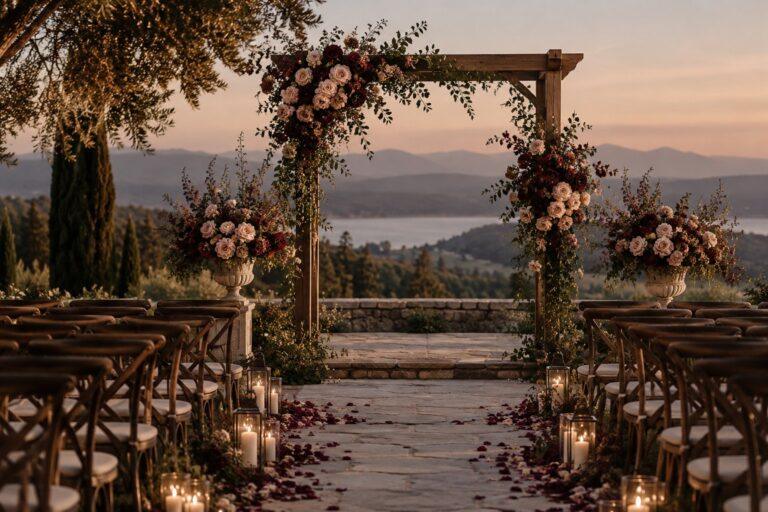
- The ceremony backdrop or aisle — it’s in every ceremony photo.
- The bridal or head table — it’s in every speech photo.
- The entrance or welcome moment — it sets expectations in the first ten seconds.
- One feature moment, such as a dessert table, bar or lounge area.
Guest tables matter, but they’re seen up close by a handful of people at a time. A strong, simple, repeated table design will always beat a fussy one that’s been watered down to fit the budget.
The 70/30 rule stylists use
A useful working habit is to push most of the décor spend toward the focal points and keep the remainder for repeated basics across guest tables. You won’t find this written into any rulebook — it’s a mindset rather than a formula — but it stops you from spreading the money so thinly that nothing has impact.
Choose a tight palette and repeat it
Nothing makes a wedding look more expensive than a confident, limited colour palette. Three colours plus a neutral is plenty. When every napkin, ribbon, candle and bloom sits inside the same family, the eye reads it as cohesive — and cohesive reads as considered.
A tight palette also saves real money. You buy or hire in bulk, you’re not chasing one-off items to match a fifth accent colour, and your florist can source fewer varieties in larger quantities.
| Budget move | Why it works | Where to use it |
|---|---|---|
| — | — | — |
| Limit the palette to 3 colours plus a neutral | Cohesion looks intentional and premium | Linen, florals, stationery, candles |
| Repeat one hero element | Repetition creates rhythm across a room | Bud vases, candle clusters, napkin treatment |
| Hire rather than buy | Access to quality pieces without storage | Furniture, arches, large vessels |
| Swap florals for candlelight in places | Glow fills space and flatters every photo | Guest tables, aisle, bar |
| Repurpose ceremony pieces | One piece, two moments | Aisle arrangements, signage stands, arbour florals |
Candlelight: the stylist’s best friend
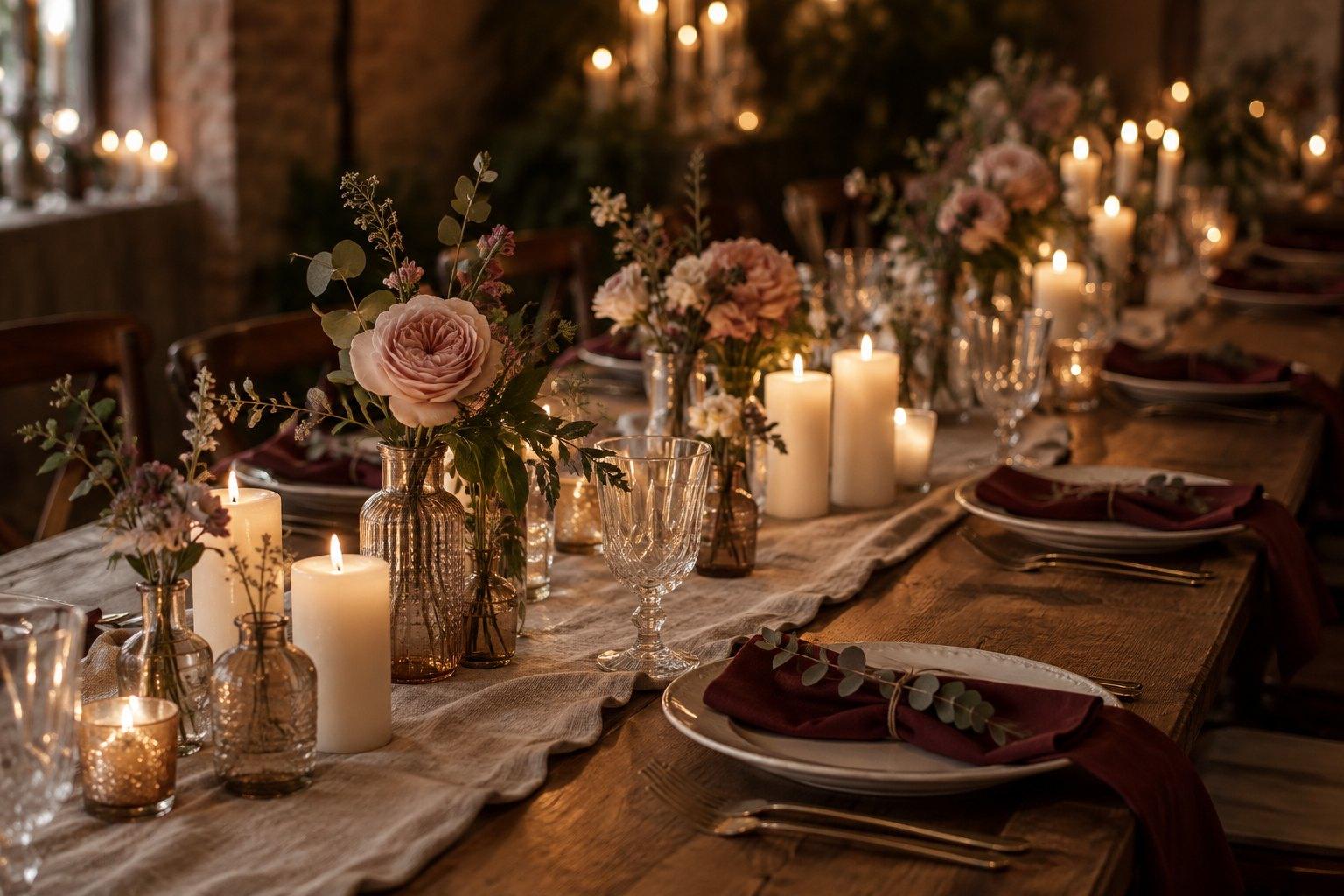
If there’s one tool that makes every dollar show, it’s light. Grouped candles at different heights add warmth, depth and movement that flowers alone can’t — and they photograph beautifully as the evening goes on. Check every venue’s rules on naked flames first, though; plenty of venues require enclosed candles, hurricanes or quality LED alternatives.
Lighting the room well also means you need less décor overall. A softly lit space with a few strong focal points feels far richer than a brightly lit room full of small, scattered details.
Make florals work harder
Flowers are usually one of the biggest line items, so this is where smart planning pays off. Talk to the florist early and be honest about the number. Good florists love a clear brief — it’s guessing that wastes everyone’s time.
Ways stylists stretch the floral budget:
- Fewer, bigger moments — one generous installation beats twenty underwhelming arrangements.
- Greenery-led designs — foliage fills volume and texture, with focal blooms used sparingly.
- Bud vases instead of centrepieces — a cluster of single stems in varied glass looks styled, not sparse.
- Repurposing — aisle arrangements move to the bar, bridesmaid bouquets become table décor.
- Locally available flowers — ask what’s abundant at the time of the wedding rather than insisting on hard-to-source varieties.
Hire, borrow, build — the smart sourcing mix
Buying everything new is rarely the best use of a client’s budget. Experienced stylists build a sourcing mix:
- Hire the big, bulky or premium items — furniture, arches, large vessels, quality linen.
- Use your own inventory — over time, a stylist’s collection of candle holders, vases and stands becomes a real asset.
- Lean on the venue — ask exactly what’s included. Chairs, tables, glassware and even some décor may already be covered.
- DIY with care — only where the couple genuinely has time and skill, and never for anything structural or safety-critical.
When you’re putting together your quote, these sourcing decisions are where you’ll find the room to say yes to a client’s must-have without blowing the total. Our Certificate in Wedding Styling walks you through how to build quotes and inventory so this becomes second nature.
Where stylists never cut corners
Budget styling isn’t about saying yes to everything cheap. There are some things a professional won’t compromise on, no matter the number:
- Safety — secure structures, stable candle placement, clear walkways and venue compliance.
- Bump-in and bump-out time — under-quoting labour means a rushed set-up and a stressed team.
- Quality of the focal points — if the backdrop looks cheap, everything around it does too.
- Clean, pressed linen — creased tablecloths undo good design faster than anything.
Being upfront about these non-negotiables builds trust. Couples respect a stylist who explains why something matters rather than one who quietly cuts it.
How to talk about budget with couples
Plenty of couples feel awkward naming a figure. Make it easy. Explain that knowing the budget lets you design something realistic rather than presenting a dream they can’t afford. Then show them options: a core package that covers the essentials beautifully, plus clear add-ons if they want to stretch.
A few conversation habits that help:
- Ask what they want guests to remember — the answer shows you where to focus.
- Show visual references at their real budget level, not aspirational ones.
- Put every decision in writing so there are no surprises later.
- Offer swaps, not just cuts — “we could replace the arch florals with draped fabric and candle clusters” lands better than “we’ll have to lose the arch”.
Build your budget styling toolkit
The stylists who handle budget weddings best have systems: a costed inventory list, a go-to set of repeatable table designs, trusted hire suppliers and a quote template that shows clients exactly where their money goes. If you want a head start, The Wedding Stylist’s Handbook (Volumes 1 & 2) by Jac Bowie covers styling principles, planning and the business side of running a styling service — a handy companion while you build your own systems.
And if you’re also helping clients with the wider planning picture, the Certificate in Wedding Planning pairs naturally with styling skills.
The bottom line on budget wedding styling
Every dollar shows when it’s spent with intent. Pick your focal points, commit to a tight palette, lean on candlelight and repetition, and make every piece work twice. Do that and a modest budget stops being a limitation — it becomes the brief that proves how good you are.
Frequently asked questions
How do you style a wedding on a small budget?
Focus spending on two or three focal points such as the ceremony backdrop and head table, use a tight colour palette, repeat simple elements across guest tables, lean on candlelight and reuse ceremony pieces at the reception.
What should you not cut when styling a wedding on a budget?
Never cut safety, adequate set-up and pack-down time, the quality of your main focal points or clean, pressed linen. These are what guests notice and what keeps the event running smoothly.
Is it cheaper to hire or buy wedding décor?
For large, bulky or premium items, hiring is usually more practical than buying. Stylists often combine hired pieces with their own inventory and whatever the venue already includes.
How can candles help with budget wedding styling?
Grouped candles add warmth, depth and atmosphere and photograph beautifully, so you need less décor overall. Always check the venue’s rules — many require enclosed candles or LED alternatives.
Can I learn budget wedding styling online?
Yes. The Wedding Academy’s Certificate in Wedding Styling is 100% online and covers design principles, sourcing, quoting and running a styling business.
Ready to design weddings that look generous at any budget? The Certificate in Wedding Styling teaches you the design principles, sourcing habits and business systems professional stylists rely on — 100% online, at your own pace.