
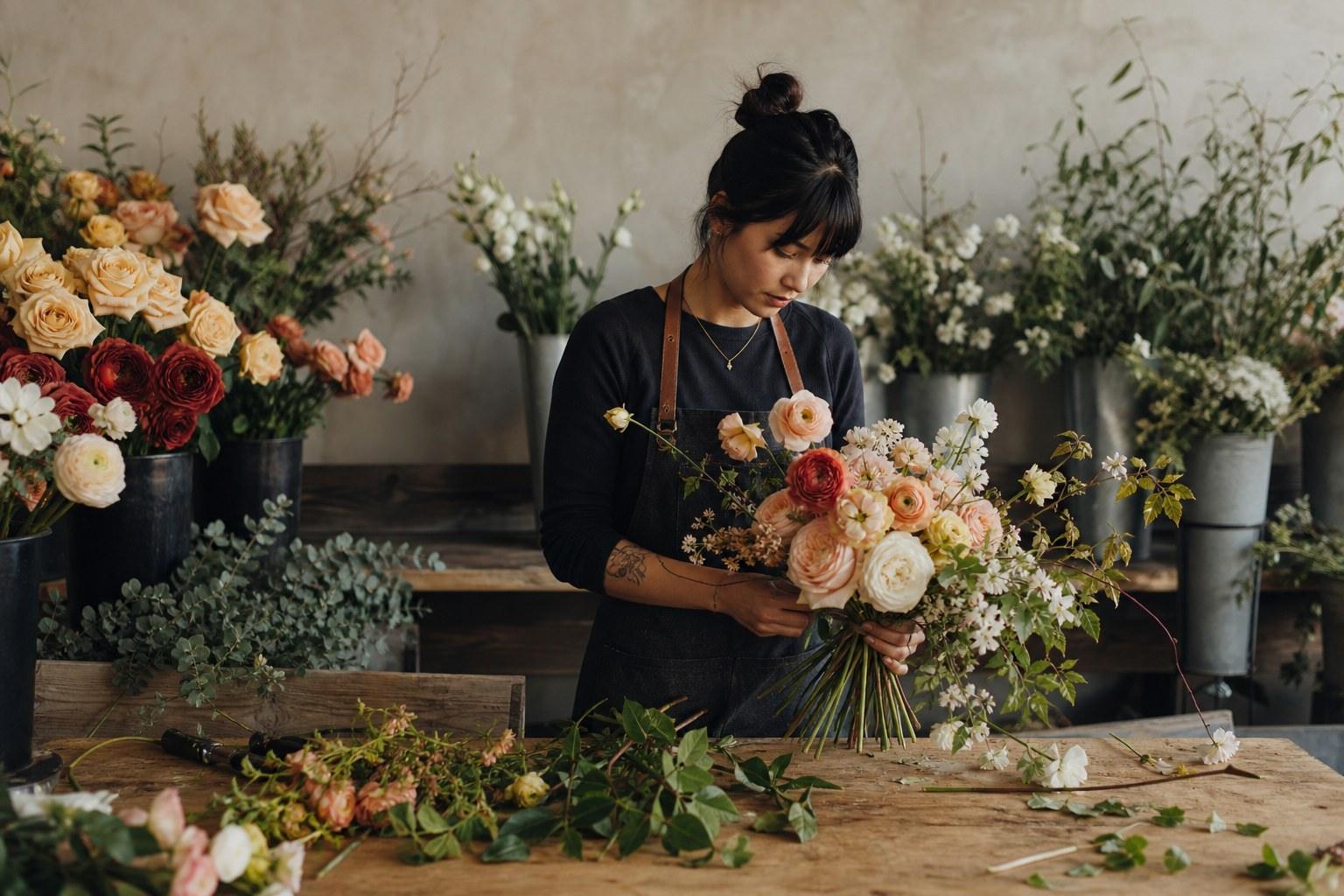
A bridal bouquet is the most scrutinised floral piece of the entire wedding. It is held for hours, photographed from every angle, carried down an aisle, thrown, pressed, and looked at again in twenty years. It also has to survive a hot car, a photographer who wants it just so, and a bride who is not thinking about her grip.
That is a lot of pressure for a bunch of flowers. The good news: bouquet design is a repeatable craft. There is a build sequence, a hand position and a set of proportion rules that make the difference between an arrangement that looks like a supermarket bunch and one that looks like it was designed for the person holding it.
Here is how a bridal bouquet actually gets built, step by step, and the decisions that happen long before the first stem is picked up.
Before you touch a stem: the design brief
Bouquets fail at the brief stage far more often than at the bench. A couple says “natural and romantic” and you say “lovely” and three months later you build something they did not picture at all.
Pin the brief down to things you can actually buy and build:
- The gown: silhouette, neckline, detail and colour. A heavily beaded gown wants a quieter bouquet; a plain slip can carry a big loose design.
- Scale: the wearer’s height and frame decide the bouquet’s size — not the venue and not the budget.
- Palette: agree on tones and depth, not flower names. Varieties fail; a colour story survives.
- Texture: the difference between soft and structured, airy and dense.
- Seasonality: what is genuinely available in your market at that time of year.
- Movement: does the couple want it to trail, or to sit neatly?
Always agree a substitution policy in writing. Flowers are a living product, and the crop that was perfect last year may not arrive this year. Couples accept substitutions easily when you explain it early and terribly when you spring it on the morning of.
Conditioning: the boring step that decides everything
Flowers that are not conditioned properly will collapse in the exact hour you need them at their best. Conditioning is simply preparing the stems so they can drink.
- Unpack immediately and check for damage, disease or dehydration.
- Strip foliage that would sit below the waterline — it rots and fouls the water.
- Cut stems at an angle with a sharp, clean blade so the cut surface stays open.
- Place into clean buckets with fresh water, ideally with flower food.
- Give the flowers hydration time in a cool, dark, draught-free space before you design.
- Handle woody, hollow and milky stems according to their own needs rather than one blanket rule.
Cleanliness is not optional. Dirty buckets shorten vase life more than almost anything else you can do wrong.
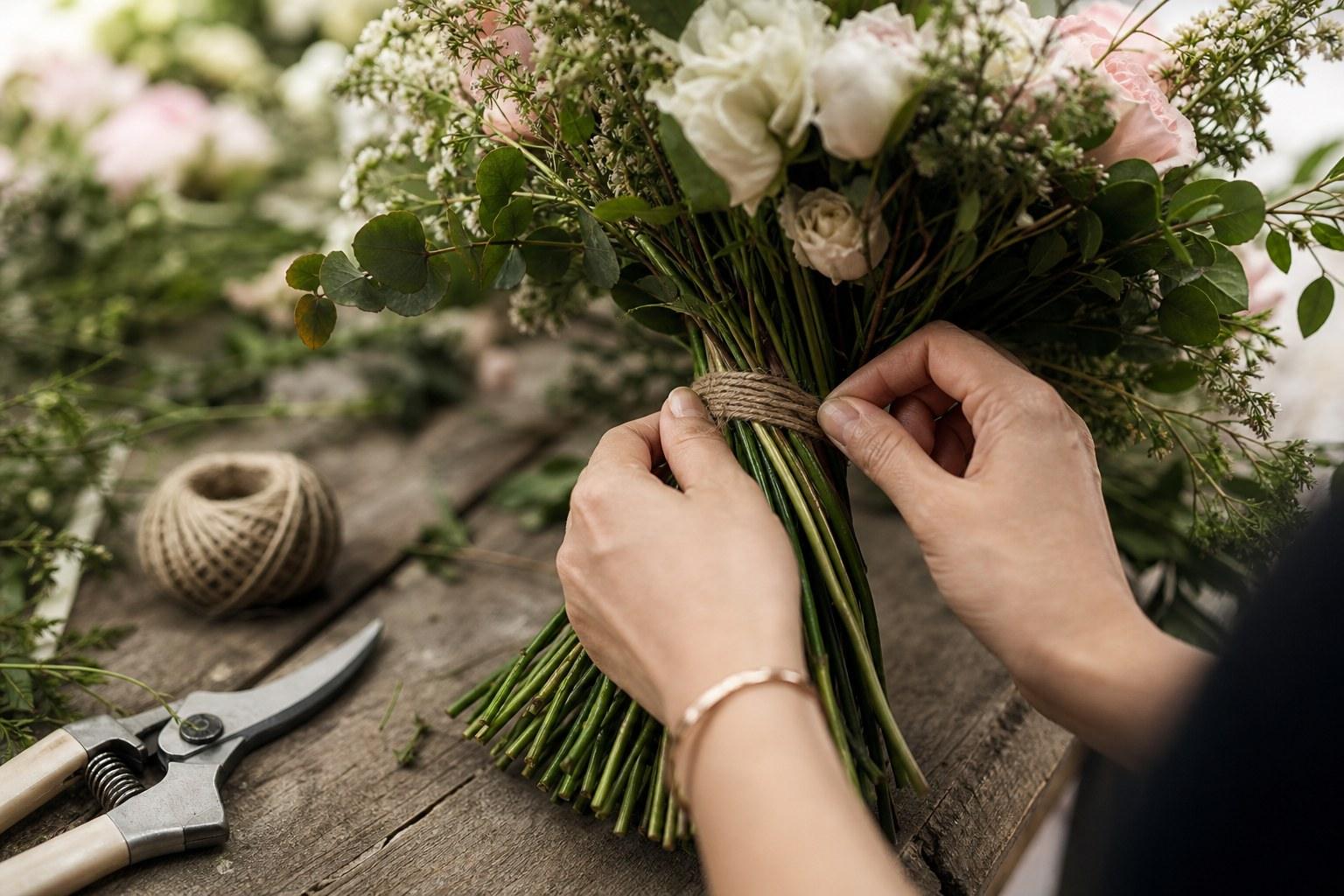
How to build a hand-tied bridal bouquet, step by step
Step 1: Sort your material into roles
Lay everything out and group it: focal blooms, secondary blooms, filler, texture and foliage. Working from a sorted bench is faster and stops you burying your best flowers where nobody sees them.
Step 2: Start the spiral
Take a first stem in your non-dominant hand and hold it loosely at the binding point. Add each new stem at a consistent angle, always laying it in the same direction, and rotate the bouquet a little after each addition. That rotation is what creates the spiral, and the spiral is what gives you a round shape and a clean, comfortable handle.
Step 3: Build with rhythm, not symmetry
Place focal blooms in a loose triangle rather than an even ring, and let them sit at slightly different depths so the surface is not flat. Add texture in odd groupings. Bring foliage in as you go rather than adding a collar at the end — a foliage frame stuck on last always looks stuck on last.
Step 4: Check it in the mirror
Hold the bouquet where it will be carried, in front of a mirror, at hand height. Almost every bouquet is built too tight and too round on the bench. Look for the silhouette, the gaps and the balance from three metres away, which is how guests will see it.
Step 5: Tie, cut and finish
Bind firmly at the binding point — tight enough to hold, not so tight you crush stems — then cut all stems to the same length so the bouquet stands on its own. A bouquet that stands is a bouquet that photographs on a table without a stylist propping it.
Step 6: Wrap
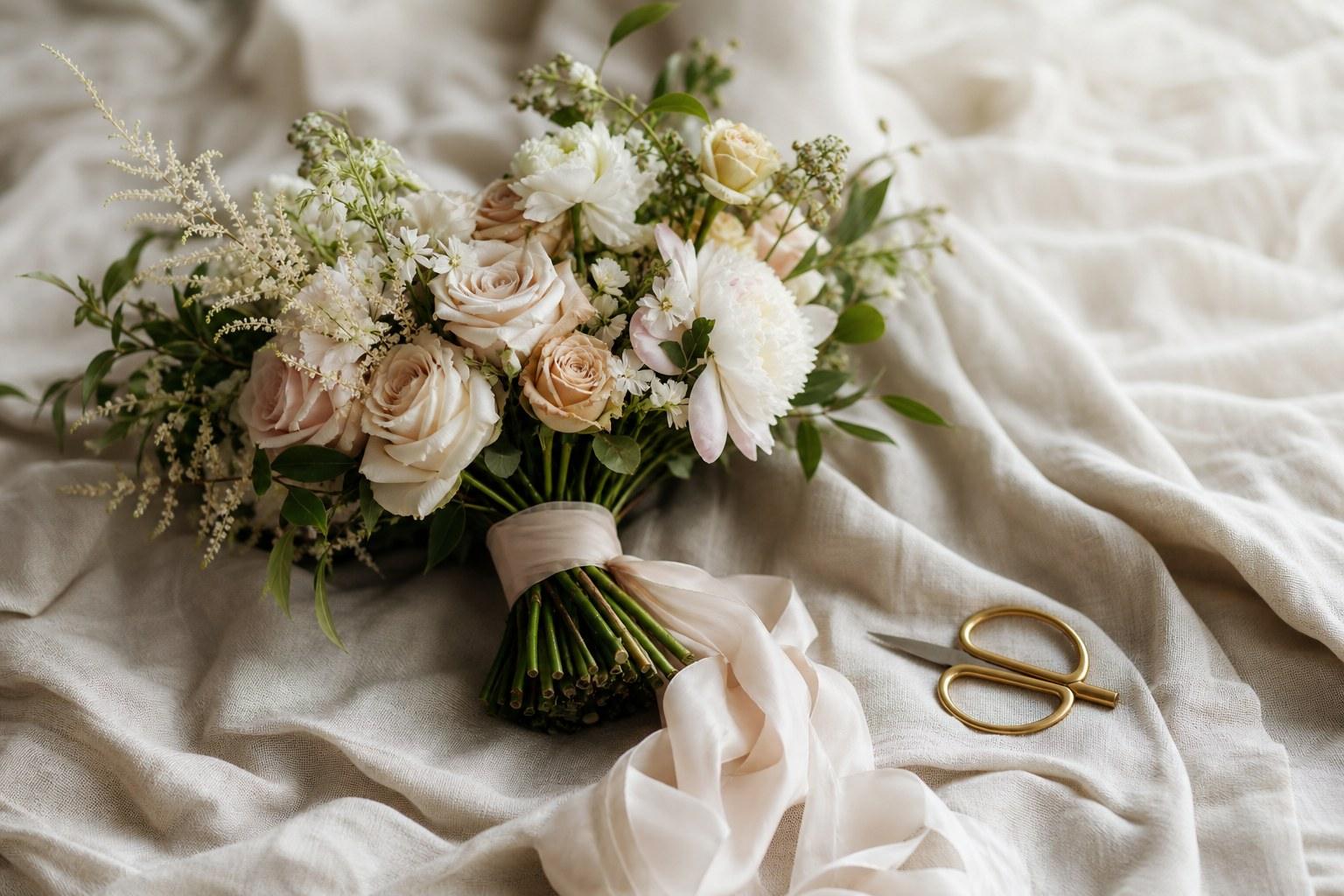
Finish with ribbon that suits the gown, either covering the stems fully or leaving the natural stems visible with a soft tie. Make sure nothing sharp or wet touches the dress: hidden wire ends and dripping stems have ruined more gowns than falling petals ever have.
Proportion rules that make a bouquet look professional
| Rule | Why it works |
|---|---|
| Width relates to the wearer’s frame | A bouquet wider than the torso overwhelms a smaller frame |
| Vary the depth of focal blooms | A flat surface reads as artificial |
| Odd-numbered groupings | The eye moves instead of pairing things off |
| Let some material break the outline | Escaping stems create movement and softness |
| Keep the handle length comfortable | Long handles pull the bouquet away from the body in photos |
| Match the density to the gown | Busy dress, quieter bouquet; simple dress, bolder bouquet |
Matching the rest of the bridal party
The bridal bouquet sets the language for everything else you make that day. Bridesmaid posies, buttonholes, flower crowns and the mothers’ corsages should all read as the same family — same palette, same texture, different scale.
- Bridesmaid posies: noticeably smaller than the bridal bouquet, and simplified. Two or three of the bridal ingredients, not all of them.
- Buttonholes: lightweight, wired or taped, and built to survive being hugged all day. Pin them from behind the lapel and show someone how before you leave.
- Flower crowns and hair pieces: made from the most robust material you have, sized to the head, and delivered with spare pins.
- Corsages: ask whether the wearer prefers a wrist or a pin — delicate fabrics and heavy pins do not mix.
- Toss bouquet: a small, cheap, expendable copy if the couple wants the tradition without risking the real one.
Build the personal flowers as one batch, from one bench, in one palette. It is faster, it uses your offcuts properly, and it guarantees the whole party looks deliberately connected in the group photographs.
Delivery, transport and the morning of
You can build a perfect bouquet and lose it in the car. Transport is part of the craft.
- Travel bridal work upright and stabilised in water where possible
- Keep the vehicle cool, and never leave flowers in direct sun or a hot boot
- Deliver with a small kit: spare ribbon, pins, scissors, a cloth and water
- Show the bride how to hold it — low, at hip level, relaxed — because most people hold it far too high
- Leave a vessel of water and tell someone where it is, so the bouquet gets a drink during photographs
Turning bouquet skills into a wedding floristry business
Bridal work is a natural entry point into the industry: the order is small, the impact is huge, and the images are excellent portfolio material. Many florists start with bouquets and buttonholes, then add ceremony and reception installations as their confidence and equipment grow.
Getting there needs two things. The craft — conditioning, mechanics, colour theory, proportion, installation — which is what the Certificate in Floral Design is built around. And the business — quoting, sourcing, client management and marketing — which the Certificate in Wedding Business & Marketing covers. Florists who also style full weddings often add the Certificate in Wedding Styling so they can quote the whole room, not just the flowers.
Build ten bouquets before you build one for a client. Photograph every single one. Repetition is the entire secret — your hands learn the spiral long before your brain does.
Ready to design wedding flowers professionally?
Learn conditioning, mechanics, bouquet construction, installations and the design principles behind beautiful wedding florals — online, at your own pace, with globally recognised certification.
Frequently asked questions
What is the easiest bridal bouquet shape for a beginner?
A loose, hand-tied posy in a spiral. It is forgiving, it suits most gowns, and it teaches you the fundamental grip and rotation that every other shape builds on. Cascades and compotes come later, once your spiral is secure and even.
How far in advance can you make a bridal bouquet?
Most florists build bridal work the day before and keep it cool and hydrated overnight. That depends entirely on the flowers, the climate and your storage. Delicate, fast-opening blooms are best placed as late as possible; hardier structural material can be built earlier.
Do I need to wire a bridal bouquet?
Not usually. Hand-tied bouquets rely on the stems themselves for structure. Wiring is used for specific jobs — supporting heavy or fragile heads, building cascades, and constructing buttonholes and hair flowers — and it is a technique worth learning even if you rarely need it.
How many stems go into a bridal bouquet?
There is no fixed number, because it depends on bloom size, stem thickness and the shape you are building. Design by proportion instead: hold the bouquet against the body at hand height and judge it against the wearer’s frame and gown, not against a stem count.
Can I become a wedding florist without a horticulture background?
Yes. Wedding floristry is a design and craft discipline — mechanics, conditioning, colour, proportion and delivery logistics. Plenty of florists come from completely unrelated careers and learn the craft through structured training and repetition.



