Every bouquet that looks effortless is lying to you a little. Behind the loose, garden-gathered buttonhole and the flower crown that survives a full dance floor is a quiet framework of wire, tape and binding you’re never meant to see. That framework has a name — wedding floristry mechanics — and it’s the difference between flowers that hold their shape until the last song and flowers that flop before the speeches.
Nobody posts a close-up of bind wire — but it’s the skill clients are really paying for. Here’s how wiring and taping really work, when to use them, and the mistakes that give amateurs away.
What are wedding floristry mechanics?
Mechanics are everything that holds, supports, positions or hydrates flowers without being part of the design itself. In wedding work that covers two broad families:
- Wired and taped work — buttonholes, corsages, wristlets, flower crowns, hair pieces and cascading bouquets, where individual stems are replaced or reinforced with wire so you can bend, angle and lighten them.
- Structural mechanics — the hidden grids, cages, pin holders and bindings inside centrepieces, urns, arches and installations that keep stems exactly where you placed them.
Good mechanics are secure, invisible and let flowers drink as long as possible. Miss one and the design suffers.
It’s also why technique sits at the heart of the Certificate in Floral Design — pretty flowers are the easy part; making them behave for a twelve-hour wedding day is the craft.
The wedding florist’s mechanics toolkit
Floristry wire and wire gauges explained
Florist wire is sold by gauge, and the rule that trips beginners up is that a higher gauge number usually means a finer wire. Fine wires are for delicate work — a single spray rose head, a sprig of waxflower, a leaf you want to curve. Heavier wires are for support — a heavy bloom on a weak stem, or a long trail in a cascade that needs to hold its line. The golden rule: use the lightest wire that does the job. Too heavy and it adds weight, shows through petals and makes the piece stiff and lifeless.
Stem tape
Stem tape (often called floral tape) is a waxy, slightly stretchy tape that only grips itself once it’s been stretched. It covers wire, seals the cut end of a stem to slow moisture loss, and gives you a neat, natural-looking finish.
Bind wire, pot tape and the structural crew
- Bind wire — paper-covered wire for tying hand-tied bouquets and attaching bundles of foliage to frames without cutting into stems.
- Pot tape — narrow waterproof tape for making grids across the mouth of a vase or securing cages and chicken wire to vessels.
- Pin holders (kenzan) — heavy bases of upright pins that hold stems at precise angles, beloved for low bowls and ikebana-inspired designs.
- Chicken wire — scrunched into vessels or wrapped around structures, it gives stems hundreds of anchor points.
- Cages and frames — reusable structures for arches, hanging installations and large pedestals, often combined with water tubes for hydration.
Wiring techniques every wedding florist should know
Piercing method
Push a wire horizontally through the seed box or base of the flower head, just under the petals, then bend both ends down parallel to the stem. Ideal for roses, carnations and other flowers with a firm base.
Hook method
Push a wire up through the stem and out the centre of the flower, bend a tiny hook at the top, then gently pull it back down so the hook buries itself in the centre. Works well for daisy-type flowers and blooms with a central disc where the hook disappears.
Stitch or hairpin method for leaves
Make a tiny stitch through the back of a leaf across the central vein, about a third of the way up, then bend the wire into a hairpin shape so both legs run down alongside the leaf stem. It lets you curve and angle foliage without it flopping — essential for buttonhole backings and crown work.
Support wiring
Here you keep the natural stem but strengthen it. Insert a wire into the base of the flower head and spiral it gently down the stem, or run it inside a hollow stem.
Mount wiring
Mounting replaces most of the natural stem with wire. Cut the stem short, lay a wire alongside, and wrap one leg firmly around both the stem stub and the other leg. You get a light, bendable “false stem”.
How to tape wired stems neatly
Taping is where good wiring either looks professional or looks like a school craft project.
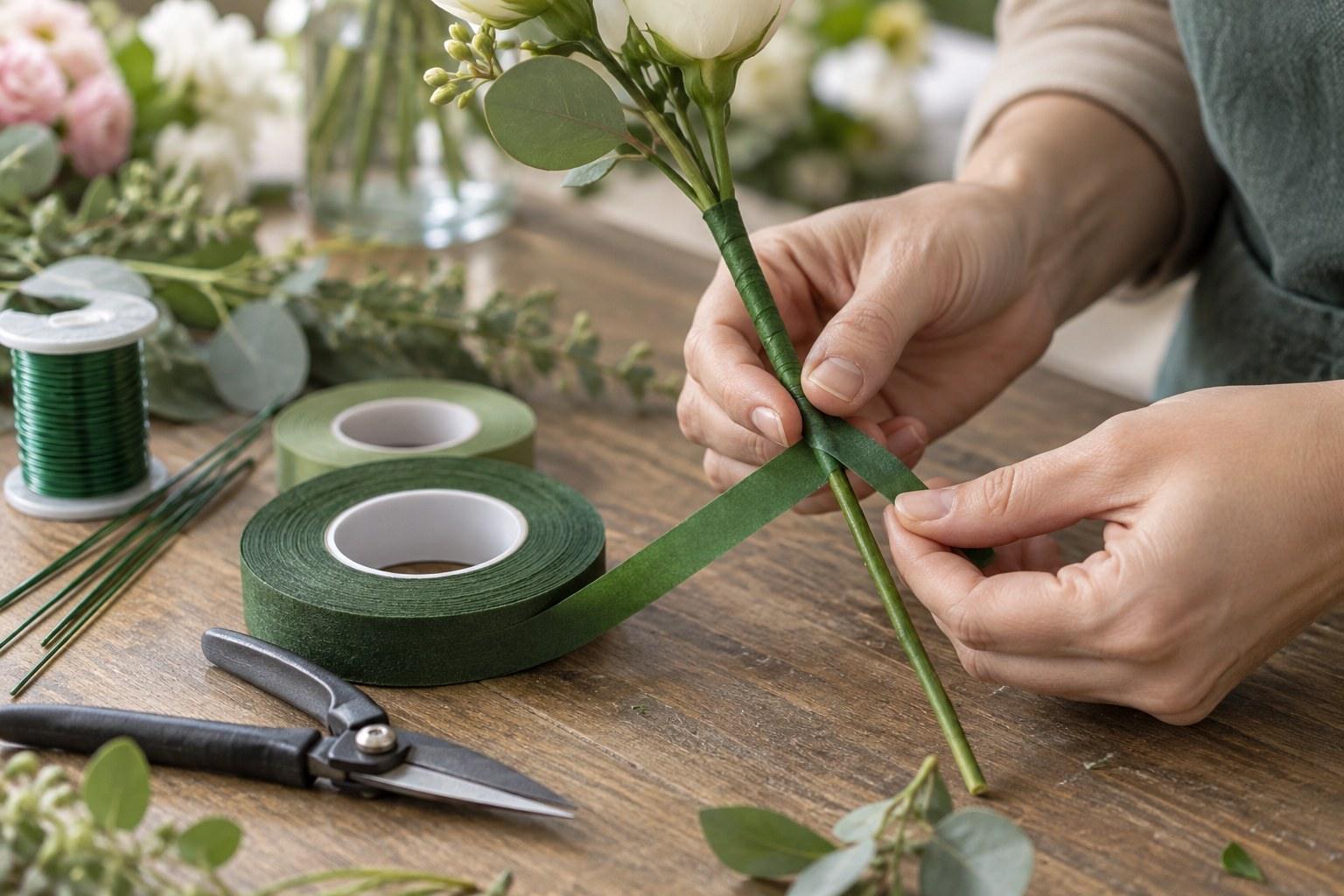
- Stretch to activate. Stem tape won’t stick until it’s stretched. Pull it gently as you work so it thins and becomes tacky.
- Start high and seal the stem. Begin just under the flower head or leaf, covering the point where wire meets stem, and wrap a couple of times to anchor it.
- Spiral down at an angle. Hold the tape at roughly a diagonal and twist the stem with your other hand, letting the tape overlap slightly as it travels down.
- Finish smoothly. Keep going to the end of the wire, then tear the tape and press the tail flat. No lumps, no exposed wire, no gaps.
Wedding floristry mechanics technique table
| Technique | Used for | Pro tip |
|---|---|---|
| Piercing | Roses, carnations, firm-based blooms in buttonholes and corsages | Pierce just under the petals so the wire is hidden but still secure |
| Hook | Daisy-type and disc-centred flowers | Keep the hook tiny and pull it down slowly so it sinks out of sight |
| Stitch / hairpin | Leaves and foliage backings | Stitch across the central vein so the leaf can curve without tearing |
| Support wiring | Heavy heads on soft stems in bouquets | Spiral loosely — you’re steadying the stem, not strangling it |
| Mount wiring | Cascades, corsages, anything you need to shape | Use the lightest wire that holds the bloom’s weight |
| Taping | Covering wire and sealing stems | Stretch as you go and overlap only slightly for a slim finish |
| Chicken wire / grid | Vases, urns, arches, foam-free installations | Tape it to the vessel so the whole structure can’t shift |
Applying the mechanics: buttonholes, crowns, wristlets and cascades
Buttonholes and boutonnieres
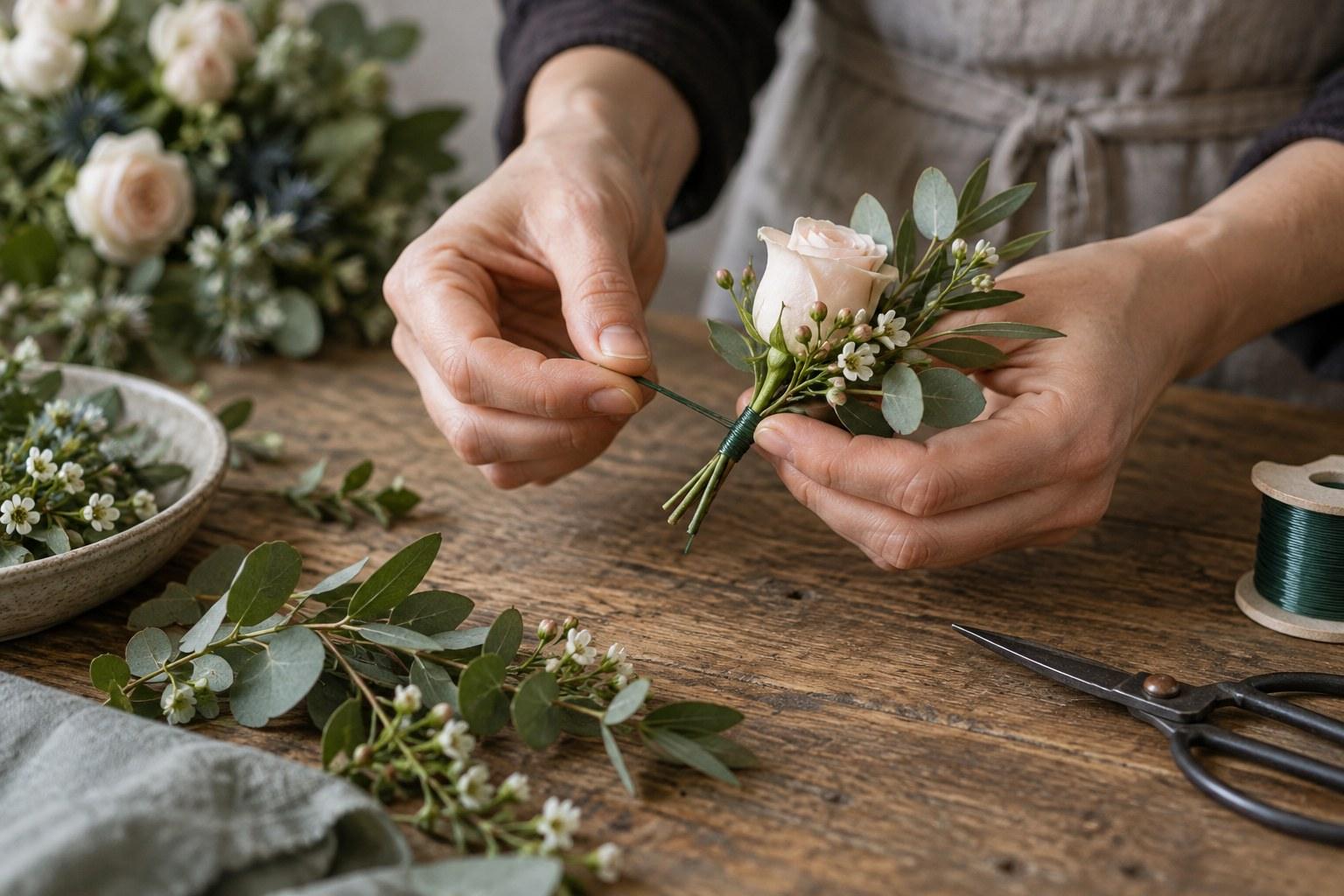
Wire your focal bloom and supporting pieces individually, tape each one, then assemble them in your hand into a neat little posy and bind them together. Trim the wired stems to a tidy length, tape the bundle, and finish with ribbon or twine if the design calls for it. A wired buttonhole is lighter and sits flatter on a lapel than a natural one.
Flower crowns
Make a base from taped wire measured to the wearer’s head, then wire and tape small clusters of flowers and foliage. Attach the clusters along the base, each one overlapping the last to hide the stems. Keep blooms small and light — a crown that’s too heavy slides, and it’ll be worn for hours.

Wristlets and corsages
Wire and tape a small composition, then attach it to a wristband or a pin. A wristlet gets waved, hugged and leaned on, so secure everything and keep scratchy wire off the skin.
Wired cascade bouquets
Cascades are where mount wiring earns its keep. Long trails of flowers and foliage are wired into graduated lengths and built into a flowing line that holds its shape instead of drooping. It’s slower, more technical work — and it shows.
If you want step-by-step builds for all of these in one place, the Wedding Florist’s Handbook ebook is a handy companion to keep beside your workbench.
When to wire flowers — and when to keep natural stems
Wiring isn’t always better. Natural stems keep drinking and move more freely. As a rough guide:
- Wire it when the piece is worn (buttonholes, crowns, wristlets), when it must hold a precise shape (cascades), or when you need weight off a stem.
- Keep it natural for hand-tied bouquets, centrepieces and installations where stems can sit in water and the design benefits from movement.
- Support rather than replace when a stem is nearly strong enough — a little support wire keeps the hydration and adds stability.
Hydration and timing: keeping wired flowers fresh
Wired flowers are cut off from their water supply, so timing matters. Condition your flowers well before you start, wire as close to the event as your schedule allows, and seal stem ends with tape. Once finished, keep pieces cool and away from direct sun and heaters, mist lightly if the flower variety tolerates it, and store them in boxes or containers that protect delicate petals.
Stable arrangements and arches without floral foam
Plenty of florists are moving away from single-use foam. Chicken wire, pin holders, pot-tape grids, reusable cages and water tubes can hold arches, urns and centrepieces securely — they just need more planning. Build the structure first, make sure it’s anchored so it can’t tip or shift, and test it before a single flower goes in. If you’re exploring this approach, our guide to wedding floral foam alternatives goes deeper. Large installations also overlap with styling, which is where the Certificate in Wedding Styling becomes a natural next step.
Common wedding floristry mechanics mistakes
- Wire that’s too heavy. It shows through petals, adds weight and makes pieces stiff. Go finer.
- Untidy tape. Lumps, gaps and exposed wire look amateur in close-up photos.
- Wiring too early. Pieces wired too far ahead can wilt before the ceremony. Plan your workflow around freshness.
- Visible mechanics. Chicken wire peeking out of an urn, tape on show at the base of a bouquet — cover everything with foliage or finish.
Mechanics are learnable — repetition, feedback and knowing why each technique exists. That’s what the Certificate in Floral Design gives you — and if you want to combine flowers with planning and business, the Advanced Certificate in Wedding Planning, Styling and Business takes you further.
Wedding floristry mechanics FAQs
What does mechanics mean in floristry?
Mechanics are the hidden materials and techniques that hold, support and hydrate flowers — wire, stem tape, bind wire, grids, pin holders, chicken wire and cages. They’re not part of the visible design, but the design can’t stand up without them.
What gauge wire should I use for a buttonhole?
Use the finest wire that securely holds each element. Delicate flowers and leaves need fine wire; a heavier bloom may need something slightly stronger. With most florist wire, higher gauge means thinner.
Why won’t my floral tape stick?
Stem tape needs to be stretched to activate its grip. Pull gently as you wrap and spiral down with a slight overlap.
How far ahead can you wire wedding flowers?
As close to the event as your schedule allows, because wired flowers have no water source. Condition flowers first, seal stems with tape, then keep finished pieces cool, protected and lightly misted where the variety tolerates it.
Do you have to wire a bridal bouquet?
No. Most hand-tied bouquets use natural stems, which stay hydrated and move beautifully. Wiring is used for worn pieces, cascades and shapes that need to be held precisely, or as light support for weak stems.
Ready to make the invisible part of floristry your strongest skill? Learn the techniques properly, practise with feedback, and build wedding work you’re proud to put your name to. 🌿