To make buttonholes and corsages that last all day, choose hardy flowers, condition them properly, wire and tape the stems for strength and lightness, and keep finished pieces cool and misted until they’re pinned on. Knowing how to make buttonholes well is mostly about preparation — the actual making only takes minutes once the flowers are ready.
These little designs carry a lot of weight. They’re worn close to faces, photographed constantly, hugged, squashed and danced in. Here’s a practical, step-by-step guide to making buttonholes and corsages that look as fresh at the last dance as they did at the first photo.
Choosing flowers that last
Wearable flowers spend hours out of water, warmed by body heat and handled by guests. Not every bloom can cope. Choose flowers and foliage known for holding up well out of water.
| Good choices | Why they work | Use with care |
|---|---|---|
| — | — | — |
| Spray roses and small roses | Firm petals, classic shape | Check heads are not too open |
| Ranunculus | Layered petals, good colour | Can be soft; condition well |
| Orchids such as dendrobium | Hold up well out of water | Handle gently to avoid bruising |
| Wax flower and thistle | Textural and tough | Thistle can be prickly near fabric |
| Eucalyptus, rosemary, ruscus | Sturdy foliage, long-lasting | Some foliage can mark fabric |
| Succulents and dried elements | Very durable | Heavier; wire securely |
Delicate blooms that wilt or bruise quickly — many soft garden flowers, for example — are lovely in bouquets with water but risky in a buttonhole. Test any flower you’re unsure of by leaving a stem out of water for several hours before the wedding and watching how it behaves.
Conditioning first: the step most people skip
Well-conditioned flowers last far longer out of water. Before you make anything:
- Re-cut stems at an angle with clean, sharp snips.
- Strip any leaves that would sit below the waterline.
- Place stems in clean water with flower food and let them fully hydrate in a cool spot.
- Allow tight buds to open to the stage you want — but not beyond it.
Give flowers plenty of time to drink before you start. A thirsty flower wired into a buttonhole will droop by the speeches.
Tools and materials you’ll need
- Sharp floristry snips and scissors
- Florist wire in a few gauges — finer for delicate heads, heavier for support
- Stem tape (floral tape)
- Ribbon, twine or fabric for binding
- Pearl-headed pins or buttonhole pins, plus magnets for delicate fabrics
- Corsage wristlets or elastic bands, and florist-grade adhesive suitable for flowers
- A misting bottle and a cool place to store finished pieces
How to make buttonholes, step by step
1. Prepare the focal flower
Shorten the stem of your main flower, leaving a short length. Push a wire up through the base of the flower head — or through the stem just below it — to support the bloom and let you angle it. The wire replaces the bulk of the natural stem, keeping the buttonhole light.
2. Wire the supporting pieces
Wire small sprigs of foliage and filler in the same way. Fine wire is enough for most foliage; heavier pieces need more support. Keep everything small — a buttonhole should complement the outfit, not overwhelm the lapel.
3. Tape each wired stem
Wrap each wired stem with stem tape, stretching it slightly as you go so it grips. Taping covers the wire, seals in moisture and gives you a neat, easy-to-hold stem.
4. Assemble
Hold the focal flower and place foliage behind and around it, building from the back so the flower sits slightly forward. Check the buttonhole from the front, as it will be seen on the lapel. Bind the stems together with tape at the binding point.
5. Finish the stem
Trim the stems to a neat length, then wrap with ribbon, twine or fabric to hide the tape. Secure the end with a pin or a dab of adhesive. Keep the finished stem slim so it sits flat against the jacket.
How to make wrist corsages
Wrist corsages follow the same principles — conditioned flowers, wired or glued, built light — but sit on a wristlet or band rather than a pin.
- Choose a base — a corsage wristlet, a ribbon tie or an elastic band, depending on the style and the wearer’s comfort.
- Build a flat-backed design — the corsage must sit comfortably on the wrist without poking or wobbling.
- Glue or wire elements onto the base — florist-grade adhesive suitable for fresh flowers works well for many corsages; wired pieces add movement and security.
- Keep it proportional — a corsage that’s too heavy slides around the wrist and gets in the way.
Pin-on corsages for jackets or dresses are made like a slightly larger buttonhole, often with a little more flow or trail.
Making buttonholes and corsages last all day
Good making is half the job. Care and timing do the rest.
- Make them as close to the wedding as practical — usually the day before or the morning of, depending on your workflow and the flowers.
- Mist lightly once finished, then store them in a cool place, in a lidded box with damp tissue below (not touching) to keep humidity up.
- Avoid crushing — box each piece so petals aren’t squashed in transit.
- Keep them out of heat and direct sun on the day until they’re worn.
- Label boxes clearly so the right buttonhole goes to the right person.
Pinning buttonholes securely
A beautifully made buttonhole is no good if it flops forward or comes loose during the hugs. Pin it properly:
- Position it on the left lapel, angled toward the face, with the flower sitting at roughly the top of the lapel’s buttonhole area.
- Push the pin through the back of the lapel, catch the stem, then push it back through the lapel so the pin is hidden underneath.
- Use two pins for heavier pieces, crossing them for extra security.
- On delicate fabrics, use buttonhole magnets instead of pins to avoid marks.
Show a groomsman or family member how to do it. It’s a small kindness that saves a lot of lapels on the morning.
Matching buttonholes to the wedding party
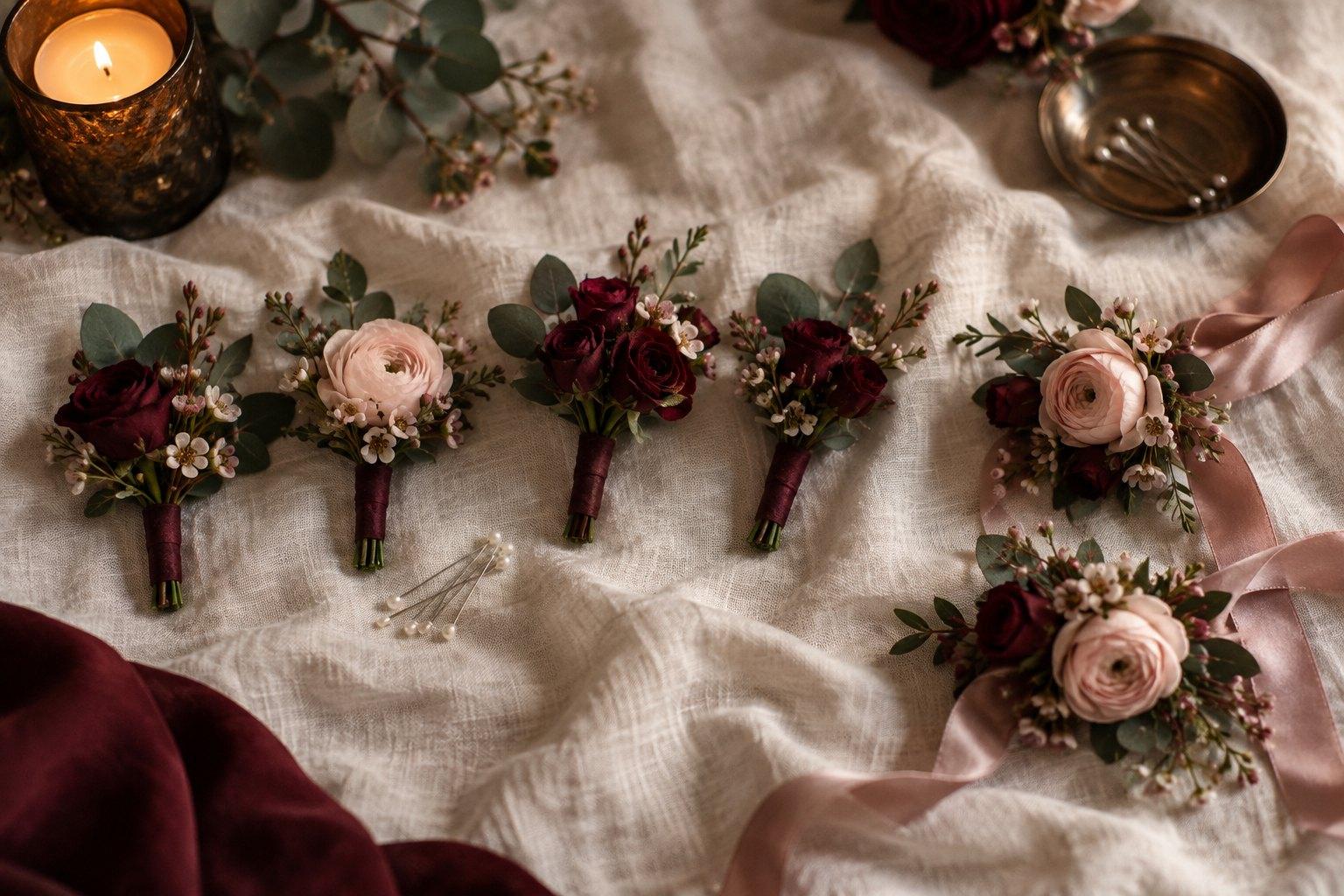
Buttonholes don’t all have to be identical. Many couples like a slightly larger or more detailed design for the groom or partner, matching pieces for the wedding party, and simpler versions for parents, grandparents and ushers. Corsages for mothers and grandparents often echo the bridal bouquet in a smaller, wearable form.
Ask about outfits at the consultation. Suit colour, lapel width and fabric all affect how a buttonhole looks and how it’s best attached. A bold burgundy rose may disappear against a dark suit and sing against a pale one — and a heavy design can drag on a fine linen jacket. Small details like these are what make your work look considered.
Common buttonhole and corsage mistakes
- Using soft flowers that wilt quickly out of water.
- Skipping conditioning to save time.
- Making designs too big or too heavy.
- Leaving wires exposed where they can scratch the wearer or snag clothing.
- Storing finished pieces somewhere warm.
- Not labelling boxes for the bridal party.
Practise, then practise again
Buttonholes and corsages are one of the best skills to practise when you’re learning floristry. They’re small, use few stems and teach you wiring, taping, proportion and finishing. Make several from the same materials and compare them side by side — you’ll quickly see which techniques give you the cleanest results.
The Wedding Florist’s Handbook by Jac Bowie covers wedding floristry techniques like these alongside the business side of running a floral service — a useful bench reference while you practise. If you’re building a broader wedding career, explore all our wedding courses.
The bottom line
Buttonholes and corsages that last all day start with hardy flowers and proper conditioning, then rely on clean wiring, neat taping, secure binding and careful storage. Master those steps and these tiny designs become one of the most reliable — and admired — parts of your wedding work. Ready to go further? The Certificate in Floral Design takes you through wedding floristry from the basics up.
Frequently asked questions
What flowers last longest in buttonholes?
Hardy flowers that hold up out of water work best, such as spray roses, small roses, orchids, wax flower and thistle, with sturdy foliage like eucalyptus, rosemary or ruscus.
How far in advance can you make buttonholes?
Usually the day before or the morning of the wedding. Store finished pieces lightly misted in a cool place in a lidded box to keep them fresh.
Do you need to wire buttonholes?
Wiring isn’t always essential, but it supports flower heads, lets you angle them and replaces bulky stems, making buttonholes lighter and longer lasting. Taping over the wire seals and neatens the stem.
How do you attach a buttonhole so it stays secure?
Pin through the back of the left lapel, catch the stem, then pin back through so the pin is hidden. Use two crossed pins for heavier pieces or magnets for delicate fabrics.
Can you glue flowers for corsages?
Yes. Florist-grade adhesive suitable for fresh flowers is commonly used to attach blooms to wristlets and bases, often combined with wiring for extra security.
Want to master buttonholes, corsages, bouquets and the full range of wedding floristry? Enrol in the Certificate in Floral Design and learn professional techniques online, at your own pace.