A typical wedding ceremony order runs like this: guests arrive and are seated, the processional begins, the officiant welcomes everyone, readings follow, vows and rings are exchanged, the couple is pronounced married, the register or certificate is signed, and the recessional takes everyone out. Most civil and non-religious ceremonies follow that skeleton, while religious and cultural ceremonies add, remove or reorder elements.
As the planner, you’re the one who turns that list into a smooth, well-timed moment — cueing music, lining up the wedding party and making sure nobody walks out too early. This guide breaks down the wedding ceremony order step by step, with timings, who does what, and the behind-the-scenes cues that make it look effortless.
The standard wedding ceremony order at a glance
Here’s the most common structure for a civil or celebrant-led ceremony. Use it as a starting template, then adapt it to your couple’s traditions and the requirements of whoever is legally marrying them.
| Step | Typical timing | Who’s involved |
|---|---|---|
| Guest arrival and seating | 20–30 min before start | Ushers, musicians, planner |
| Seating of family | 5 min before start | Ushers, close family |
| Processional | 3–5 min | Wedding party, couple, escorts |
| Welcome and introduction | 2–3 min | Officiant |
| Readings | 2–6 min | Readers |
| Vows | 2–5 min | Couple, officiant |
| Ring exchange | 1–2 min | Couple, ring bearer or best person |
| Declaration and kiss | 1 min | Officiant, couple |
| Signing of the register | 5–10 min | Couple, witnesses, officiant |
| Recessional | 2–3 min | Couple, wedding party |
Add those up and most ceremonies land at roughly 20 to 40 minutes. Religious ceremonies can run considerably longer.
Step 1: Guest arrival and pre-ceremony music
Guests usually start arriving 20 to 30 minutes before the published start time. Pre-ceremony music sets the mood, while ushers or the planner guide guests to their seats and hand out programmes or confetti.
Planner cues for this stage:
- Confirm the musician or DJ is playing by the time the first guests arrive
- Reserve the front rows for immediate family, clearly marked
- Check on any guests with accessibility needs and seat them where they can see and hear
- Keep an eye on the clock and the couple’s arrival — you need to know exactly where they are
Step 2: Seating of family and special guests
Just before the processional, grandparents, parents or other honoured guests are escorted to their seats. This signals to everyone that the ceremony is about to start. It’s a lovely moment to recognise family — and a practical one, as guests naturally settle and quieten.
Step 3: The processional
The processional is the entrance of the wedding party and the couple. There’s no single correct order, but a common Western sequence is:
- Officiant takes their place (sometimes with one partner already waiting at the front)
- Attendants walk in, in pairs or individually
- Maid or man of honour, then best person
- Flower children and ring bearer
- The partner or partners walking down the aisle, alone or escorted
Modern couples often rewrite this — walking in together, being escorted by both parents, or skipping attendants entirely. Your job is to know the final order, rehearse it, and space each entrance so guests aren’t still watching one attendant when the next arrives. A good rule: send the next person when the previous one is about halfway down the aisle.
Step 4: Welcome and introduction
The officiant welcomes guests, may say a few words about the couple, and explains what’s about to happen. Some couples include an acknowledgement of loved ones who can’t be there, or a short story about how they met.
Step 5: Readings and symbolic rituals
Readings are typically placed after the welcome and before the vows. One or two is common. Brief your readers in advance: where they sit, when they stand, whether there’s a microphone, and how to return to their seat.
This is also where symbolic rituals often sit — a handfasting, sand ceremony, unity candle, ring warming or a cultural tradition. Plan the logistics carefully: tables, matches or lighters (and venue permission for open flame), and who sets up and clears each item.
Step 6: Vows
The emotional heart of the ceremony. Couples may repeat traditional vows after the officiant, read personal vows, or combine the two. Make sure printed copies are available in case a phone dies or nerves take over — and have tissues within reach of the front row.
In many countries, certain legal words must be spoken for the marriage to be valid. The officiant should know these requirements, but if you’re planning a wedding in an unfamiliar country, check with the relevant registry or marriage authority well in advance.
Step 7: Ring exchange
The rings are handed over by the best person, a ring bearer, or passed through the guests in a ring-warming. Decide who holds the rings on the morning and when they’re handed over. A simple ring box or pouch beats loose rings in a jacket pocket every time.
Step 8: Declaration and first kiss
The officiant pronounces the couple married, and the first kiss follows (if the couple wants one). Photographers will want to know this moment is coming — a quick nod from you or the officiant helps them get the shot.
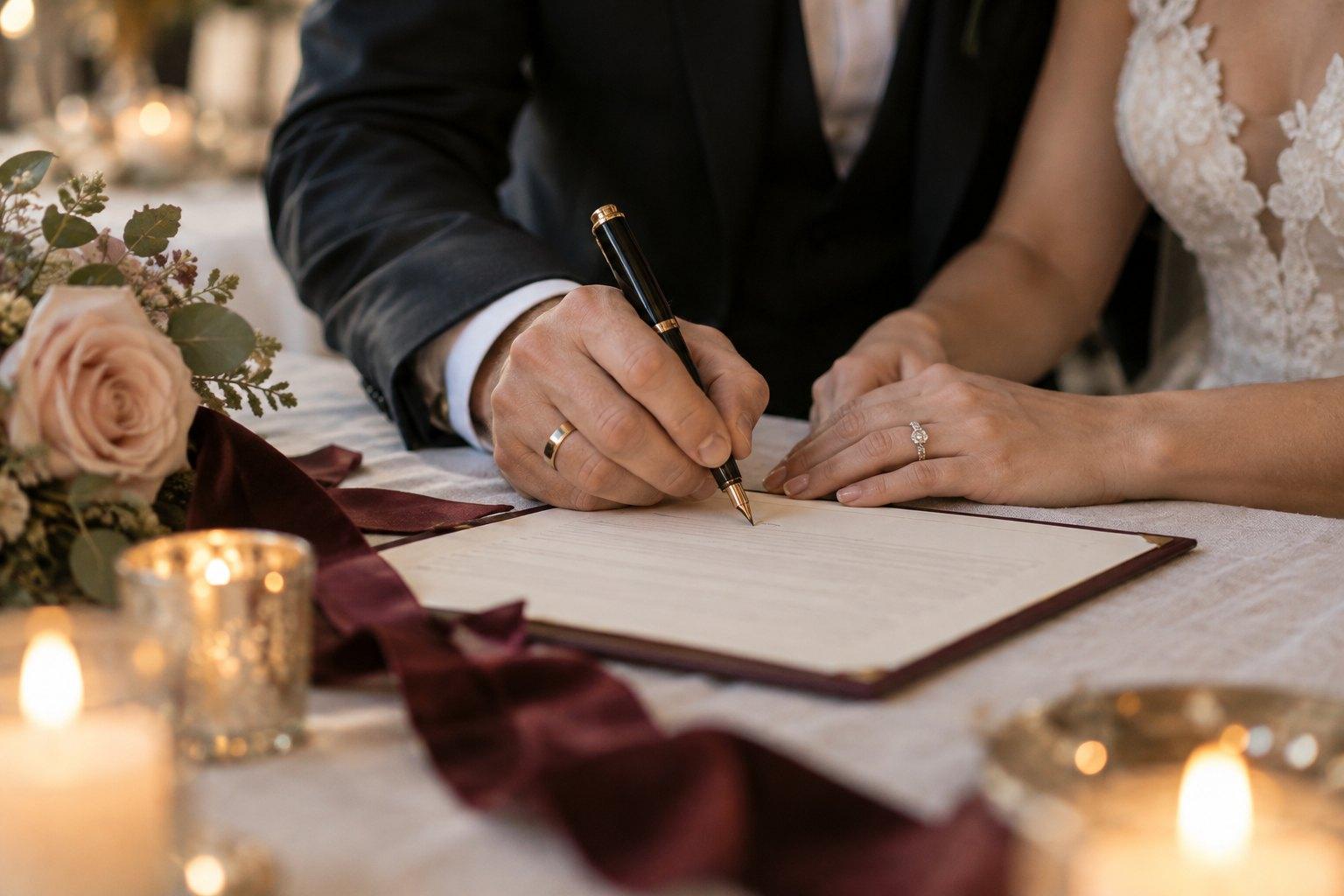
Step 9: Signing the register
The couple, their witnesses and the officiant sign the legal documents. It usually takes 5 to 10 minutes, so plan music to fill the gap — a live performance or a playlist works well. Make sure witnesses know they’re needed and are seated close to the front.
Some couples choose to sign before or after the ceremony in a private room. Requirements for paperwork, witnesses and identification differ between countries and regions, so confirm the details with the officiant and the relevant authority.
Step 10: The recessional
The couple walks back down the aisle as a married couple, followed by the wedding party in reverse order. Upbeat music, confetti or petal tosses (check what the venue permits) make this a joyful moment.
Once the couple exits, the officiant or planner should tell guests where to go next — drinks, photos or transport. Without this direction, guests hover awkwardly. A short, warm announcement solves it.
How the order changes across traditions
Ceremony structures vary widely. A few examples of how the skeleton above shifts:
- Religious ceremonies may include prayers, hymns, blessings, a homily or sermon, and communion or other rites, often in a set order.
- Jewish ceremonies commonly take place under a chuppah and may include the signing of the ketubah before the ceremony, blessings and the breaking of a glass.
- Hindu ceremonies can include multiple rituals around a sacred fire and often run much longer than a civil ceremony.
- Civil ceremonies may have restrictions on religious content depending on local law.
Always ask the couple and their officiant for the exact order rather than assuming. If you’re working with a tradition you’re less familiar with, ask respectful questions and allow extra time at rehearsal.
How planners keep the ceremony on track
Knowing the order is the easy part. Running it smoothly comes down to preparation:
- Hold a rehearsal. Walk the processional and recessional at least once, ideally at the venue.
- Write a ceremony cue sheet. List every music change, entrance and handover, with who gives each cue.
- Brief the musicians. Agree visual cues for when to fade out, start the processional song and launch the recessional.
- Line up the party in order out of sight of guests, and check buttonholes, bouquets and rings before the first person walks.
- Stay at the back. You need eyes on the aisle, the musicians and the officiant all at once.
These are exactly the skills covered in the Certificate in Wedding Planning, alongside run sheets, supplier management and full wedding-day coordination. For checklists and planning tools you can adapt to any ceremony, see The Wedding Planner’s Handbook by Jac Bowie.
Common ceremony mistakes to avoid
Even experienced teams slip up. Watch for these:
- Starting too late. A few minutes is fine; much longer and guests get restless and the whole timeline slides. Agree a firm start time with the couple.
- No microphone for the officiant or readers. Outdoor spaces swallow sound. If guests can’t hear the vows, they’ll remember that more than the flowers.
- Forgetting the witnesses. Make sure the people signing know who they are, where to sit and that they need to stay put.
- Letting the music run out. Prepare more tracks than you think you’ll need for the processional and the signing.
- No direction after the recessional. Always tell guests clearly what happens next.
Frequently asked questions
What is the correct order of a wedding ceremony?
A common order is guest arrival, seating of family, processional, welcome, readings, vows, ring exchange, declaration and kiss, signing of the register and recessional. Religious and cultural ceremonies may add or reorder elements.
How long does a wedding ceremony usually last?
Many civil and celebrant-led ceremonies last around 20 to 40 minutes. Religious ceremonies or those with several cultural rituals often run longer.
Who walks down the aisle first?
In many Western ceremonies the attendants walk first, followed by the flower children and ring bearer, then the partner or partners being escorted. Many modern couples customise this order.
When are readings included in a ceremony?
Readings usually come after the officiant’s welcome and before the vows, though couples can place them wherever they feel most meaningful.
Does the wedding planner run the ceremony?
The officiant leads the ceremony itself, while the planner coordinates everything around it — lining up the wedding party, cueing music, managing timing and directing guests afterwards.
Ready to run ceremonies — and whole wedding days — with calm, confident precision? Learn the full planning process online with The Wedding Academy, at your own pace.