How to make a flower crown: build a lightweight wire base sized to the wearer’s head, then wire and tape small flowers and foliage into individual pieces and bind them onto that base in overlapping layers, all facing the same direction. That’s the whole method — the craft is in choosing hardy blooms, keeping every piece feather-light and finishing it so it sits comfortably for a full wedding day.
Flower crowns and hair flowers look simple in photos, but they’re among the most technical pieces a wedding florist makes. They sit on a living, moving, dancing person for twelve hours with no water source. If you’ve ever wondered how to make a flower crown that doesn’t wilt, slip or scratch, this is your step-by-step guide.
What you need to make a flower crown
Before a single stem gets cut, get your kit together. Working with the right gauge of wire and good tape is the difference between a crown that holds and one that unravels by the first dance.
- Heavier gauge wire for the base — one or two lengths, depending on how sturdy and how fine you want the frame.
- Finer wire for individual flower heads and leaves, so each piece can bend without snapping.
- Paddle or reel wire for binding pieces onto the base quickly.
- Stem tape (often called floral tape) in green or brown to seal wires and hold moisture in stems.
- Ribbon for ties at the back if you’re making an adjustable crown — silk or chiffon in a soft tone.
- Wire cutters, florist scissors and a sharp knife — keep wire cutters separate so your scissor blades stay sharp.
- A misting bottle and a cool place to store finished pieces.
Choosing flowers for crowns and hair pieces
The best flowers for crowns are small, firm and slow to wilt out of water. Think about how a bloom behaves in a hand-tied bouquet with no vase for hours — that’s the real-world test.
Reliable flowers for flower crowns
- Spray roses — small heads, strong petals and plenty of colour choice.
- Waxflower — tough, textural and great for filling gaps.
- Craspedia, statice and strawflower — practically indestructible and lovely for boho or dried looks.
- Hypericum berries — add texture and hold well.
- Eucalyptus, rosemary, myrtle and ruscus — robust foliage that frames blooms beautifully.
- Orchids such as dendrobium — elegant and long-lasting when handled carefully.
Flowers to use with caution
Hydrangea, sweet peas, gardenia, lily of the valley and fresh jasmine are breathtaking — and thirsty or bruise-prone. If a couple loves them, use them in hair pins that go in later in the day, condition them really well, or tuck them into the bouquet instead. Be honest with clients about what will still look fresh by the reception.
Before the wedding, always test-wire a stem of anything you haven’t used in a crown before. Leave it out of water for a few hours and see how it holds. That simple habit saves heartache.
How to make a flower crown, step by step
Step 1: Measure and build the base
Measure the wearer’s head where the crown will sit — across the forehead for a halo, further back for a crown that sits like a headband. Add a little extra for overlap. Form a circle with your heavier wire, twist the ends to secure and wrap the whole base in stem tape so it doesn’t slide or scratch. For an adjustable version, form a small loop at each end and tie ribbon through later.
Step 2: Condition your flowers
Give flowers and foliage a long drink in clean water in a cool spot before you start. Well-hydrated stems last noticeably longer once they’re wired. Strip off damaged petals and any leaves you won’t use.
Step 3: Wire and tape each piece
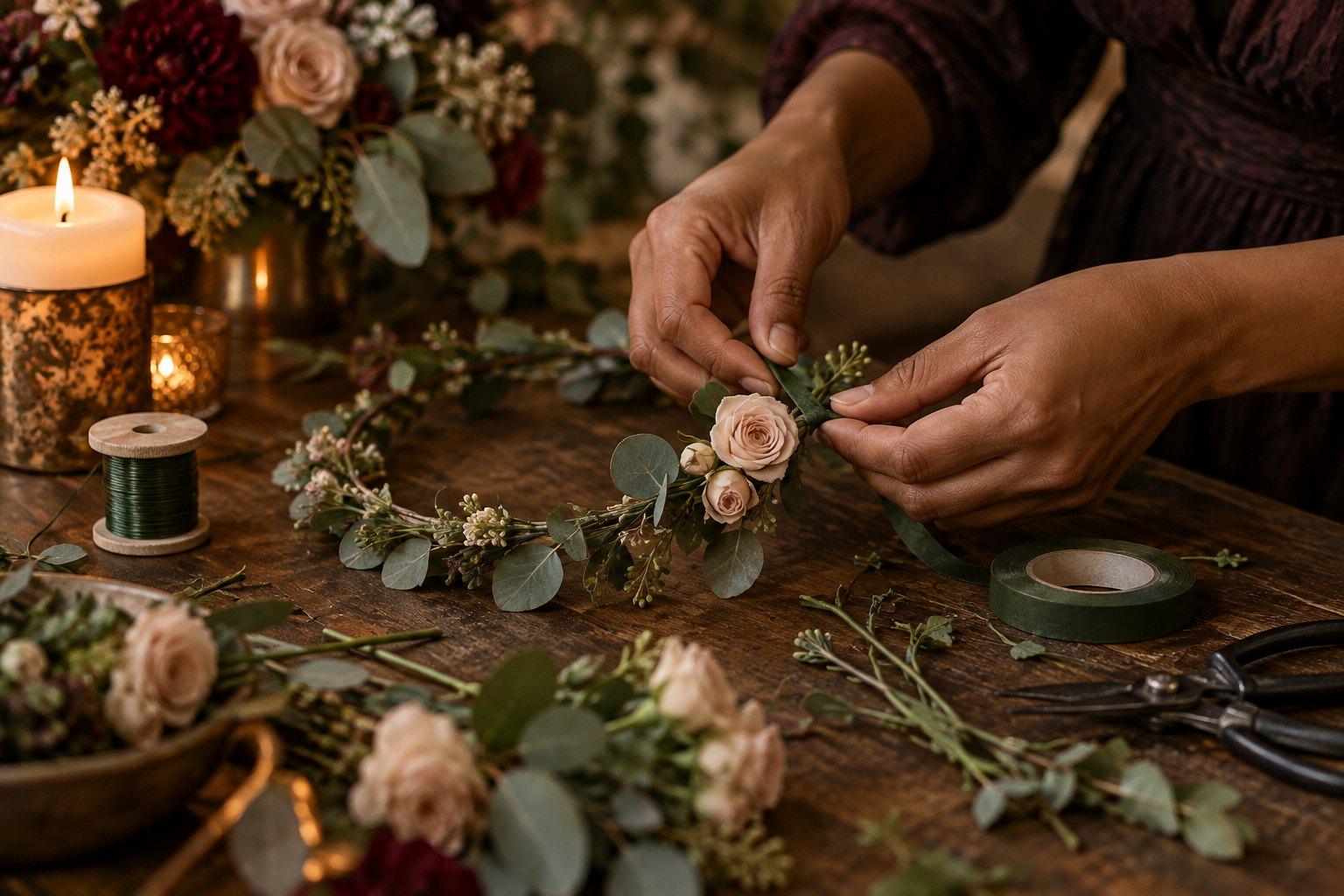
Cut each flower with a short stem. For firm stems, push fine wire up through the stem into the head; for flowers with a solid calyx, pierce the wire horizontally through the base and bend both ends down. Then wrap tightly with stem tape from the top of the stem down the wire, stretching the tape as you go so it grips and seals. Wire leaves by stitching a fine wire through the back of the leaf near the centre vein.
Step 4: Make small bundles
Group two or three taped elements together — a small rose, a sprig of waxflower and a leaf, for example — and tape them into a mini cluster. Building in bundles is faster than attaching single stems and gives you that lush, layered look.
Step 5: Bind bundles onto the base
Lay the first bundle against the base and bind it on with reel wire or tape. Place the next bundle so its flowers cover the stems of the first, always working in the same direction. Keep going around the crown, checking the balance as you work. Most crowns look best with the focal flowers slightly off-centre or concentrated at the front and sides.
Step 6: Finish and check comfort
Tuck the final bundle under the first so no wire ends show. Run your fingers around the inside of the crown — any sharp wire ends must be trimmed and taped over. Gently mist, then place the crown in a lidded box with damp tissue (not touching the flowers) in a cool place until delivery.
Crown styles couples ask for
| Style | How it’s built | Best flowers |
|---|---|---|
| Full halo | Flowers all the way around the base | Spray roses, waxflower, foliage |
| Half crown | Flowers across the front only; bare wire or ribbon at back | Mixed small blooms with trailing greenery |
| Asymmetric | Cluster of focal flowers at one side | One or two larger blooms with fine fillers |
| Boho dried | Dried and preserved elements on a taped base | Bunny tails, strawflower, grasses |
| Minimal greenery | Foliage with a few tiny accents | Olive, myrtle, rosemary, eucalyptus |
How to make bridal hair flowers and pins
Not every couple wants a full crown. Hair flowers — single blooms on pins, combs or a small comb cluster — are more subtle and often easier to wear with a veil.
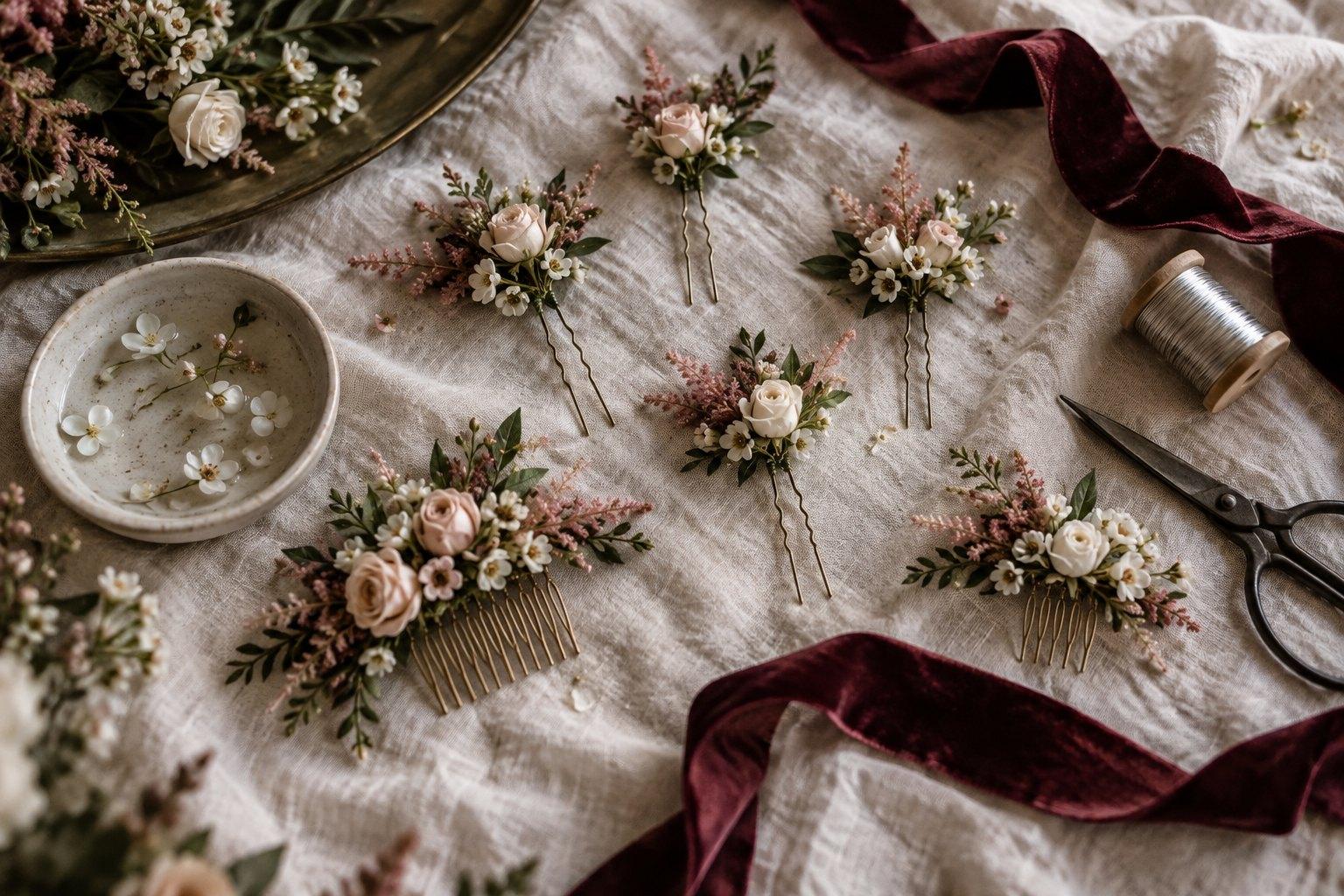
- Hair pins: wire and tape a single flower or tiny cluster, then tape the wire to a bobby pin or hairpin. Keep them lightweight so they don’t drag.
- Combs: bind small bundles along the spine of a hair comb with fine reel wire, then tape neatly underneath.
- Hair vines: bind flowers along a long length of taped wire that the hairstylist can weave through a braid or updo.
Talk to the hairstylist early. They’ll tell you whether the hair will be up, half-up or loose, how much grip they need and when they’d like the pieces delivered. A quick chat avoids last-minute rewiring.
Pricing, timing and logistics for crowns
Crowns are labour-heavy. Every element is individually wired and taped, so time is the real cost. When you quote, account for the hours of construction, not just the stems. Many florists also offer flower crowns as a separate line item for bridesmaids or flower girls so couples can see exactly what each piece involves.
Make crowns as late as practical — ideally the day before or the morning of — and keep them cool. Deliver them in protective boxes, labelled with the wearer’s name. If you’re unsure how to factor construction time into a quote, The Wedding Florist’s Handbook by Jac Bowie walks through pricing, recipes and planning worksheets for the whole wedding order.
Common flower crown mistakes to avoid
- Too heavy: big blooms and thick wire make a crown slip and give the wearer a headache.
- Visible mechanics: wire ends or tape poking out look amateur in close-up photos.
- Poor flower choice: wilting blooms by the ceremony are the most common complaint.
- Wrong size: always confirm measurements — and whether the crown sits on or behind the hairline.
- No backup: pack spare wired pieces and tape in your emergency kit for on-the-day repairs.
Mastering wiring and taping opens up buttonholes, corsages, wristlets and cascading bouquets too. It’s foundational floristry, and it’s covered in depth in our online floral design course, alongside bouquets, centrepieces and running your own floral business.
Frequently asked questions
How long does a fresh flower crown last?
A well-made crown using hardy, well-conditioned flowers will usually look fresh through a full wedding day if it’s kept cool and misted before wearing. Delicate, thirsty flowers fade much faster.
Can you make a flower crown the day before the wedding?
Yes. Most florists make crowns the day before or the morning of, then store them in a lidded box with damp tissue in a cool place. Avoid freezing temperatures and direct sun.
What wire do you use for a flower crown?
Use a heavier gauge wire for the base and finer wire for individual flowers and leaves, with stem tape to seal and bind. Reel or paddle wire makes attaching bundles quicker.
What is the difference between a flower crown and a hair vine?
A flower crown is a closed or tied circle that sits on the head, while a hair vine is a flexible length of wired flowers that a hairstylist weaves through a braid or updo.
Where can I learn how to make wedding flower crowns properly?
The Wedding Academy’s Certificate in Floral Design is studied 100% online and covers wiring, taping and wearable flowers alongside bouquets, centrepieces and floral business skills.
Ready to turn flower crowns, bouquets and full wedding designs into a real floristry business? Study online at your own pace with The Wedding Academy’s Certificate in Floral Design and learn the techniques florists rely on every wedding day.