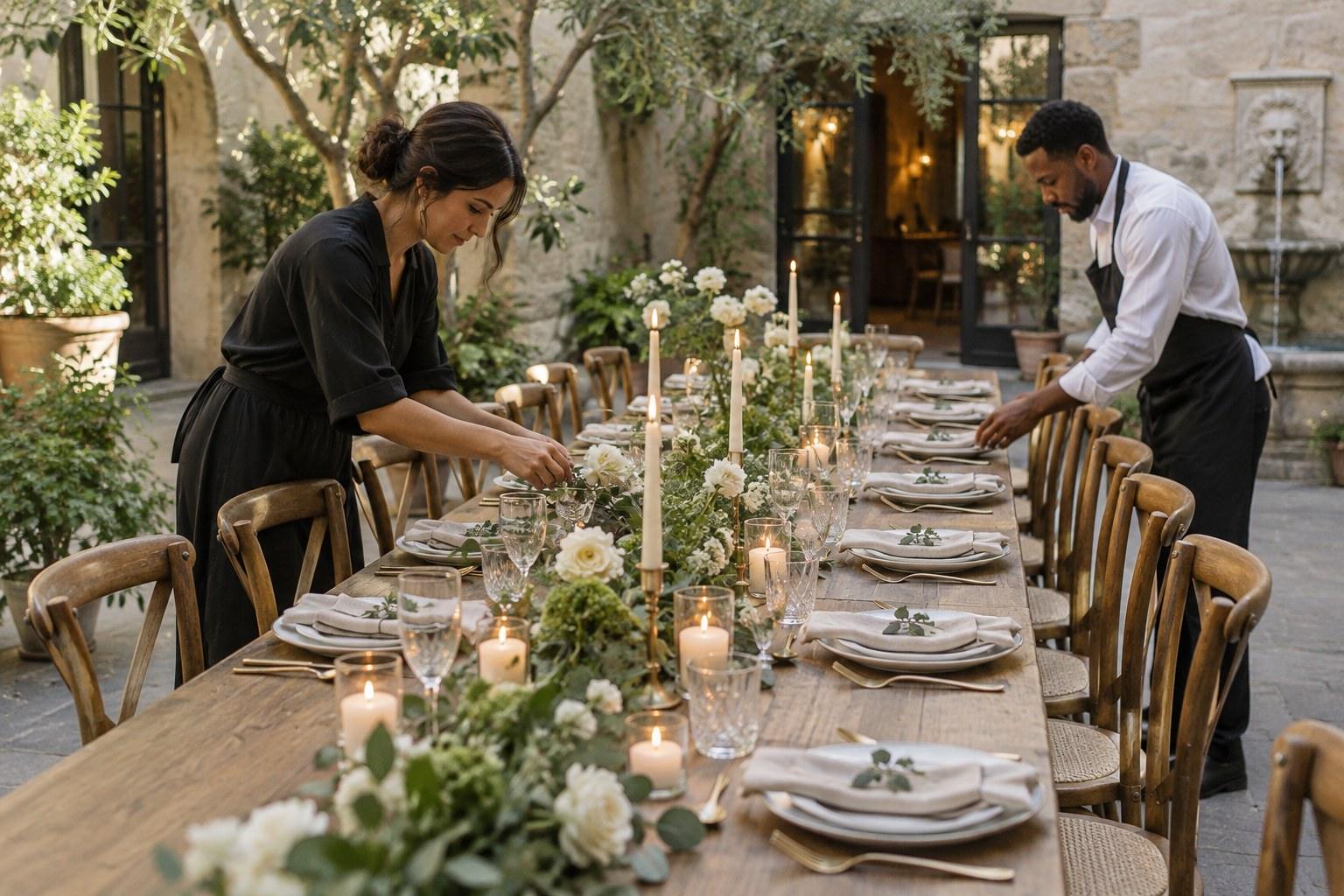
A small guest list doesn’t mean a small vendor list. That’s the first thing to get straight with any couple planning an intimate celebration — and the first thing a lot of new planners get wrong.
Here’s the short answer. Most micro weddings still need a core team of micro wedding vendors: a celebrant or officiant, a photographer, someone handling food and drink, someone handling florals and styling, and someone running the day. What changes is the scale. Each role can be scaled down, simplified or combined with another — but very few of them disappear entirely.
Here’s who’s essential, who’s optional, what you can combine and how to brief vendors so twenty guests get the same polish as two hundred.
Micro wedding vendors: the essential core team
Strip a wedding back to what it can’t happen without, and you land on five roles.
1. Celebrant or officiant
If the couple wants the marriage to be legal on the day, they need someone authorised to solemnise it — and the rules on who that can be vary from country to country. With a tiny guest list, the ceremony is often the main event — this is not the place to cut corners.
2. Photographer
Small weddings are often the most photographed weddings per guest. Coverage hours can shrink, but the photographer stays.
3. Food and drink
A restaurant, a private chef, a caterer, a venue’s in-house kitchen — the format is flexible, but someone has to feed people well. For many micro weddings, the meal is the reception.
4. Florals and styling
Bouquet, buttonholes, a ceremony moment and a table. That’s often the full brief — and it’s enough. With fewer surfaces to dress, every detail is seen up close, so quality matters more than quantity.
5. Someone running the day
This is you. Or it should be. Small weddings still have timings, deliveries, vendor arrivals, a ceremony cue and a meal service. Without a coordinator, those jobs fall to the couple or their closest family — the exact people who should be present, not checking whether the cake has arrived.
Nice-to-have vendors for an intimate wedding
Once the core is locked, everything else is a conversation about priorities. Ask the couple what they’ll remember in ten years, then build from there.
- Videographer — brilliant for couples who want to hear the vows again, or share the day with people who couldn’t attend.
- Music — a solo musician or a duo suits a small room far better than a full band. For some couples, a carefully built playlist and a decent speaker is the right call.
- Hair and makeup — often still booked, just for fewer people. Check whether the artist has a minimum number of clients.
- Hire — chairs, linen, tableware, lighting. Many restaurants and small venues cover this, but private homes and outdoor sites rarely do.
- Cake — a small celebration cake, a dessert course from the kitchen, or a dessert table. Plenty of couples skip the tiered cake entirely.
- Stationery — a handful of invitations, menus and place cards. Small runs can be beautifully done, and digital invitations are perfectly acceptable.
Micro wedding vendor checklist: essential or optional?
| Vendor | Essential or optional | Micro wedding tip |
|---|---|---|
| Celebrant / officiant | Essential | Confirm the legal requirements in the wedding location early — they vary between countries. |
| Photographer | Essential | Book fewer hours, not a lesser photographer. Ask about shorter packages. |
| Food and drink | Essential | A restaurant or venue with an in-house kitchen can remove a whole layer of logistics. |
| Florals and styling | Essential | Focus the budget on a few close-up pieces: bouquet, ceremony, one hero table. |
| Planner / coordinator | Essential | Even a day-of coordination package protects the couple’s experience. |
| Videographer | Optional | Look for photo and video teams who work together, or a short highlights package. |
| Music | Optional | Solo acoustic or a duo fits the room. Check the venue’s noise rules. |
| Hair and makeup | Optional | Ask about minimum client numbers before you shortlist. |
| Hire | Optional | Check what the venue includes before quoting anything extra. |
| Cake | Optional | A dessert course from the kitchen often replaces a separate cake vendor. |
| Stationery | Optional | Small print runs or digital invitations; keep menus and place cards for the table. |
Which wedding vendors can you combine?
This is where intimate weddings get genuinely efficient. Fewer guests means fewer moving parts, and fewer moving parts means some roles can merge without anyone noticing.
- Venue with in-house catering. A restaurant, winery, boutique hotel or private dining room gives you the space, the kitchen, the staff, the tableware and often the drinks in one contract.
- Photographer and videographer pairs. Many creatives work as a team — or one business offers both. One booking, one timeline, one set of people who already know how to stay out of each other’s shots.
- Stylist who also does florals. A florist-stylist can design the whole look, source the pieces and dress the space, rather than you coordinating two vendors for one long table.
The trade-off? Combining roles concentrates risk. If one vendor cancels, two jobs go with them. Always have a backup name for every combined role on your list.
Vendors who don’t take small weddings — and how to find ones who do
Here’s the honest truth: some vendors simply won’t take a micro wedding. It’s not personal. A caterer with a large team and a minimum spend often can’t make the numbers work for fifteen guests.
So you need to know how to find the vendors who actively want this work:
- Ask about minimums up front. Minimum guest numbers, minimum spend, minimum hours. Ask in your first email and you’ll save days of back-and-forth.
- Look at weekday availability. Many venues and vendors are far more open to small bookings midweek, when the date wouldn’t otherwise be filled. Weekday micro weddings can unlock suppliers who’d say no to a Saturday.
- Search for the right language. Vendors who love small weddings say so — “elopement packages”, “intimate weddings”, “micro wedding collections”. Their portfolios show small tables and close-up ceremonies, not ballrooms.
Sourcing and vetting small-event suppliers is a core part of the Certificate in Intimate, Micro & Destination Weddings — because building the right team is half the job.
How to brief micro wedding vendors for a small guest count
A great brief turns a vendor’s standard package into something designed for twenty people. A vague one gets you a scaled-down big wedding — which always looks like exactly that.
Every brief should cover:
- Exact guest count, including children and anyone joining only for the ceremony or the meal.
- The format of the day — ceremony, drinks, long-table dinner, or something different entirely.
- The space — dimensions, access, power, load-in times and any restrictions.
- The feel the couple wants, with images, not adjectives. “Relaxed” means something different to everyone.
- What they’re not doing — no first dance, no speeches, no formal portraits. Vendors plan around what’s missing as much as what’s included.
- Who else is on the team, with contact details, so nobody is surprised on the day.
Then put it all in one shared timeline. Small events move fast — a ceremony for twelve can be over before a vendor who’s running late even parks the car.

Contracts and minimum spends for micro weddings
Small weddings still need proper contracts — arguably more so, because combined roles and tighter margins leave less room for misunderstanding. For every vendor, make sure the couple (or you, depending on how you’ve structured your business) has in writing:
- Exactly what’s included, and what costs extra
- Any minimum spend or minimum guest number, and what happens if numbers drop
- Arrival, setup and pack-down times
- Cancellation, postponement and refund terms
- Whether the vendor needs a meal, a break or parking
- What happens if the vendor can’t attend — and who replaces them
Minimum spends deserve special attention. A venue’s minimum can sometimes be met through food and drink upgrades the couple genuinely wants — a better wine list, an extra course — rather than paying for something unused. Read the fine print and negotiate in writing.
The planner’s role on the day of a micro wedding
On a micro wedding day, you’re the conductor. You might be the only person who knows the whole timeline. You let vendors in, check deliveries, cue the celebrant, signal the kitchen and quietly handle whatever goes wrong.
And something always goes wrong — the difference is that at a small wedding, every guest is close enough to notice. Calm, invisible problem-solving is the service. Couples choose intimate weddings to be present with the people they love. Your job is to make sure they can.
If you want the full playbook — run sheets, supplier checklists and planning frameworks for small and destination celebrations — the Micro, Intimate & Destination Wedding Handbook is a practical companion to keep beside you.
Building a micro wedding preferred supplier list
Every micro wedding you plan teaches you who’s great at small. Capture it. A preferred supplier list built specifically for intimate weddings becomes one of your most valuable business assets.
- Note each vendor’s minimums, weekday availability and smallest package
- Record which vendors combine roles well
- Keep at least two options per category, including a backup for every combined role
- Track how each vendor communicated, arrived and delivered on the day
Over time, this list lets you quote faster, plan faster and pitch your service with confidence: “I already know who does small weddings brilliantly.” That’s a sentence couples pay for. Building those supplier relationships — and the business systems around them — is something the Advanced Certificate in Wedding Planning, Styling and Business goes deeper into.
Elopement vs micro wedding vs intimate wedding
The terms overlap and nobody owns the definitions, but here’s how most planners use them:
- Elopement — the couple plus a celebrant, a photographer and perhaps a couple of witnesses. The vendor list is at its leanest.
- Micro wedding — a small group of the closest family and friends. Usually a ceremony plus a meal, with the core five vendors.
- Intimate wedding — a bit larger, often with more traditional elements like music, speeches and a styled reception, so more of the optional vendors come back in.
Whatever the label, the planning principle is the same: fewer guests, every detail seen up close. Learn to plan all three in the Certificate in Intimate, Micro & Destination Weddings.
Micro wedding vendors FAQs
What vendors do you need for a micro wedding?
Most micro weddings need a celebrant or officiant, a photographer, food and drink, florals and styling, and a planner or coordinator to run the day. Everything else — videography, music, hair and makeup, hire, cake and stationery — is optional and depends on the couple’s priorities.
Do you need a wedding planner for a micro wedding?
Not legally, but it makes a real difference. Small weddings still involve timings, deliveries and several vendors. Without a coordinator, those jobs fall to the couple or their family — the people who should be enjoying the day.
Will wedding vendors take a small booking?
Some will and some won’t. Ask about minimum guest numbers, minimum spend and minimum hours in your first enquiry, consider weekday dates, and look for vendors who advertise elopement or intimate wedding packages.
Can one vendor cover more than one role at a micro wedding?
Yes. Venues with in-house catering, photographer and videographer teams, and stylists who also do florals are common combinations. Just make sure every combined role has a backup, because one cancellation affects two jobs.
What’s the difference between an elopement and a micro wedding?
An elopement is usually just the couple, a celebrant, a photographer and perhaps witnesses. A micro wedding includes a small group of close family and friends, typically with a ceremony and a shared meal, so it needs a slightly bigger vendor team.
Ready to make small weddings your specialty? Enrol now and learn how to plan, source and run intimate, micro and destination celebrations with confidence.