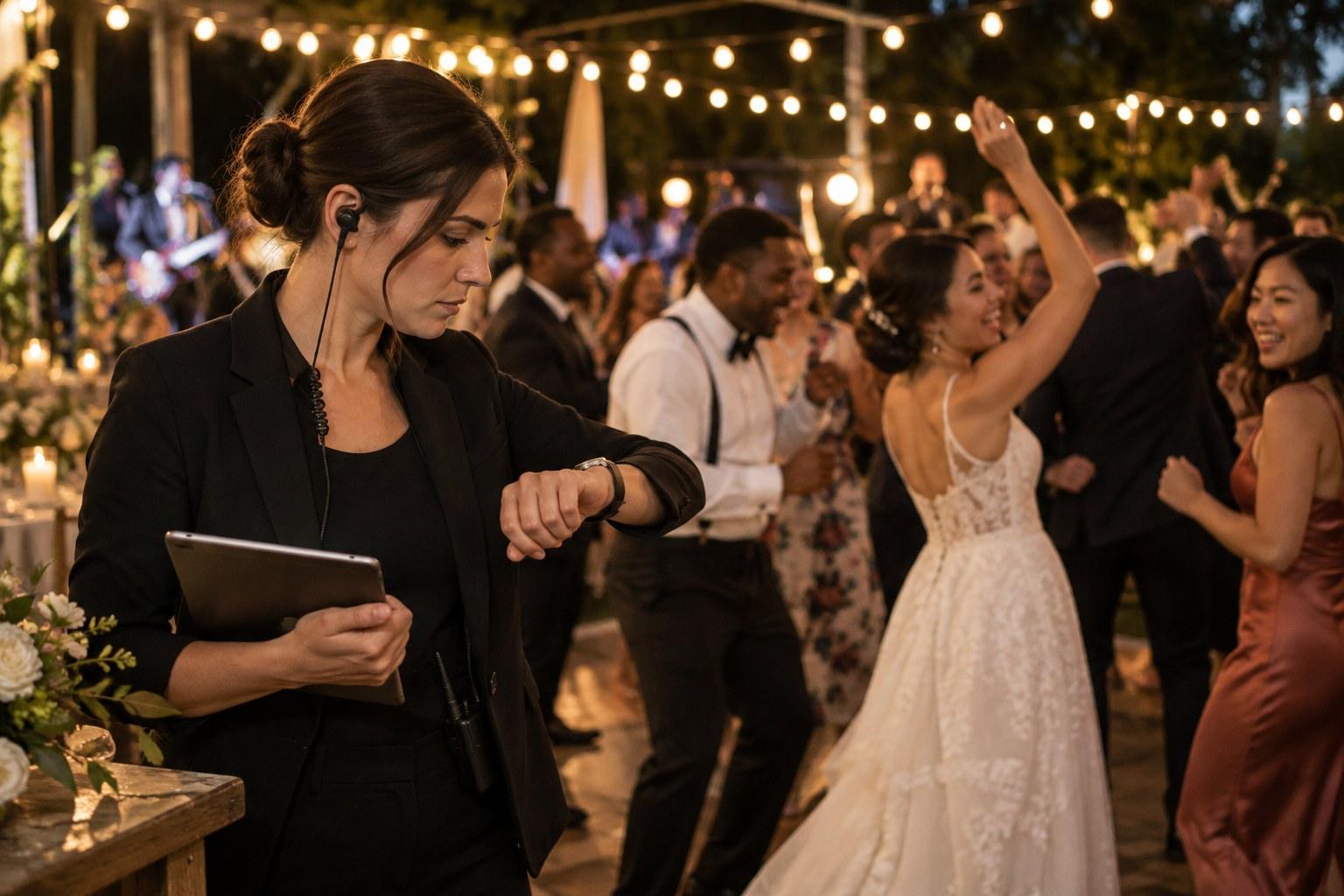
It’s 11:40pm. The band has just been asked for “one more song” for the third time, the venue manager is hovering with a set of keys, and your package officially ended forty minutes ago. You’re still there, because of course you are — you’re not going to walk out on a wedding mid-dance floor.
But here’s the question nobody asks in the moment: who’s paying for this hour? If the answer is “nobody, and it happens every weekend”, you don’t have a hard-work problem. You have a wedding planner overtime problem — and it’s fixable with clearer packages, a fair contract clause and a few kind, confident conversations.
This guide covers overtime on the wedding day itself and the quieter kind that creeps into the planning months — the endless meetings, the scope creep and the 11pm messages.
Why wedding planner overtime happens in the first place
Overtime rarely comes from one dramatic disaster. It usually comes from small gaps you left open months earlier. The most common culprits:
- Vague scope. “Full planning” means something different to every couple. If you haven’t written down what it includes, they’ll assume it includes everything.
- No defined coverage hours. “Wedding day coordination” with no start or finish time is an open invitation to stay until the last guest leaves.
- Timeline slippage. Hair and makeup runs late, the ceremony starts late, speeches run long — and every minute pushes the end of the night further out.
- Vendor delays. A late delivery, a slow bump-out or a hire company that arrives after the agreed pickup time keeps you on site long after the couple has gone.
- Your own soft boundaries. Answering every late-night message instantly teaches couples that you’re always available. Honest, but true.
Notice that almost all of these are preventable before the wedding day. That’s good news — it means the fix is mostly paperwork and communication, not stamina.
How to define coverage hours in your wedding planning packages
You can’t charge for “extra” hours if you never said what the normal hours were. Every package should spell out the boundaries in plain language, so a couple can read it once and know exactly what they’ve bought.
Wedding day start and finish times
State the number of on-site hours, or a clear start and finish point — for example, from bump-in to the end of the formalities, or from bump-in to a fixed clock time. Avoid “until the end of the night”. The end of the night is whenever the last cousin stops dancing.
Number of meetings and site visits
Put a number on planning meetings, venue walkthroughs and vendor meetings. Say whether they’re in person or online, and roughly how long each one runs. Extra meetings aren’t forbidden — they’re simply an add-on.
Response hours for messages and email
Tell couples when you reply — business days, within a stated window — and which channel to use. Keep an emergency line for the final week and the wedding day itself. This one line in your welcome pack quietly kills most of the 11pm messages.
What bump-out actually includes
Bump-out is where hours disappear. Spell out whether you’re packing down your own styling items, supervising vendor pickups, or staying until the venue is fully cleared. If hire companies collect the next morning, say whether you’ll be there for that too.
Structuring packages like this — with real boundaries baked in — is core business practice we cover inside the Certificate in Wedding Planning, because the planners who last are the ones who stop working for free.

How to write a wedding planner overtime clause
An overtime clause isn’t about squeezing couples. It’s about removing the awkwardness, so that when the night runs late, everyone already knows the rules. A good clause usually covers:
- Billing increments. Overtime is charged in set blocks — say, per half hour or per hour — rather than to the minute. It’s simpler to track and simpler to explain.
- Who can authorise it on the day. Nominate one contact — often a parent, a best friend or the couple themselves — who can approve extra time. You don’t want to be chasing a newlywed across the dance floor to ask.
- How it’s confirmed. A quick text or written message from the nominated contact is enough. It protects both of you from “I never agreed to that”.
- When it’s invoiced. Usually after the wedding, as a separate line item, so nobody is handling payment on the night.
- Payment terms. A clear due date for the overtime invoice, matching your usual terms.
- Team overtime. If assistants stay too, say whether overtime applies per person.
One important caveat: contract law differs between countries, states and regions. Use this as a checklist of what to think about, then have your contract reviewed by a local lawyer before you use it with clients.
How to calculate your overtime rate (in principle)
There’s no single “right” overtime rate, and anyone quoting you a universal figure is guessing. Instead, build yours from your own numbers:
- Your hourly value. Take what a package earns you and divide it by the real hours it takes — including admin, travel and planning, not just the wedding day. That’s your true hourly rate, and often a sobering one.
- Team costs. If your assistants are paid by the hour, their overtime is a direct cost to you. Your rate needs to cover it.
- Late-night travel. Finishing late can mean taxis, extra parking, an overnight stay or a long drive home tired. Factor it in.
- The next-day cost. A very late finish can wipe out the following morning. That’s time you can’t sell.
It’s reasonable to set overtime at or above your standard hourly value — it’s unplanned, unsociable and harder on the team. Whatever you land on, make it a number you’d genuinely be happy to receive at midnight.
Overtime triggers, prevention and contract wording
| Overtime trigger | How to prevent it | What your contract should say |
|---|---|---|
| Reception runs past the agreed finish | Confirm the end time with the venue, band and couple in the final run sheet | Coverage finish time, billing increments and who can authorise extra time |
| Delayed ceremony start | Build buffers into getting-ready times and share a firm schedule with hair and makeup | Coverage is a set number of hours or a clock time, not “the whole day” |
| Long or late bump-out | Book vendor pickups in writing and confirm the night before | Exactly what bump-out includes and what happens if vendors arrive late |
| Extra planning meetings | Agenda for every meeting; batch questions into one session | Number of meetings included and the rate for additional ones |
| Scope creep (new tasks added) | Refer back to the package inclusions as soon as a new request lands | A list of inclusions, plus a change process for added services |
| Late-night messages | Share response hours in your welcome pack and use auto-replies | Communication hours and preferred channels |
How to talk about overtime with couples (kindly) at the proposal stage
The best time to talk about overtime is before anyone needs it. Bring it up while you’re walking a couple through your proposal — calmly, briefly, like any other inclusion.
Try something like: “Your package includes coverage from bump-in until the end of formalities. Weddings sometimes run longer — that’s totally normal. If you’d like me and the team to stay on, we charge overtime in set blocks, and your nominated contact can approve it with a quick text. You’ll get a simple invoice afterwards, so you never have to think about it on the night.”
Framed like that, overtime sounds like a service, not a penalty. Couples generally appreciate knowing — what they hate is surprises. If you want help writing proposals and packages that sell without sounding salesy, the Certificate in Wedding Business & Marketing goes deep on exactly that.
What to say when the wedding runs over: on-the-day scripts
When the party’s still going, you need short, warm lines you can deliver without breaking the mood. Find your nominated contact around 30 minutes before your finish time — not at the finish time itself.
- The heads-up: “Everything’s going beautifully! Just a heads-up — our coverage finishes in about half an hour. Would you like us to stay on to look after the send-off and pack down?”
- The confirmation: “Perfect. I’ll send you a quick text now to confirm the extra hour, and it’ll come through on a separate invoice next week.”
- The graceful exit: “No problem at all. The venue team has everything they need, the vendors know their pickup times, and I’ve left the couple’s belongings with you. Have the best night.”
If they say no, leave properly: hand over to the venue manager, brief your contact on what’s left, and go. A clean handover is just as professional as staying.
Protecting your team when weddings run late
Your assistants feel overtime more than anyone — usually on their feet, often without a proper meal. Look after them like the business asset they are:
- Breaks are scheduled, not hoped for. Put them on the run sheet, staggered so the floor is always covered.
- Meals are confirmed with the caterer in advance, including for anyone staying beyond the original finish.
- Safe travel home is planned. Late finishes, tired drivers and quiet car parks are a real risk. Arrange rideshares, pair people up or book accommodation when distances are long.
- Overtime is optional and paid. Ask, don’t assume — and make sure your rate covers what you pay them.

Track your hours with a simple time log
You can’t fix what you can’t see. Keep a basic log for every wedding — a notebook, a spreadsheet or a time-tracking app all work. Record the date, the task (meeting, admin, vendor calls, site visit, wedding day, bump-out) and the time spent.
After a few weddings, patterns jump out. Maybe vendor emails eat far more time than you priced for. Maybe one package type always blows out on meetings. That’s the data you need to adjust your inclusions, raise your prices or tighten your process. Our Wedding Planner’s Handbook ebook is a handy companion for building these kinds of systems into your workflow.
When to absorb overtime as goodwill — and when to charge
Not every extra fifteen minutes needs an invoice. Being a little flexible builds loyalty and referrals. The trick is to choose goodwill deliberately, not by default.
Absorb it when: the overrun is short, it was caused by something genuinely outside the couple’s control, or it was partly your own timeline that slipped. If you do, tell them — “we stayed an extra twenty minutes, no charge” — so the value is seen.
Charge it when: the couple or their family chose to extend, it involved your team staying on, or it’s a pattern rather than a one-off. Generosity that happens every weekend isn’t generosity anymore — it’s an unpriced service.
Want the full toolkit — packages, contracts, run sheets and the confidence to use them? The Certificate in Wedding Planning walks you through planning from first enquiry to final bump-out, and the Advanced Certificate in Wedding Planning, Styling and Business takes you further into pricing and running a sustainable business.
Wedding planner overtime FAQs
Do wedding planners charge for overtime?
Many do, and it’s a normal part of professional practice. The key is defining your included coverage hours in the package, then explaining how extra time is billed before the couple signs — so it’s never a surprise.
How much should a wedding planner charge for extra hours?
There’s no universal figure. Work out your true hourly value from the real hours a package takes, then add your team costs, late-night travel and the knock-on effect on the next day. Set a rate you’d genuinely be happy to receive at midnight.
Who approves wedding planner overtime on the day?
Nominate one contact in your contract — often a parent, close friend or the couple themselves — who can approve extra time. Get their confirmation by text or in writing, then invoice after the wedding.
How do you stop scope creep as a wedding planner?
List your inclusions clearly — number of meetings, response hours, what bump-out covers — and refer back to them as soon as a new request appears. Offer the extra as a paid add-on rather than quietly absorbing it.
Should I put an overtime clause in my wedding planning contract?
Yes — it removes awkwardness on the night. Cover billing increments, who can authorise it, how it’s confirmed and when it’s invoiced. Because contract law varies by location, have a local lawyer review your contract before using it.
Ready to build a planning business with boundaries that protect your time — and your team? Enrol today and start planning like a professional.