Last Updated: November 7, 2026
Quick Summary
To create a wedding floral budget, start with your total wedding budget and set aside 8-10% for flowers as a starting point, then split that share into personal flowers and site flowers. Build a worksheet with quantities and fees, add a 10-15% contingency reserve, and compare florist quotes on all-in totals.
- Most couples spend $500 to $3,000 on wedding flowers, though scope varies widely.
- A bridal bouquet runs $250 to $350, or $500 and up for premium blooms.
- Hold back 10-15% of the floral line for price volatility and substitutions.
- A $1,500 floral budget may skip the arch, aisle flowers and corsages entirely.
- Guest count drives cost through tables, so a 100-guest wedding with round tables of ten needs ten centerpieces.
Table of Contents
- Start With the Total Wedding Budget, Not the Flowers
- A Complete Wedding Flower Cost Breakdown
- Use a Wedding Floral Cost Estimator Before You Request Quotes
- Building a $1,500 Wedding Flower Budget Line by Line
- The Average Cost of Wedding Flowers for 100 Guests
- Fees Beyond the Flowers: What Florist Quotes Leave Out
- How to Compare Florist Quotes and Negotiate Without Losing Quality
- Learn to Build Floral Budgets for Paying Clients
- Frequently Asked Questions
Start With the Total Wedding Budget, Not the Flowers
Most couples start with the flowers. Once the total is clear, you can decide how much belongs to flowers and where budget-friendly wedding decor can help the rest of the celebration feel cohesive.
Most couples spend $500 to $3,000 on wedding flowers, according to Fallon’s Flowers’ guide to wedding flower budgets. That range is wide because scope varies so much.
At The Wedding Academy, we teach planners to set the total budget first, then carve out the floral share. It keeps every other line item honest.
The Percentage Rule and Why It Fails Some Couples
The common advice is to set aside 8-10% of your total budget for flowers. Junebug Weddings’ floral budget guidance notes that this is only a rule of thumb, and every wedding is different.
It fails because a garden venue needs fewer installations than a blank hall, and a flower-heavy vision costs more than a minimalist one.
Use the percentage as a starting point, not a law:
-
8-10%: a sensible default for most weddings
-
Under 8%: realistic if your venue already has strong greenery
A Complete Wedding Flower Cost Breakdown
A wedding flower cost breakdown has two halves: personal flowers and site flowers. Personal flowers are the bouquets and boutonnieres. Site flowers cover the ceremony, reception and tables.
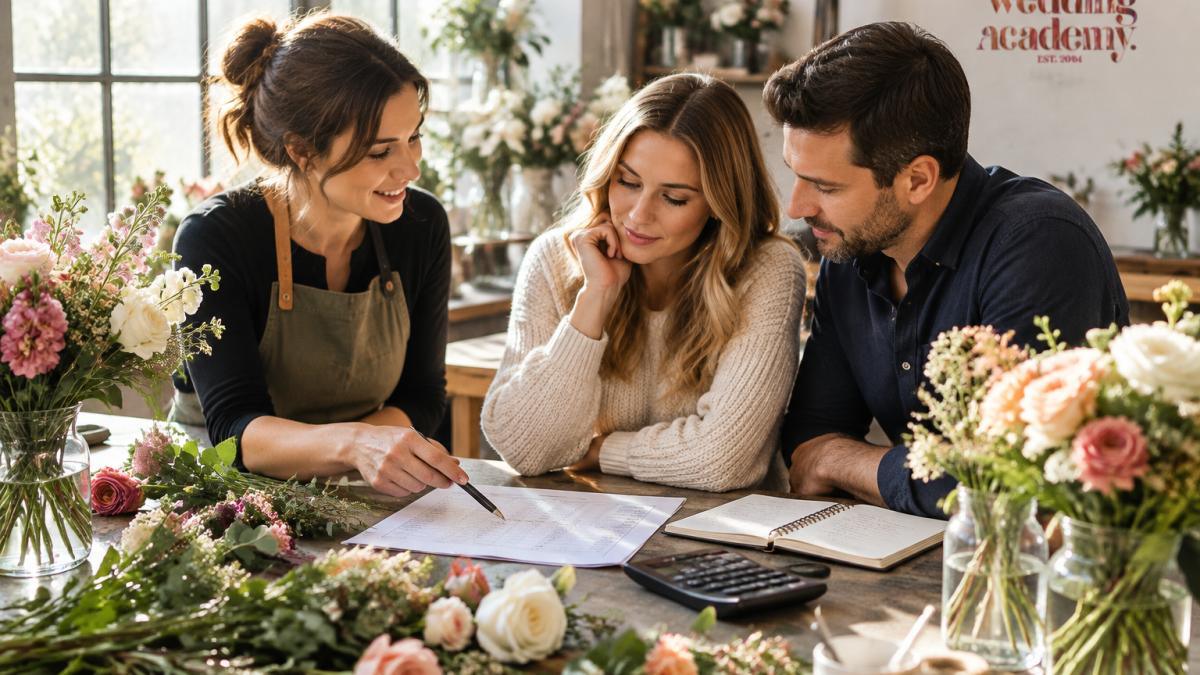
Budget both halves separately. Couples who lump them together tend to overspend on bouquets and run short on centerpieces.
Personal Flowers: Bouquets and Boutonnieres
The bridal bouquet is the single most photographed arrangement of the day. A Zola wedding flower pricing guide puts a bridal bouquet at $250 to $350, or $500 and up for premium blooms.
Then add:
- Bridesmaid bouquets: smaller, but multiplied by your party size
- Boutonnieres: one per partner, groomsman and usher
- Corsages: for mothers and grandmothers
Count the people before you fall in love with a bouquet design. Five bridesmaids changes the math fast.
Ceremony, Reception and Table Flowers
Site flowers are where budgets quietly balloon. The list includes:
- Aisle flowers or pew markers
- An arch or backdrop
- Reception centerpieces, one per table
Centerpieces multiply by guest count, so this is the line to watch. Repurposing ceremony flowers at the reception is one of the simplest ways to stretch the budget.
If you want to see which floral looks are driving demand right now, our guide to wedding design trends for 2026 is worth a read before you finalize your style.
Use a Wedding Floral Cost Estimator Before You Request Quotes
A wedding floral cost estimator turns your wish list into a rough all-in number before any florist quotes you. Build one in a spreadsheet, and you walk into every conversation prepared, able to compare proposals on equal terms instead of reacting to headline totals.
Build the Worksheet in Two Blocks
Split the worksheet into two blocks: the flowers themselves, and everything attached to delivering them. Couples who track only stems are the ones surprised by the final invoice.
Block 1, Arrangements and quantities:
- Bridal bouquet (1)
- Bridesmaid bouquets (one per attendant)
- Boutonnieres (one per partner, groomsman, usher, and often fathers)
Block 2, Fees beyond the flowers:
- Delivery (often charged per trip; installations may need two)
- Setup and teardown labor
- Design and on-site labor hours
A Fill-In Template You Can Copy
| Line Item | Quantity | Est. Cost Each | Line Total |
|---|---|---|---|
| Bridal bouquet | 1 | $300 | $300 |
| Bridesmaid bouquets | 4 | $85 | $340 |
| Boutonnieres | 6 | $25 | $150 |
| Corsages | 2 | $35 | $70 |
| Ceremony arch | 1 | $450 | $450 |
| Aisle markers | 6 | $40 | $240 |
| Centerpieces | 10 | $95 | $950 |
| Bar and cake accents | 2 | $60 | $120 |
| Delivery | 1 | $150 | $150 |
| Setup and teardown | 1 | $200 | $200 |
| Rentals | 1 | $175 | $175 |
| Service charge (if applicable) | 1 | $120 | $120 |
| Tax (estimate) | 1 | $180 | $180 |
| Contingency reserve | 1 | $250 | $250 |
| Estimated all-in total | $3,695 |
Fill in your own quantities and price ranges. The total will not be exact, but it tells you whether your vision fits your budget before you waste anyone’s time, and gives you a number to compare against real quotes.
Add a Contingency Reserve
Hold back 10-15% of the floral line for price volatility. Seasonal availability shifts, supply changes, and substitution policies can move a quote between the site visit and the final order. A reserve keeps a small swap from becoming a budget overrun.
When comparing quotes, check whether delivery, setup or rentals are included, and compare all-in totals rather than the headline number.
Normalize Quotes Before You Compare
Two florists can quote the same number for very different scopes. Before you choose, ask each for an itemized proposal and line them up side by side:
- List every arrangement, quantity, and stem type.
- Add delivery, setup, rentals, service charge, and tax to each column.
- Note any line marked “market price” or “seasonal” and ask for a range.
- Check the substitution policy, what happens if a stem is unavailable?
- Confirm payment terms and the deposit schedule.
- Compare the all-in totals, not the flowers-only subtotals.
This checklist is the single most useful habit in floral budgeting: it turns a stack of proposals into an apples-to-apples comparison and gives you a fair basis for negotiating on scope rather than price alone.
Building a $1,500 Wedding Flower Budget Line by Line
A $1,500 wedding flower budget is tight but workable. It forces choices, and that is useful. Here is one way to split it:
Notice what is missing: no arch, no aisle flowers, no corsages. A budget this size rewards focus.
Two levers can help it stretch further. Choose seasonal, local flowers, and ask your florist which stems give the most volume for the price.
Doing your own flowers is an option, though it costs time and labor instead of money.
The Average Cost of Wedding Flowers for 100 Guests
The cost of wedding flowers for 100 guests depends on three things: table count, style, and venue. Guest count drives cost through tables, not people. A 100-guest wedding with round tables of ten needs ten centerpieces; long banquet tables may need fewer, larger arrangements. That is why two 100-guest weddings can land hundreds or thousands of dollars apart.
Three Scenario Budgets for 100 Guests
Most practitioners find it useful to sketch three scenarios before requesting quotes. Use your own local prices when you build a scenario.
Scenario A, Minimalist, garden venue (flowers as accent):
- Bridal bouquet: $200
- Two bridesmaid bouquets: $120
- Four boutonnieres: $80
Scenario B, Classic, blank hall (flowers as centerpiece):
- Bridal bouquet: $300
- Four bridesmaid bouquets: $340
- Six boutonnieres: $150
- Ten mixed-bloom centerpieces: $950
Scenario C, Lush, flower-forward (flowers as the design):
- Bridal bouquet: $450
- Five bridesmaid bouquets: $500
- Eight boutonnieres and corsages: $280
- Ten full centerpieces plus hanging pieces: $2,200
These scenarios show the mechanism behind the averages: table count sets the centerpiece line, venue sets the installation line, and style sets the per-arrangement price.
Adjust for Venue and Table Shape
- Garden or outdoor venue: fewer installations needed; greenery may already be in place, lowering the ceremony line.
- Blank hall or ballroom: more installation and rental costs; arches, stands, and lighting accents add up.
- Round tables of ten: one centerpiece per table; ten tables means ten arrangements.
- Long banquet tables: fewer, larger arrangements; per-table cost rises but table count falls.
For a real-world benchmark, Soul Flora Design’s sample wedding floral budgets walks through five New England weddings, including one totaling $15,925 plus tax. That figure shows what a flower-forward wedding can cost at the top end, and why scenario planning matters before you fall in love with a lush look.
A per-guest rule of thumb can ignore table count and venue, so treat it with caution.
Fees Beyond the Flowers: What Florist Quotes Leave Out
The flowers are rarely the whole invoice. This is where a carefully built budget springs a leak.
Fees to check on every quote:
- Delivery fee: often charged per trip, and installations may need two
- Setup and teardown: labor for installing arches and hanging pieces
- Labor costs: design time and on-site hours
- Rental costs: vases, stands, arches and candles
Ask for an all-in total, not a flowers-only total. The difference can be several hundred dollars.
How to Compare Florist Quotes and Negotiate Without Losing Quality
Comparing quotes properly means normalizing them first. Two florists can quote the same number for very different scopes.
Follow this method:
- Ask each florist for an itemized quote, not a lump sum
- List every arrangement, quantity and stem type side by side
- Add delivery, setup, rentals, service charge and tax to each
- Compare the all-in totals, not the headline figures
- Flag any line marked “market price” or “seasonal”
Then negotiate on scope, not just price. Ask what could be swapped for a seasonal stem, or which arrangement could shrink without losing impact.
Pricing conversations go better when both sides are clear on scope from the start. Our guide to managing wedding client expectations covers how to keep those talks calm and productive, whether you are the couple or the planner.
Learn to Build Floral Budgets for Paying Clients
Budgeting is one of the most valuable skills you can learn if you want to work in weddings.
That is the gap our Certificate in Floral Design is built to close. It covers budgeting, supplier management and installations, delivered online and self-paced.
Kelsey Reiersen of Stone & Co.
If you want to go further, our online floral design courses guide compares options for building this skill. And if you are thinking about turning it into income, our guide to pricing wedding planning services and our walkthrough on starting a wedding business with no experience both cover the money side in detail.
Flowers are one of the wedding costs you can shape through careful planning.
Frequently Asked Questions
What is a realistic floral budget for a wedding?
Wedding flower budgets vary widely by guest count and style. A common starting point is 8-10% of the total wedding budget, a figure Junebug Weddings calls a rule of thumb rather than a fixed rule. A Connecticut floral designer told The Knot that couples who treat flowers as a priority may need to allocate closer to 15%. Build your wedding floral budget from the arrangements you actually want, then check the total against these benchmarks.
What is the 3-5-8 rule for wedding flowers?
The 3-5-8 rule is a planning shorthand for spreading floral spend across three tiers of importance: roughly 30% on the pieces guests see most (ceremony backdrop, head table), 50% on high-visibility arrangements like centerpieces, and 20% on smaller accents such as boutonnieres and aisle markers. When you build your wedding flower cost breakdown, adjust the split to match your venue and the moments you care about most.
How can you reduce the cost of wedding flowers?
Three levers move a wedding floral budget the most. First, choose seasonal, locally available flower varieties, which cost less than out-of-season imports. Second, repurpose ceremony flowers at the reception, for example moving aisle arrangements to the head table. Third, trim the guest list of tables rather than the quality of each centerpiece. DIY flowers are another route:
How much do people spend on flowers for a 200 person wedding?
A 200-guest wedding needs roughly 20 to 25 tables, and table flowers are usually the largest line in the budget. Rather than guessing, use a wedding floral cost estimator: multiply your table count by your target per-arrangement cost, add personal flowers and ceremony items, then add delivery, setup and service charges.