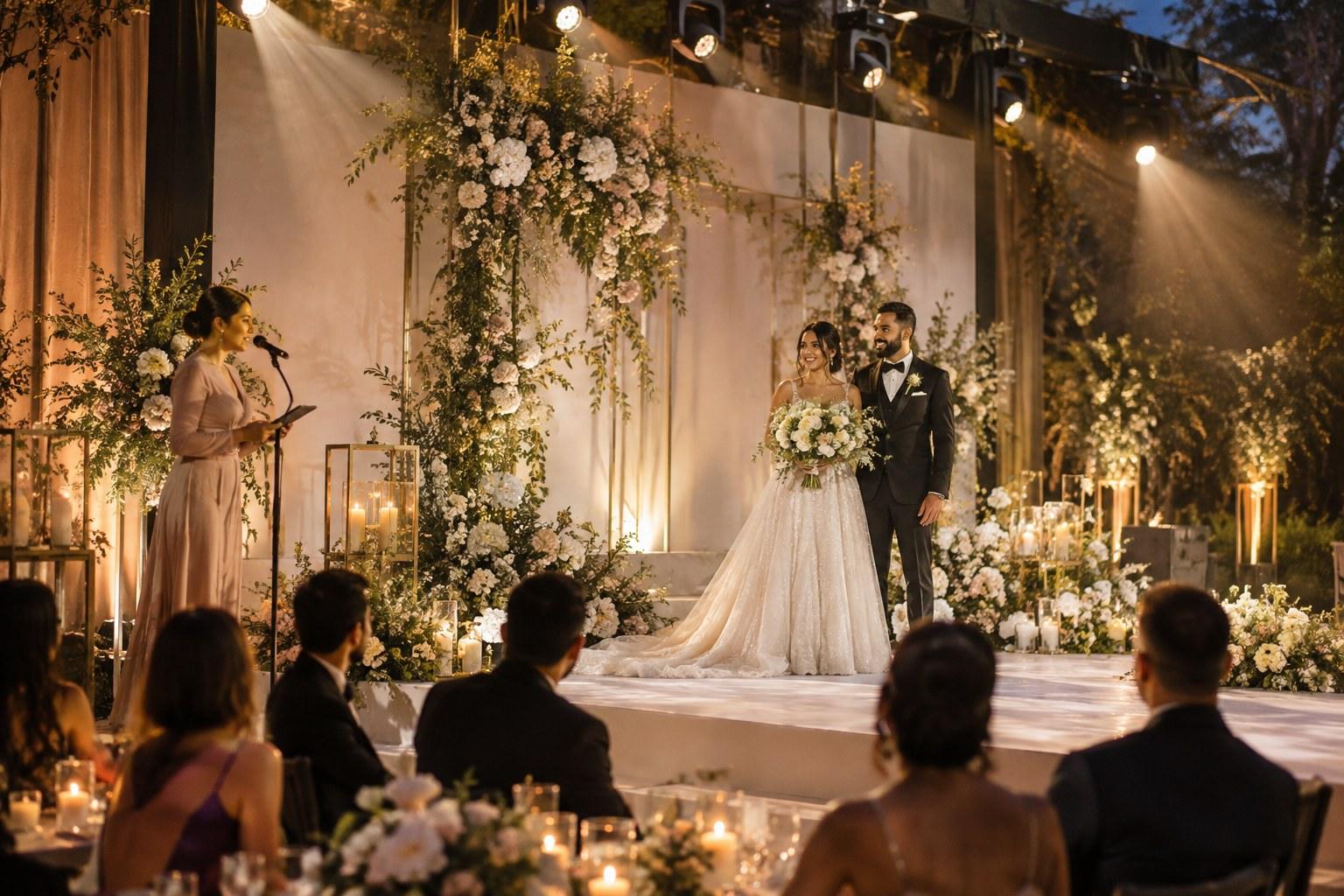
You spent months curating the texture of the linen, the curve of the arch, and the exact tone of the florals, but the moment the room lights up, your hard work vanishes. Poor wedding stage lighting styling can instantly flatten a meticulously planned focal point, turning a high-end design into a washed-out blur. Lighting is not an afterthought handled by the venue technician at the last minute; it is a fundamental pillar of spatial design that dictates how every element is perceived by guests and captured by cameras. When you walk into a blank-canvas ballroom or a historic industrial loft, the structural lighting is the invisible skeleton holding your entire concept together. If that skeleton is weak, crooked, or poorly proportioned, the whole aesthetic collapses under scrutiny. Stylists who ignore lighting mechanics often wonder why their physical mood boards look vibrant in a studio setting but feel lifeless and flat on-site. The secret lies in understanding how light behaves in real-world environments, dealing with unpredictable venue limitations, and treating illumination as your primary design medium rather than a mechanical utility.
When you approach a venue, you have to treat illumination as your primary design medium from the initial concept phase onward. If you rely solely on overhead house lights or single-direction spotlights, you are letting technical oversight dictate your aesthetic outcome. Great design requires intention from the ground up, merging architectural awareness with lighting placement that flatters both the couple and the curated backdrop. Every shadow cast, every highlight emphasized, and every color temperature chosen tells a visual story. When lighting is integrated into your styling workflow early, you can coordinate directly with technicians to ensure that pin-spots land precisely on floral arrangements, that backdrops catch a gentle rear glow, and that guests are bathed in flattering illumination rather than harsh, direct glares. This level of coordination separates amateur decor setups from professional, high-end styling productions.
Let us look at where stylists frequently go wrong with stage and backdrop setups, how light interacts with different textures, and the practical adjustments you need to make to elevate your visual execution across every type of venue setup. From understanding the dangers of ambient light contamination to mastering color temperatures and spatial separation, we will break down the exact technical adjustments required to keep your designs looking sharp, intentional, and breathtaking from every angle.
Why Your Wedding Stage Lighting Styling Falls Flat
The most common failure in modern design execution is treating illumination as a utility rather than an aesthetic tool. You might have an incredible installation, but if the light source is poorly positioned, it creates harsh shadows, washes out color saturation, and highlights structural flaws in the venue rather than your focal point. Too many stylists design exclusively for daylight or static mood boards, forgetting that once evening arrives, the room’s entire visual ecosystem shifts dramatically.
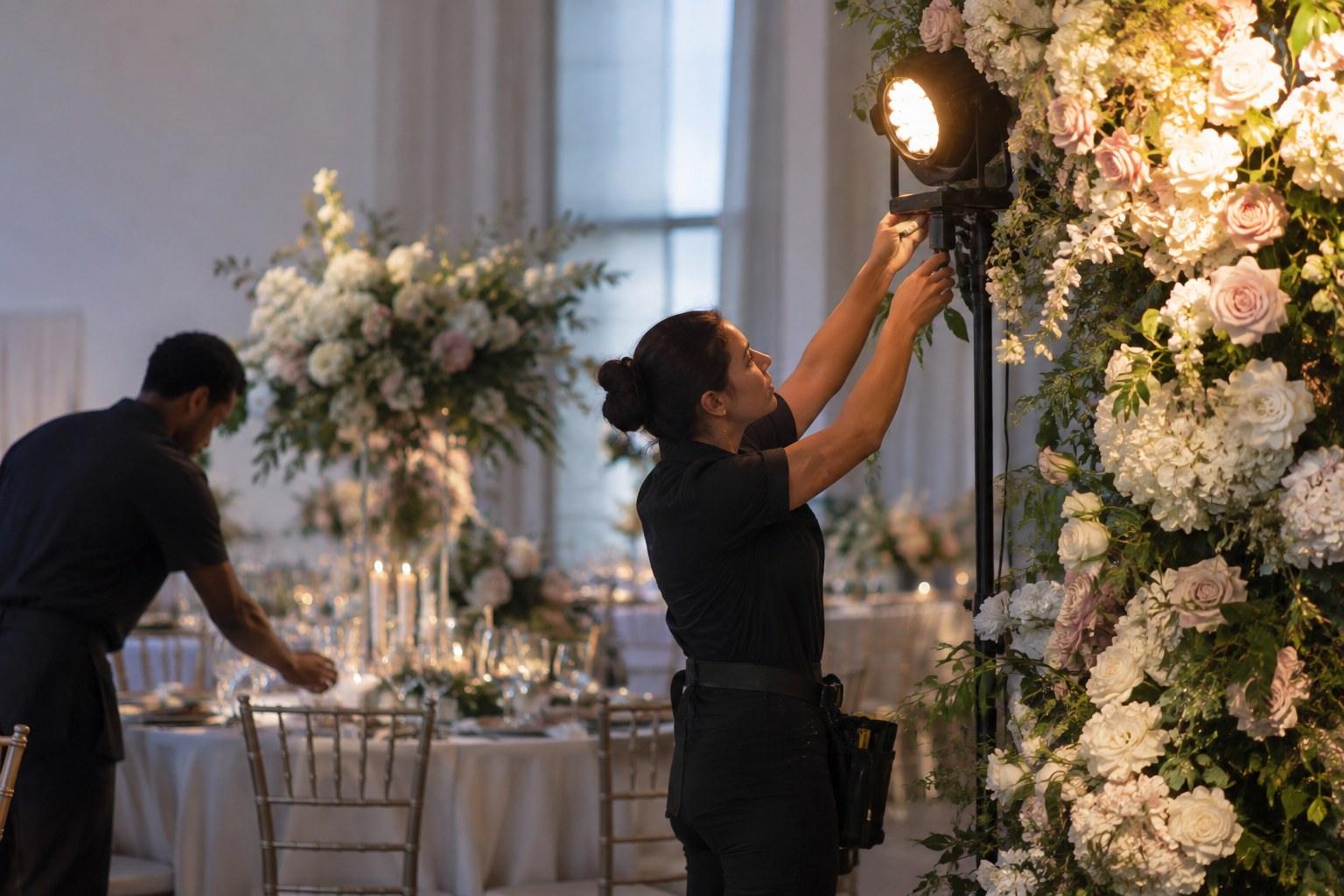
When you fail to account for how light interacts with physical distance, beam angles, and power sources, you leave your design vulnerable to unpredictable venue quirks. A beautiful floral arch can easily be plunged into darkness or cast in an unflattering amber glare if the lighting fixtures are rented and placed without precise spatial mapping. You must take an active role in directing where light falls, how bright it shines, and what mood it projects across the entire focal area.
Over-reliance on Ambient Room Light
Venues love to keep their ambient overhead lights on because it makes cleaning and moving around easier for staff, and frankly, it requires less technical management. For a stylist, it is a disaster. High ambient light completely neutralizes pin-spotting and washes out carefully calibrated backdrops. You have to take control of the venue’s electrical plan and negotiate house light dimming schedules before the celebration begins. If the room is flooded with bright, neutral light, your carefully layered lighting cues will be entirely invisible, rendering hours of precise styling work completely pointless.
Negotiating lighting control requires confidence and clear communication with venue coordinators. You need to establish exact timelines for when house lights must drop to specified percentages, allowing your theatrical or architectural lighting to take center stage. Without this pre-planned dimming schedule, your moody candlelit tablescapes and precisely lit backdrops will compete with harsh fluorescent or institutional ceiling cans, destroying the intimate atmosphere you worked so hard to build.
The Trap of Flat Frontal Washes
Slapping a pair of generic white wash lights on either side of the stage creates a flat, clinical look that resembles a corporate conference rather than an intimate celebration. People do not look natural under direct frontal lighting; it erases facial features, removes depth from textured backdrops, and flattens out intricate floral arrangements until they resemble two-dimensional paintings. Instead, you need dimensional lighting that sculpts the space, using side lighting, subtle cross-illumination, and backlighting to create rich layers of depth.
Dimensional lighting relies on angles. By positioning key lights at forty-five-degree angles relative to the focal subject, you introduce soft, natural shadows that define facial structures and emphasize the three-dimensional curves of your backdrop architecture. This technique transforms a static stage into a dynamic, engaging visual landscape that commands attention without overwhelming the senses.
Balancing Backdrop Textures and Luminescence
Different materials absorb and reflect light in radically different ways. A design element that looks stunning in natural daylight can completely fail under specific colored gels or harsh LEDs. You must match your lighting strategy directly to the physical properties of your backdrop materials, ensuring that light enhances rather than compromises your chosen textures.
Consider how light behaves across various standard surfaces used in focal installations:
| Backdrop Material | Light Reflection Profile | Recommended Lighting Approach |
|---|---|---|
| Raw Wood & Timber | Absorptive, warm tones | Use warm directional spots to highlight grain and natural knots without creating glare. |
| Acrylic & Glossy Panels | High reflection, prone to hot spots | Avoid direct frontal spots; use edge lighting or soft rear wash to prevent blinding reflections. |
| Velvet & Heavy Draping | Deep absorption, heavy shadows | Layer with intense grazing light from above or below to emphasize folds and rich texture. |
| Live Greenery Walls | Semi-reflective, uneven surface | Diffuse neutral lighting to prevent dark leaf shadows from looking patchy and chaotic. |
Understanding these material interactions prevents expensive design errors on site. When working with complex floral installations, for instance, consulting with specialized disciplines or expanding your knowledge base through comprehensive training ensures that every element—from petals to timber frames—receives optimal illumination.
Temperature Clashes: Warm vs. Cool Tones
Nothing ruins a cohesive color palette faster than a mismatch in color temperatures. Mixing a warm, candlelight-inspired palette with cold, blue-toned LED backdrops creates an immediate visual jarring effect that disrupts the entire aesthetic harmony of the room. You need to standardize your Kelvin ratings across all fixtures to maintain professional consistency.
When selecting uplighting or pin-spots, ensure they sync with the existing venue architecture and your chosen floral tones. A warm white around 2700K to 3000K usually flatters skin tones and organic textures, whereas anything creeping past 4000K starts feeling clinical and sterile. Master these nuances by building formal competency through structured education like the Certificate in Wedding Styling, where spatial mechanics and technical execution are broken down systematically.
Furthermore, color temperature influences emotional resonance. Warm lighting fosters intimacy, conversation, and a sense of cozy luxury, while cooler temperatures can drain warmth from organic elements like wood, linen, and blooms. Maintaining strict control over your Kelvin spectrum ensures that your design narrative remains intact from the moment guests enter the room until the final dance.
Common Wedding Stage Lighting Mistakes to Avoid
Fixing your lighting errors starts with auditing your current planning checklist. Here are the recurring traps that undermine structural designs across international venues:
- Ignoring camera sensor reactions: What looks balanced to the naked eye can blow out completely on digital camera sensors if the light intensity is dialed too high or concentrated in a single hotspot.
- Forgetting background separation: Placing the couple directly against a solid backdrop with no backlight makes them blend into the wall, losing all visual definition in wide-angle photographs.
- Neglecting cable management: Exposed cords running across a focal stage ruin the illusion of effortless luxury, regardless of how good the lighting design looks on paper.
- Failing to test during twilight shifts: Ambient light changes drastically over the course of an evening; a setup that works at dusk might look blindingly bright an hour later if not programmed for gradual dimming.
- Overusing saturated color gels: Bathing a stage in deep primary colors distorts floral colors, making gorgeous blush roses look muddy and natural greenery look unnaturally neon.
Bridging the Gap Between Planning and Styling
Lighting decisions rarely sit in a vacuum. They intersect with every logistical choice made during the initial layout phase, from electrical power distribution to floor plan traffic flow. If you want to understand how spatial flow and structural design interact seamlessly, pairing your design knowledge with comprehensive logistical training is essential. Explore programs like the Certificate in Wedding Planning to master the broader operational picture that supports your aesthetic vision.
When stylists understand the logistical constraints of power draws, rigging points, and vendor coordination, they avoid last-minute compromises on-site. Knowing how to communicate technical requirements to lighting technicians ensures that your creative vision translates accurately from concept to reality, eliminating friction between design ambitions and venue limitations.
Mastering Professional Stage Design
Ultimately, stunning wedding stage lighting styling is about restraint, precision, and technical awareness. You do not need an arena-sized rig to make an impact; you need a clear understanding of how beam angles, color temperature, and physical textures interact under professional scrutiny. Take control of the technical elements of your designs, collaborate closely with your technical crew, and ensure every visual masterpiece you build is illuminated the way it deserves to be.
Elevate your professional capabilities, refine your technical eye, and master the intricate details of spatial design today through the Certificate in Wedding Styling. Your designs deserve to shine without compromise.
FAQs
How do I prevent wedding stage lighting from washing out backdrop details?
Prevent wash-out by avoiding flat frontal spotlights and instead using directional pin-spots or grazing light from angles that highlight surface textures. Collaborating with technicians to dim ambient room light also preserves the contrast needed to make backdrops pop.
What is the best color temperature for wedding stage lighting?
A warm white color temperature between 2700K and 3000K is ideal for flattering skin tones and organic floral textures. Avoid going past 4000K, as higher Kelvin ratings introduce sterile, clinical tones that clash with intimate event designs.
How can stylists coordinate effectively with venue lighting technicians?
Share detailed lighting maps and cue sheets well in advance of the event setup. Clearly communicate your requirements for house light dimming schedules and specific beam angles to ensure your aesthetic vision is executed correctly on-site.
Why does my floral installation look different under venue lighting compared to daylight?
Artificial lighting sources alter color saturation and shadow depth, often shifting warm floral tones into muddy or washed-out shades. Testing your color palette under similar lighting conditions beforehand helps you anticipate and adjust for these visual shifts.