Quick Summary
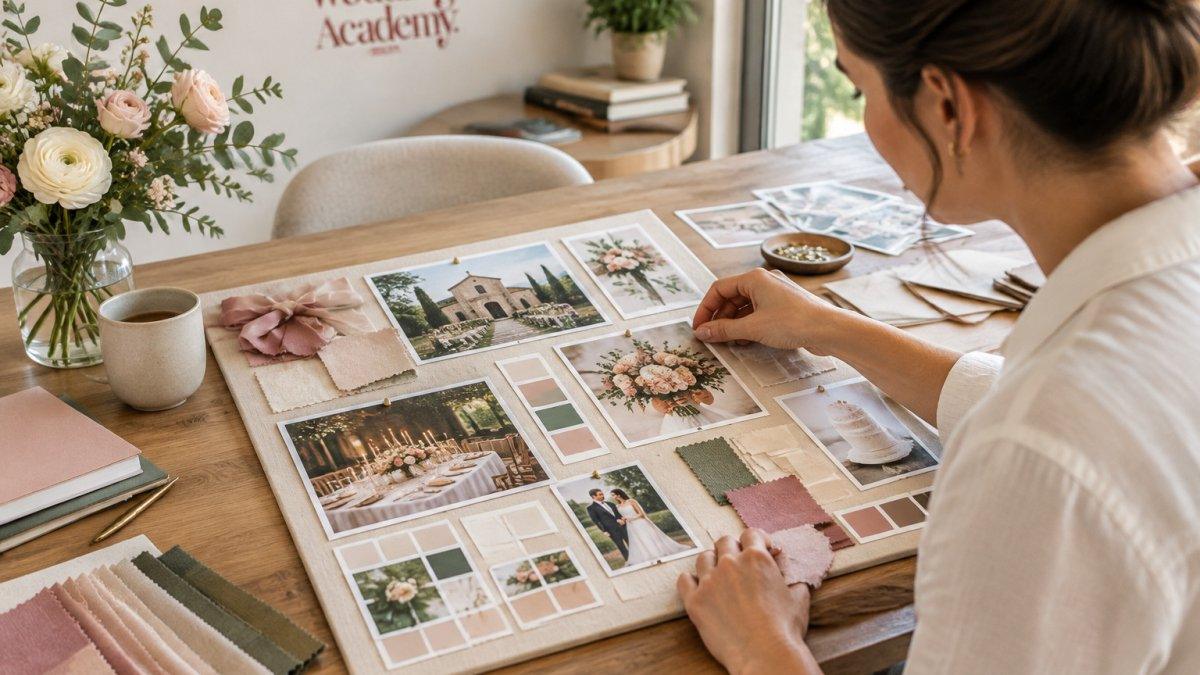
A wedding mood board is a collection of images, colours, textures and objects that shows the look and feel of your wedding in one place. To build one for a small venue, agree on your style with your partner, choose a tight three-to-five colour palette, collect inspiration from venues close to your size, and check every image against your real room.
- Agree on a style and write it in two or three words with your partner.
- Pick three to five colours, with light tones to help a small room feel bigger.
- Collect 30 to 50 inspiration images and organise them in Canva by category.
- Measure the room and add a fit check with walkway widths and table count.
- Photograph the empty room and place those photos beside your inspiration images.
Table of Contents
- What a Wedding Mood Board Is and Why a Small Venue Needs One
- Agreeing on Your Wedding Vision and Style With Your Partner
- Choosing a Wedding Color Palette for a Small Venue
- Collecting Inspiration Images and Organising Them in Canva
- Small Wedding Venue Decor Ideas That Visually Expand a Room
- Planning Scale, Layout and Guest Count Around Your Board
- Using a Wedding Mood Board Template and Finalising Your Board
- Frequently Asked Questions
What a Wedding Mood Board Is and Why a Small Venue Needs One
A wedding mood board is a collection of images, colours, textures and objects that shows the look and feel of your wedding in one place. It is a visual reference you can share with your partner, your venue and your suppliers. For a small venue, the board matters even more, because every decision has to fit a smaller room.
Couples often love a Pinterest feed full of grand ballrooms, then realise their barn or garden room cannot hold the same layout. A mood board built for a small venue solves that early.
Here is the core idea: a wedding mood board is a planning tool, not a decoration. Its job is to answer three questions before you book a single florist. What does the day feel like? What colours and textures repeat? What will actually fit in this room?
- Shared direction: Partners and family see the same vision.
- Better vendor briefs: Florists, stylists and caterers get clear reference images.
- Fewer costly changes: You spot scale problems before you order rentals.
Watch out: some couples build a board from large-venue inspiration and then discover the centrepieces block the view across the table. Check every image against your real room size before you treat it as a final choice.
Agreeing on Your Wedding Vision and Style With Your Partner
Before you pin a single photo, sit down together and talk about what matters most. Ask each other which moments you want guests to remember and which details you could skip. Learn how professionals manage differing client expectations to keep decisions aligned. Write the answers down so you can return to them later.
Many couples find that one partner leans romantic and the other leans modern. That gap is normal. A good board holds both styles and shows where they meet, such as soft candlelight with clean, minimal table settings.
Try this simple exercise together:
- Each partner picks five images that feel right, with no explanation needed.
- Sort the images into groups: “yes”, “maybe” and “no”.
- Look at the “yes” pile for repeated colours, shapes and moods.
- Name the style in two or three words, such as “warm rustic garden”.
Set a decision deadline for the style. Once the words are agreed, everything you add to the board should match them, which keeps the board focused and stops it turning into a random collection of pictures. See how a certified wedding stylist works through a couple’s vision step by step. If you want a deeper grounding in how styling decisions like these work across a whole event, the Certificate in Wedding Styling is one place to look.
Choosing a Wedding Color Palette for a Small Venue
A colour palette is the easiest way to make a small room feel calm and connected. Pick three to five colours: one main neutral, one or two accent colours and one metallic or texture tone. Keep the palette tight, because too many colours make a small space feel busy.
Light colours help a small room feel bigger. Ivory, pale sage and soft blush reflect light and make walls and ceilings seem higher. Use darker shades in smaller doses, such as a deep green runner or navy napkins, so they add depth without closing the room in.
Test your palette before you commit. Print colour swatches or use a free palette tool, then hold them against your venue’s floor, walls and natural light at the time of your ceremony. A colour that looks bright in a photo can look dull under the venue’s lights.
- Neutral base: Ivory, cream or warm white for linens and walls.
- Accent colours: Two shades that repeat across flowers, stationery and details.
- Finish tone: Brass, gold, copper or natural wood for a consistent thread.
Collecting Inspiration Images and Organising Them in Canva
Start collecting images once your style and palette are set. Save photos from real weddings at venues close to your size. Sites like Pinterest make this easy, but you can also save screenshots or print photos from magazines.

A couple sitting side by side at a bright kitchen table, laptop open showing a wedding inspiration board of pinned photos, printed swatches and fabric samples spread nearby. They are of mixed backgrounds.
Once you have 30 to 50 images, move them into Canva. To see how a planner builds styled work to draw on, read how to build a wedding planning portfolio.
Group your images by category, such as “ceremony”, “tables”, “florals” and “lighting”. Label each group with a short note about what you like. A board organised this way is far easier for a vendor to read than a long, unsorted pile.
Small Wedding Venue Decor Ideas That Visually Expand a Room
Before you collect decor inspiration, document what the venue already gives you.
With that record in hand, choose decor that works with the room rather than against it. The same restraint applies to wall decor, where choosing art for small spaces means favoring a few well-scaled pieces that echo the palette without competing with the room’s vertical lines.
Match each idea to a restriction before it goes on the board. If the venue forbids wall fixings, replace hanging garlands with freestanding arches or floor-standing screens. If open flames are not allowed, note LED candles and battery-powered fixtures instead.
Budget follows the same logic. In a small room, quantities are low but visibility is high, so it helps to spend on the pieces guests will actually see and touch: the table setting, the ceremony focal point, and the lighting.
A short venue-aware decor checklist for the board:
- Fixed features photographed and noted as keep, cover, or ignore
- Venue restrictions listed: fixings, flames, setup times, included items
- Vertical or reflective elements chosen to expand the sense of space
- One clear focal point selected, with the rest of the room kept calm
- Multipurpose or rental-friendly pieces prioritised
- Quantities and rental list matched to the floor plan
Watch out: a single oversized installation can overwhelm a low-ceilinged room and make it feel smaller, so test the height of any hanging piece against the ceiling measurement before you commit.
Finally, add one annotated example to the board: a photo of the real room, a simple sketch of the chosen focal point, the palette swatches, and three notes on what was kept, covered, or added. That single page communicates more to a florist or stylist than a dozen unlabelled inspiration images, and it keeps every later decision tied to the space you actually have. For florals in particular, the Certificate in Floral Design is a useful next step if you want to plan arrangements that suit a compact room.
Planning Scale, Layout and Guest Count Around Your Board
A small-venue mood board only becomes useful when it carries numbers. Most inspiration boards show pretty tables with no dimensions, so couples order rentals that arrive too wide for the room.
Start with a measured floor plan. Ask the venue for a dimensioned drawing, or measure the room yourself with a laser measure and note door widths, ceiling heights, and any fixed features.
Next, convert the plan into board annotations. Under each layout image, add a short note with the table count, the guest number it serves, and the walkway width it leaves.
Guest count drives the rest. For a wedding of around 40 guests, several round tables or a couple of long tables are common starting points.
Include a small “fit check” block on the board itself with these items:
- Room dimensions and ceiling height noted
- Table count and shape matched to confirmed guest list
- Walkways at least 90 cm, main routes 1.2 metres
- Door and service access widths checked against rental items
- Ceremony-to-dinner reset time and chair storage marked
- Decor heights noted so sightlines stay open
Finally, photograph the empty room from the same angles you plan to use on the day, and place those photos beside your inspiration images.
The table below pulls together the measurable checks the article recommends when fitting a board to a small room.
| Check | Target | Note |
|---|---|---|
| Walkway width | At least 90 cm | Main routes need 1.2 metres |
| Main route width | 1.2 metres | Keep clear for servers and guests |
| Guest count planning | Around 40 guests | Several round tables or long tables |
| Ceiling height | Measured and noted | Test hanging pieces against it |
| Door and service access | Measured and noted | Check against largest rental item |
| Ceremony-to-dinner reset | Time and storage marked | Plan for chair storage zone |
| Room layout | Drawn to scale | Use true-size furniture blocks |
Using a Wedding Mood Board Template and Finalising Your Board
A template keeps your board consistent. Use a layout with fixed sections for style words, palette swatches, key images, florals, lighting and the venue layout. Fill each section in order so nothing is missed.
Once the board is built, review it with your partner and then share it with your main suppliers. If you are planning to work with suppliers professionally, the Wedding Planner’s Handbook is a helpful reference for how planners structure these vendor conversations.
Many couples print a mini version of the board to bring to vendor meetings. A small, clear board keeps everyone on the same page and makes decisions faster. Once it is finalised, your board becomes the reference point for every choice that follows.
Last Updated: November 15, 2026
Ready to turn your own wedding styling ideas into a professional skill? The Wedding Academy offers self-paced certificate courses in wedding styling and planning, so you can build your board knowledge into a working career. Browse the courses to find the right starting point for you.
Frequently Asked Questions
How do you create a mood board for a wedding?
Start by gathering 30 to 50 inspiration images from Pinterest or saved photos, then sort them into groups by mood, colour and setting. Look for patterns: the images you return to most often reveal your real preferences. Add a palette of three to five colours, a few texture or material swatches, and one or two notes on what you want the day to feel like. Keep the board to a single page or screen so it stays easy to share with vendors and your partner.
How many images should a wedding mood board have?
Most couples find that 15 to 25 images is enough to communicate a clear direction, while a larger collection of 30 to 50 works well as a working gathering board before you edit it down. The goal is consistency rather than volume. If images pull in very different directions, remove the ones that do not fit the room you actually have. For a small venue, prioritise images that show a realistic table count and ceiling height over dramatic, oversized setups.
How do you choose a wedding color palette for a small venue?
Choose a dominant colour that makes the room feel lighter, such as cream, soft blush or pale sage, then add one or two accent colours for florals and linens. Lighter tones reflect more light and help a compact room feel open. Test your palette against the venue’s actual wall colour and lighting, since warm bulbs can shift cool tones quite noticeably. Keep the palette to no more than four colours so the room does not look busy once guests and tables are in place.
Can you make a wedding mood board in Canva?
Yes. Canva offers ready-made moodboard and collage layouts that let you drag in photos, add colour swatches and type short notes beside each section. Create a board sized for sharing, group images by category such as florals, lighting and tablescapes, and keep text minimal so it stays readable on a phone. Export a PDF or PNG to send to vendors, and keep an editable version so you can update the board as your plans change.