
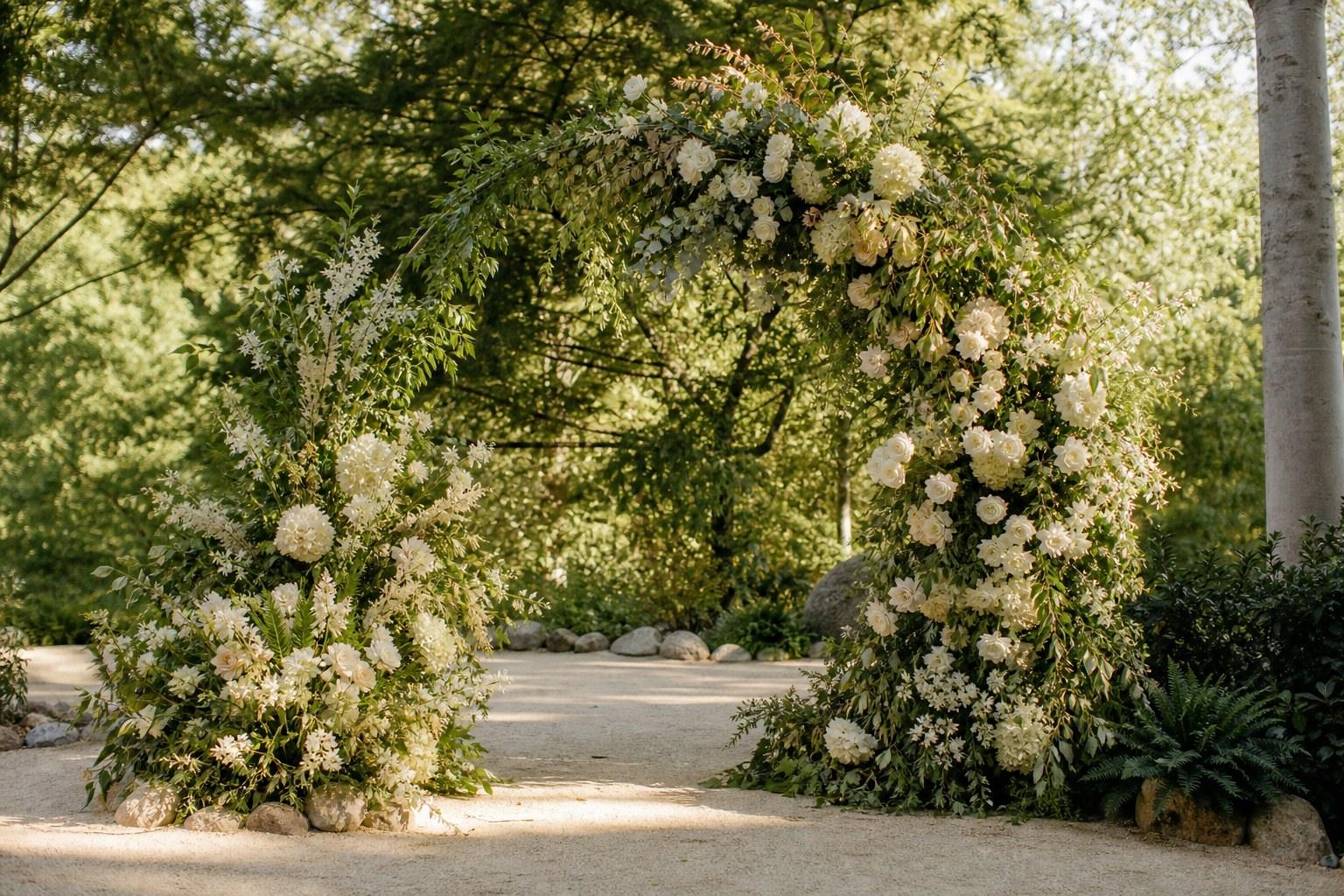
Bouquets are craft. Installations are engineering. The moment a client asks for a floral arch, a hanging cloud over the top table or a meadow down the aisle, you’ve moved from arranging flowers to building a structure that has to survive heat, wind, a photographer leaning on it and four hours of guests brushing past.
Wedding flower installations are also where the money is. They’re the images that get shared, the pieces couples save for, and the work that lifts a florist out of competing on bouquet prices. But they punish anyone who guesses — on mechanics, on quantities, or on time.
Here’s how to design, quote and build installations properly: arches, aisles, hanging pieces and statement florals that stay standing.
Design the installation for the room, the camera and the clock
Every installation answers three briefs at once:
- The room: scale, ceiling height, sightlines, what it hides, how guests move around it.
- The camera: where the photographer will stand, what’s behind the piece, whether the couple’s faces stay clear of foliage.
- The clock: how long you have to build it, how long the flowers must survive out of water, and whether it needs to be moved from ceremony to reception.
Sketch the piece to scale against a photo of the actual space. A 2.4m arch that looks generous in a courtyard vanishes in a barn with a 7m ceiling. Scale errors are the most expensive mistake in floral design, because you only discover them after you’ve bought the flowers.
Structural thinking like this is at the heart of the Certificate in Floral Design — mechanics and process first, pretty second.
Mechanics: what actually holds an installation together
The frame
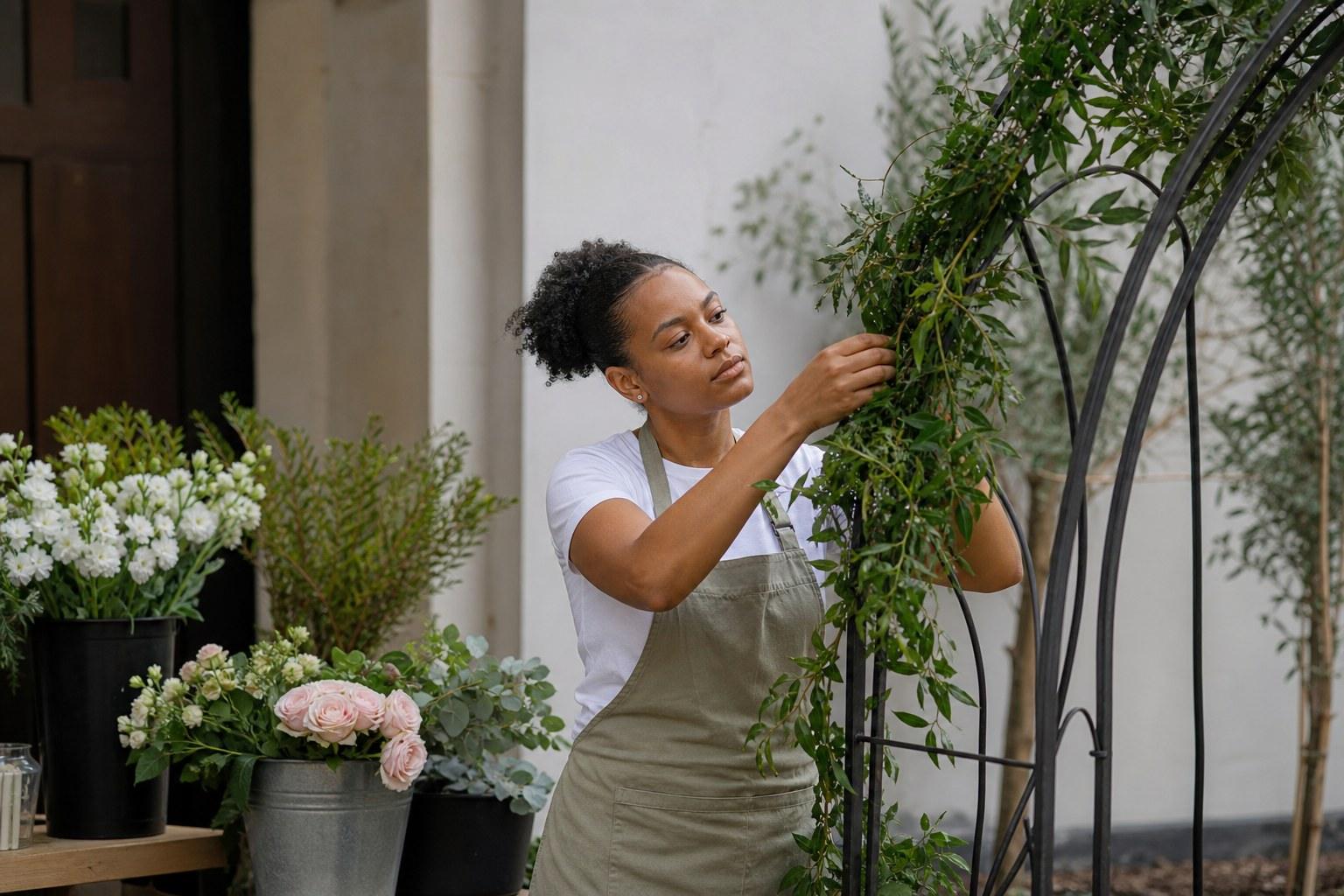
Most installations start with a rigid skeleton: a metal arch or moon frame, timber uprights, a pipe-and-base structure, chicken wire formed into a shape, or a rented plinth. Whatever you choose, it must be stable before a single stem goes on. Test it by pushing it. Then test it in wind, if you’re outdoors.
The water source
Hydration decides whether your work looks fresh at 9pm. Options include reusable hydration cages or wet moss wrapped in chicken wire, water tubes or picks for individual delicate stems, and hidden vessels or troughs at the base for tall, thirsty material. Choose foliage and hardier blooms for the areas that must run dry, and keep the divas where the water is. Always condition and hydrate thoroughly the night before — most “wilted installation” stories are conditioning failures, not design failures.
The fixings
Cable ties, bind wire, zip ties, reel wire, sandbags, ratchet straps and a lot of gaffer tape. Bring more than you think you need in every single one of these, plus spare frame joiners. Nothing kills a bump-in faster than running out of cable ties an hour before guests arrive.
How to build a ceremony arch that photographs beautifully
- Set and secure the frame in the exact final position, checked against the ceremony sightline. Weight the base — sandbags behind the uprights, hidden by foliage.
- Decide the composition: asymmetric corner, two corners, full swag or full coverage. Asymmetric is usually more elegant and always cheaper, because you’re concentrating material where the eye lands.
- Build the greenery base first, establishing shape and depth. Mix at least two or three foliage textures — one type of leaf reads flat.
- Add structural blooms in loose clusters or drifts, not evenly spaced dots. Clusters look intentional; scattering looks like polka dots.
- Layer in focal flowers and let a few stems break the outline so the piece has movement rather than a hedge-like edge.
- Finish with fine detail — trailing stems, delicate spires, a hint of something wild — and check the piece from every guest seat, not just from the front.
Two things to keep checking: the frame must never show through as an obvious bare pipe in a photo, and the couple must have clean space to stand without foliage growing out of their heads. Stand where the photographer will stand and look through your phone camera — the frame tells you the truth the naked eye misses.
Aisle florals and meadows
Aisle work is a rhythm decision. Options run from a few generous clusters at intervals, to petal-and-bloom meadows at ground level, to alternating heights on plinths or in urns. Rules that keep aisle florals working:
- Keep a clear walking width for the couple, dresses, wheelchairs and a photographer walking backwards.
- Fewer, larger moments beat many small ones — visually and financially.
- Anything at ground level will be kicked. Build for that, and place your most fragile stems above knee height.
- Design for repurposing: aisle urns that migrate to the reception entrance or bar double your budget’s mileage. Agree who moves them and when, in writing.
Hanging installations: the safety conversation comes first
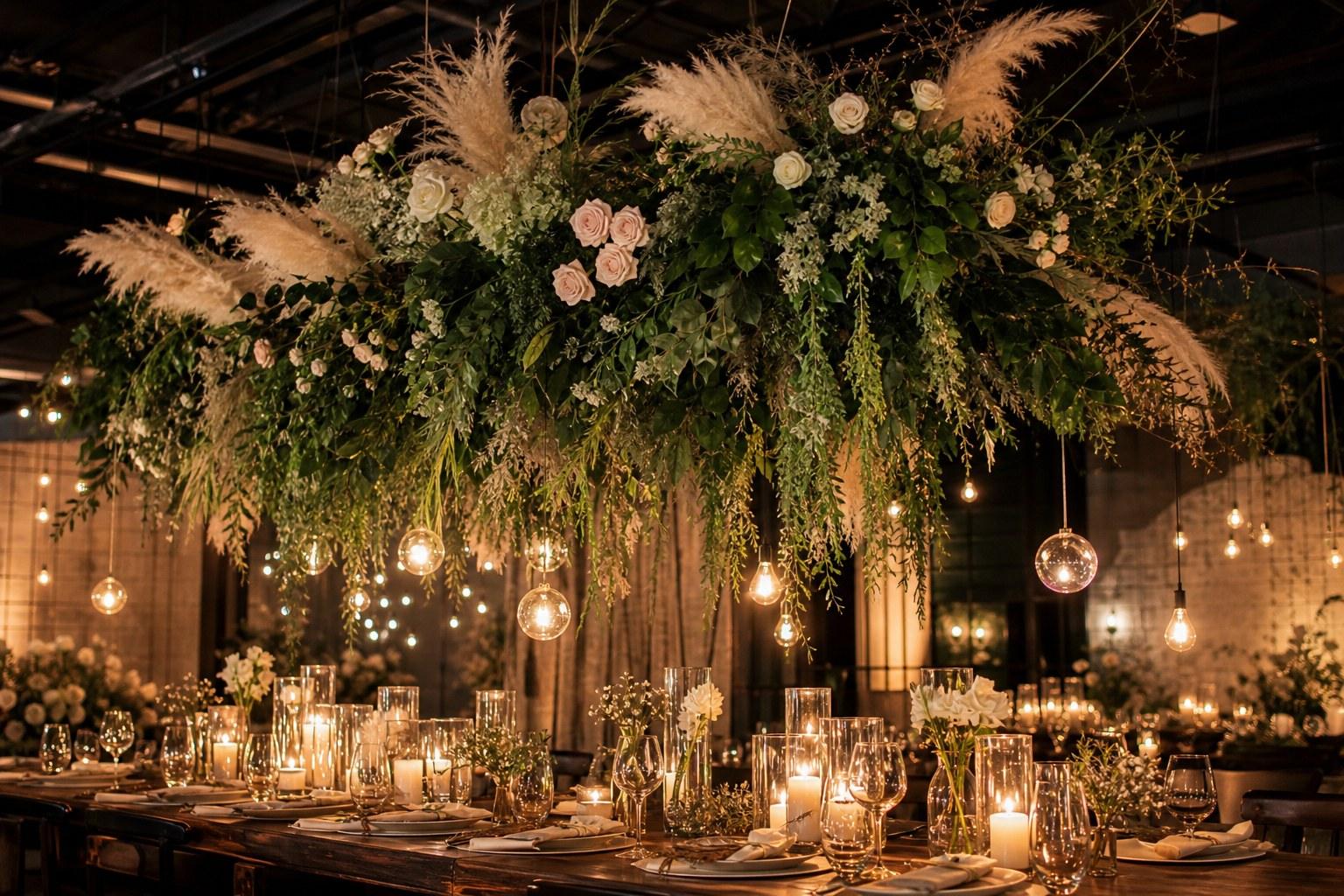
A floral cloud over a long table is the most photographed piece in modern wedding floristry, and the most dangerous thing many florists ever build. Before you design one, get answers in writing:
- Does the venue permit hanging installations at all?
- What are the fixing points, and what is the certified load limit?
- Do they require a licensed rigger, and who supplies the ladders, scaffold or lift?
- Do you have public liability insurance that covers rigged work?
Build hanging pieces light. Foam-free chicken-wire cages, airy foliage, hardy blooms that tolerate hours out of water, and generous safety margins on weight. Assemble on the floor or on trestles and lift as one unit where you can — building overhead is slow, exhausting and how mistakes happen. And always check what’s underneath: nobody wants a stem landing in the entrée.
Quoting installations without losing money
Installations bankrupt florists who quote them like bouquets. Your quote must account for every one of these lines:
| Cost line | Don’t forget |
|---|---|
| Flowers & foliage | Wastage allowance, market variability, substitution plan if a variety doesn’t land |
| Hard goods | Frames, wire, cages, vessels, fixings — hire fee or amortised purchase |
| Design & prep labour | Sourcing, conditioning, pre-building, packing |
| On-site labour | Bump-in hours × number of crew, at a real hourly rate |
| Bump-out | Late-night pack-down, often the hour nobody quotes for |
| Logistics | Vehicle, fuel, parking, loading dock access, ladder or lift hire |
| Contingency | Weather, a broken frame, a stem order short |
Quote installations as a designed piece with a scope description, not a shopping list — and put a change-of-scope clause in your contract, because installation briefs grow. Pricing, contracts and profitability are covered properly in the Certificate in Wedding Business & Marketing.
Bump-in and bump-out: the professional’s timeline
Work backwards from guest arrival, not forwards from when you’d like to start.
- Night before: condition everything, pre-build what travels, pack a labelled kit box and check the frame in your workshop.
- On arrival: confirm access, power, water, bins and where you’re allowed to work. Find the venue contact and get their mobile number.
- Build order: largest and highest first, table work last, anything the caterer needs to work around before they set.
- Buffer: finish before the photographer arrives, not while they’re shooting details. Leave the space clean — no offcuts, no buckets, no tape rolls.
- Pack-down: agree the time and who has building access at midnight, and bring your own bins and trolleys.
Photograph every finished piece yourself before guests arrive — clean room, your framing, no half-eaten canapés in shot. Those images are your portfolio, and your portfolio is what books the next installation. If you want to go further into designing and running large-scale statement work, the Advanced Certificate in Wedding Planning, Styling and Business is the next step.
Wedding flower installation FAQs
What is a wedding flower installation?
Any large-scale floral piece built onto or into a structure rather than arranged in a vase — ceremony arches and backdrops, aisle meadows, hanging clouds and garlands, staircase or bar florals, and statement entrance pieces.
How long do flowers last in an installation without water?
It depends entirely on the variety, conditioning and conditions on the day — heat, wind and direct sun shorten everything. Hardy foliage and robust blooms cope far better than delicate, thirsty stems. Test your chosen varieties in advance in similar conditions rather than assuming, and place fragile material where hydration is available.
Do you need a rigger for hanging floral installations?
Often yes. Many venues require a licensed rigger and certified fixing points for anything suspended, and your insurance may too. Always confirm the venue’s requirements and load limits in writing before you design the piece.
Can you build a floral arch without floral foam?
Yes. Chicken wire and wet moss cages, reusable hydration cages, water tubes and hidden vessels all work, and foam-free mechanics are now standard practice for many designers. Foam-free usually means more time on mechanics, so allow for it in your labour cost.
How do you make a small floral budget look bigger?
Concentrate. One generous asymmetric installation where the photos happen beats florals spread thinly through the venue. Use textural foliage for volume, choose in-season focal blooms, and design pieces that move from ceremony to reception.



