
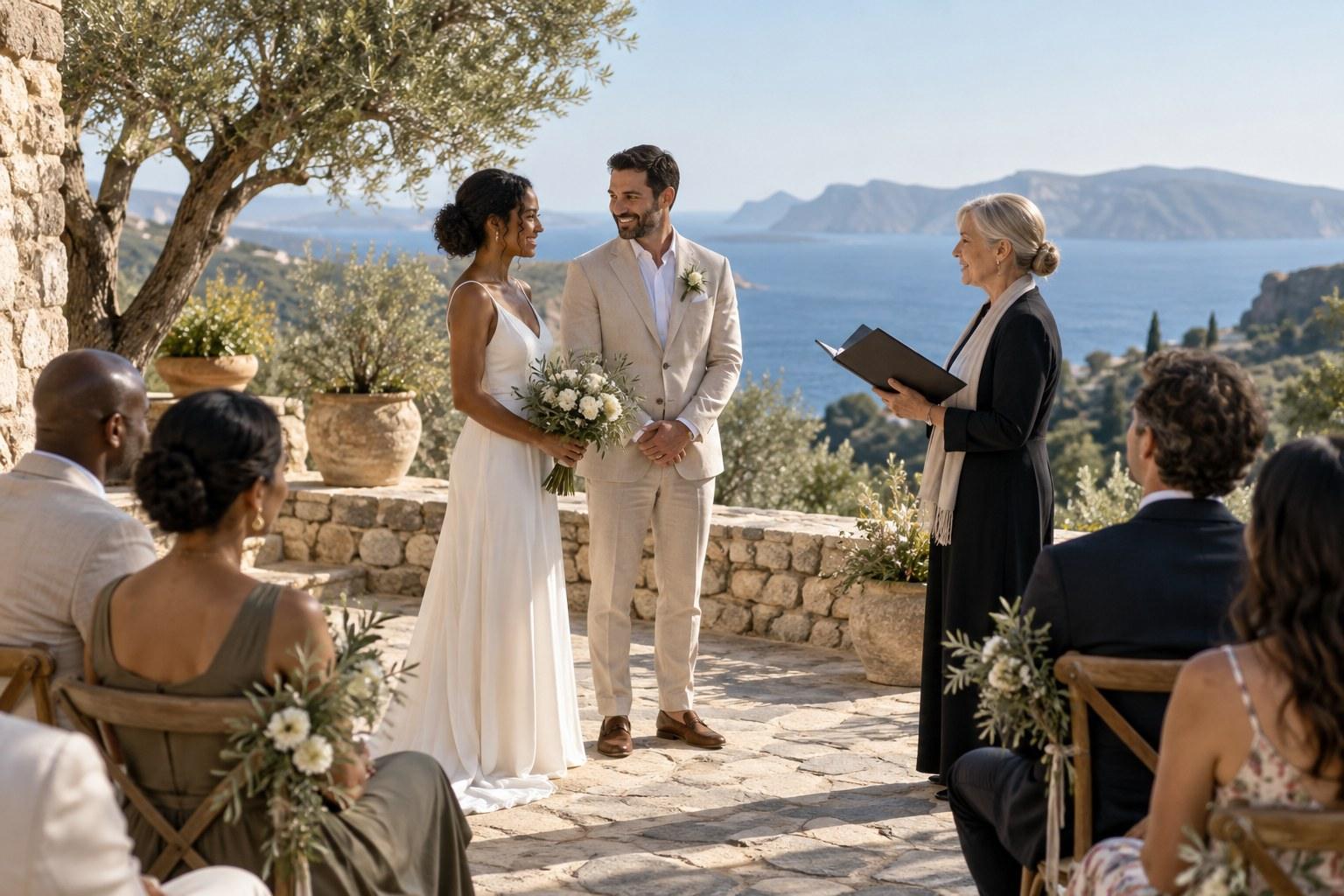
A couple books you for a wedding on a cliff in Italy. The photographer’s confirmed, the villa’s deposit is paid, and three weeks out someone asks a small, quiet question: “so are we actually married at the end of this, or not?” 😬
That’s the moment destination planning stops being pretty and starts being professional. The legal requirements for getting married abroad vary enormously by country, and they’re the one part of a destination wedding you cannot fix on the day with charm and a good florist. Paperwork has processing times. Consulates have opening hours. Translators have queues.
Here’s how experienced destination planners handle the legal side — what you’re responsible for, what you’re absolutely not, and the process that keeps couples out of trouble without turning you into an unqualified legal adviser.
First rule: you research, you don’t advise
Say this early and say it in writing. You are a planner, not a lawyer, not a registrar, not an immigration adviser. Your job is to identify the requirements, source them from official channels, build the timeline around them, and make sure the couple actually completes each step. The legal validity of their marriage rests with them and with the authority that registers it.
That distinction protects you commercially and it makes you better at the work. Once you stop trying to be the authority, you start doing what the authority can’t: chasing, translating deadlines into a plan, and spotting the gap between what a venue’s sales page claims and what the local town hall actually requires.
This is exactly the kind of judgement we build inside the Certificate in Intimate, Micro and Destination Weddings — because destination work rewards planners who can manage risk, not just aesthetics.
Where the legal requirements for getting married abroad actually come from
There are only three sources you should ever quote to a couple:
- The civil authority in the wedding country — the town hall, registry office, municipality or equivalent that will actually perform or record the marriage. Their rules win. Always.
- The couple’s own government — foreign office or state department travel and marriage-abroad guidance, plus the embassy or consulate of the wedding country in the couple’s home country.
- A licensed local professional — a local wedding lawyer, a licensed agency, or an established in-country coordinator who submits these files every week and knows which office is slow in August.
What is not a source: a Facebook group, a competitor’s blog post from 2019, or the villa manager saying “everyone does it this way.” Requirements change. Get it in writing, dated, from someone accountable.
Legal, symbolic or legal-at-home: choose the structure first
Before you touch a date, the couple needs to choose how the marriage will legally happen. Three routes, three completely different workloads.
| Route | What happens | Best for | Planner watch-outs |
|---|---|---|---|
| Full legal ceremony abroad | The marriage is performed and registered in the destination country | Couples who want the wedding day to be the legal day, in that place | Longest lead time, most documents, residency and translation rules, appointment slots |
| Legal ceremony at home + symbolic ceremony abroad | A short civil ceremony before travel; the destination ceremony carries no legal weight | Countries with heavy residency or documentation demands, tight timelines | Manage expectations — some couples feel “the real one” happened in an office; script the symbolic ceremony properly |
| Legal ceremony abroad at an embassy or consulate | Marriage conducted under the couple’s own country’s law, where that service exists | Specific nationality and country combinations only | Availability is limited and not guaranteed — verify before promising anything |
Put this choice in your first proposal call, not month four. It changes the budget, the timeline, the guest communication and sometimes the destination itself. A couple with eight weeks and a stack of unavailable documents does not need a full legal ceremony in a country with a residency requirement — they need a quiet civil ceremony at home and a spectacular symbolic one abroad.

The documents most countries ask for when getting married abroad
Every country has its own list, so never present this as universal. But these are the items that come up again and again, and they’re the ones worth pre-emptively gathering while you confirm the exact local requirements:
- Valid passports — plus copies, and a check that expiry dates sit comfortably beyond the travel window
- Full birth certificates — often long-form, often required to be recent copies rather than the original from decades ago
- Proof of freedom to marry — variously called a certificate of no impediment, single status certificate, affidavit or sworn declaration
- Evidence of the end of any previous marriage — final divorce decree, annulment paperwork or a death certificate
- Proof of address or residence where the country requires it
- Change-of-name documentation where a name doesn’t match across documents
- Certified translations into the local language, by an accepted translator
- Legalisation of documents — commonly an apostille where both countries are part of that system, or consular legalisation where they aren’t
- Notice of marriage or application forms lodged with the local authority, sometimes in person
- Witness details — how many, what ID they need, and whether they must speak the local language
Translation, apostille and legalisation — the steps couples always underestimate
Getting the document is step one. Making it acceptable abroad is steps two, three and four. A birth certificate may need to be issued fresh, then legalised, then translated by a translator the destination authority recognises, then submitted within a validity window. Each step is a separate organisation with its own turnaround.
Which is why you build backwards from the wedding date and add buffer at every stage. If a document has a validity period, gather it too early and it expires; gather it too late and you miss the lodgement window. Sequencing is the actual skill here.
Residency, waiting periods and appointment windows
Three separate constraints that couples routinely blur into one:
- Residency — some countries require the couple to be physically present in-country for a set period before the ceremony. That reshapes flights, accommodation and annual leave.
- Notice or waiting periods — the gap between lodging the paperwork and being allowed to marry.
- Appointments — registry offices, translators and notaries all run on limited slots, and peak wedding season plus public holidays can close a window you assumed was open.
Confirm all three in writing before the couple books flights. “The venue said it’s fine” has ruined more destination timelines than weather ever has.
After the wedding: registration and recognition back home
The ceremony ending is not the process ending. Your couple will usually need the official marriage certificate issued locally, potentially legalised and translated again, so it can be used at home for name changes, banks, visas and everything else adult life demands.
Whether the marriage needs to be registered or simply recognised at home depends on the couple’s own country — another point where you signpost official guidance rather than answering. Build the post-wedding admin into your service anyway: who collects the certificate, when it’s issued, where it gets posted, and what the couple should do with it. Finishing this well is the reason couples refer you.
How to build a legal timeline that holds
1. Confirm the structure and the country’s rules in writing
Written confirmation from the civil authority or a licensed local professional, dated, and saved to the client file. Screenshots of a webpage aren’t enough on their own.
2. Map every document to an owner and a deadline
One tracker: document, who requests it, where from, expected turnaround, validity period, whether it needs legalisation, whether it needs translation, status. The couple owns the requesting; you own the chasing.
3. Book the legal appointments before the fun suppliers
Registry slot first, photographer second. Reverse that order and you’ll one day be rescheduling a wedding around a filing office.
4. Appoint a local partner
An in-country coordinator or licensed agency who speaks the language, knows the officials and can physically walk paperwork into a building. Fold their fee into the quote openly. Trying to do this remotely from another time zone is how details get missed.
5. Run a document audit at fixed checkpoints
Formal reviews — early, midway and a few weeks out — where you physically sight every document, check names match exactly across all of them, and confirm nothing has expired. Mismatched middle names and unnoticed apostrophes cause real delays.
6. Carry a paper pack
Originals, certified copies, translations and appointment confirmations, in one folder that travels with you — not in a suitcase, not in the cloud only. Signal drops. Folders don’t.
Price the legal work — don’t absorb it
Document coordination is hours of unglamorous, high-stakes work: research, translation liaison, appointment booking, follow-ups across time zones, and the audits. If you fold it invisibly into a planning fee, you’ll resent it by month three.
Package it as a named line item — legal and documentation coordination — and describe the outcome, not the tasks: “your paperwork will be complete, correct and lodged on time, in the right language, with nothing left to chance.” Then set boundaries in your contract: you coordinate and signpost, the couple supplies and signs, and third-party legal advice is theirs to obtain.
Destination and micro weddings are one of the most profitable specialisms in this industry precisely because the logistics scare people off. Learn the systems and the fear becomes your margin. The Certificate in Intimate, Micro and Destination Weddings walks through destination planning end to end, and the Certificate in Wedding Business and Marketing covers packaging and selling specialist services like this properly.
Legal requirements for getting married abroad: FAQs
Is a wedding abroad legally recognised back home?
It depends entirely on the couple’s own country and whether the marriage was properly performed and registered under the destination country’s law. Direct couples to their own government’s marriage-abroad guidance, and to the relevant embassy, for a definitive answer — and keep every certificate, translation and legalisation stamp on file so they can prove it later.
What is a certificate of no impediment and do we need one?
It’s a document confirming there’s no legal reason a person can’t marry — sometimes called a single status certificate, affidavit or sworn declaration depending on the country. Many destinations ask for one; the issuing process, cost and validity period come from the couple’s home authority, so check both ends before assuming anything.
How long does it take to sort the legal paperwork for a destination wedding?
There’s no universal answer — it depends on the country, the documents required, translation and legalisation turnarounds, and appointment availability. Confirm each turnaround in writing at the start, build the timeline backwards from the ceremony date, and add buffer to every single stage.
Should we have a symbolic ceremony abroad instead?
It’s a genuinely good option when the destination has heavy residency or documentation requirements, when the timeline is short, or when the couple simply doesn’t want admin on their wedding trip. Marry legally at home first, then design the ceremony abroad with full creative freedom — just be clear with guests about which is which.
Can a wedding planner give legal advice about marrying abroad?
No. Research, coordinate, signpost official sources and manage the timeline — but never present yourself as a legal authority. State the boundary in your contract and refer couples to the civil authority, their embassy or a licensed local professional for anything that needs a legal opinion.
Get the legal side right and destination weddings become the most rewarding work in your calendar — small guest lists, generous budgets, couples who trust you completely. Ready to build that specialism properly? Enrol in the Certificate in Intimate, Micro and Destination Weddings and start planning weddings abroad with confidence. ✈️



