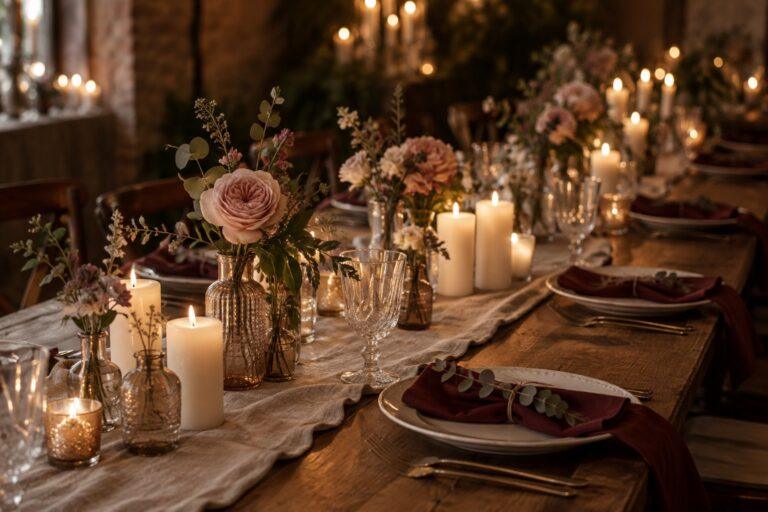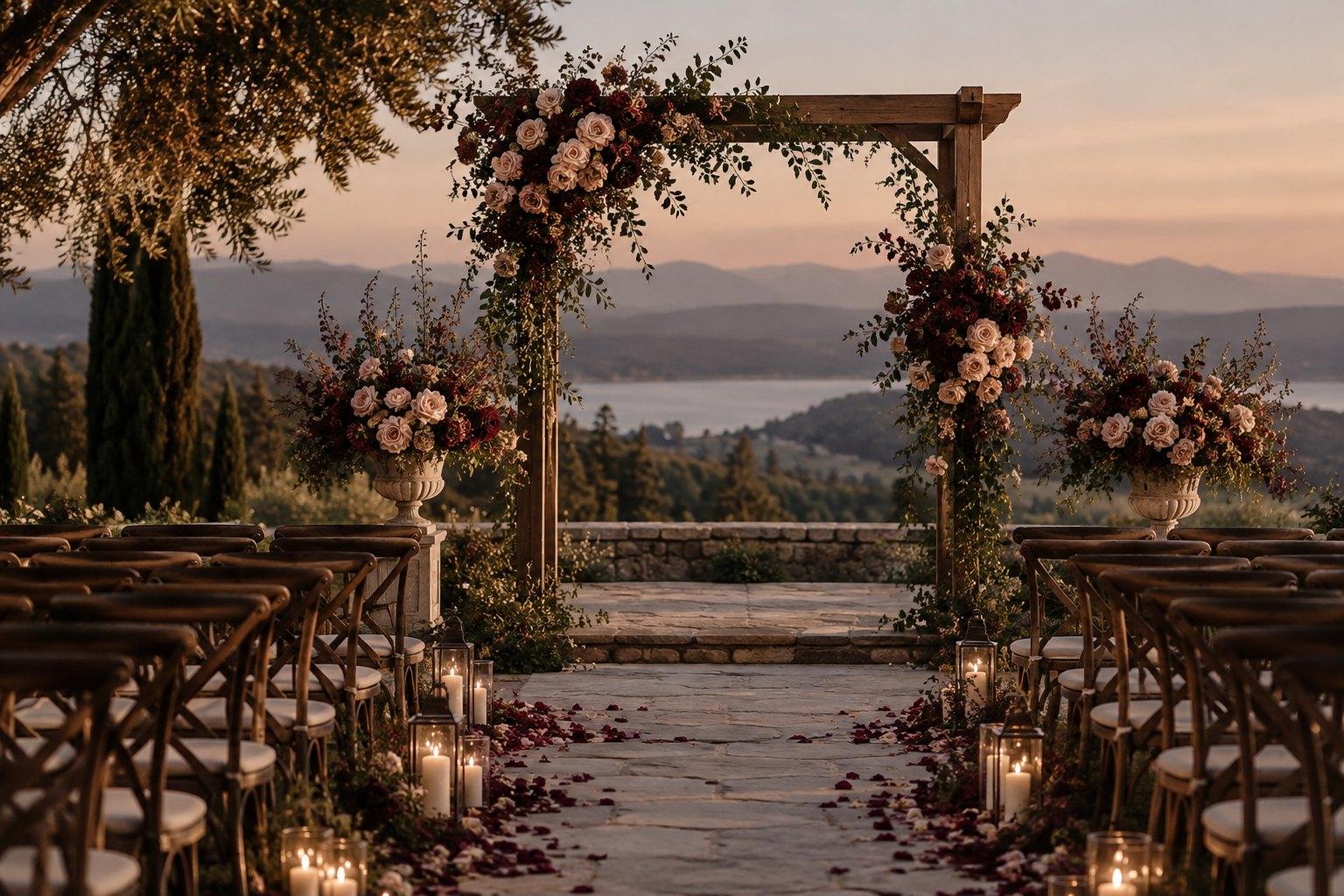
Repurposing wedding flowers means designing ceremony arrangements so they can be moved and reused at the reception — aisle urns become bar features, arbour florals become a head table display, bridesmaid bouquets become table décor. It works brilliantly, but only when it’s planned at the design stage, not improvised after the vows.
Couples love the idea because it makes their floral budget go further. Florists love it when it’s done properly — and dread it when someone promises a client “we’ll just move them” without thinking about weight, water, timing or who’s actually doing the lifting. Here’s how to plan it like a professional.
Why repurposing wedding flowers works
Most ceremonies last a short time, yet ceremony florals are often among the most impressive pieces of the day. Moving them to the reception means guests enjoy them for hours rather than minutes, and the couple gets more impact without paying for two complete sets of large designs.
It also suits couples who care about reducing waste. Fewer arrangements means fewer stems, less mechanics and less disposal at the end of the night.
Which ceremony flowers can be repurposed?
Not every design moves well. As a rule, the easier a piece is to lift, carry and re-place without damage, the better it repurposes.
| Ceremony design | Reception reuse | Notes |
|---|---|---|
| — | — | — |
| Aisle urns or pedestal arrangements | Bar, entrance, dessert table or stage | Design on a stable base; plan for weight |
| Freestanding arbour or arch florals | Head table backdrop or front-edge display | Build in removable sections |
| Aisle markers and chair florals | Guest table accents or cocktail tables | Small, light and quick to move |
| Bridal party bouquets | Head table or guest book table in vases | Have water-filled vases ready |
| Signage florals | Seating chart or welcome sign | Often the easiest swap of all |
| Fixed installations | Usually stay in place | Rarely practical to move |
Large hanging installations and complex fixed structures usually stay put. If a couple wants those repurposed, the conversation is really about designing a different, more modular piece.
Design for the move from the start
The secret of successful repurposing is simple: the ceremony design must already be the reception design. That means thinking about both spaces at the consultation.
Choose vessels and bases with two locations in mind
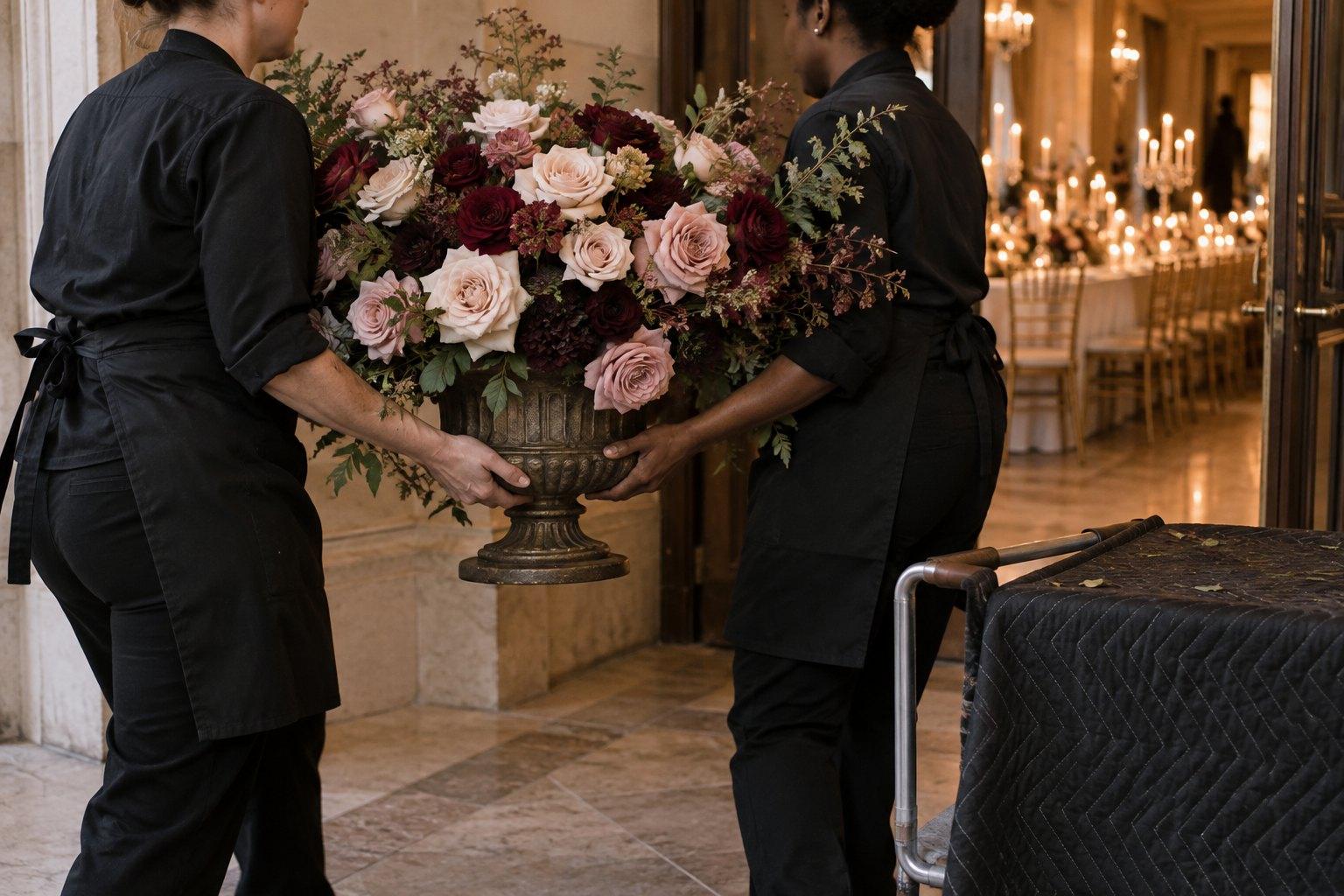
Pick vessels that look beautiful in both places and can be lifted safely. Footed urns, compotes and sturdy troughs travel well. Wide, shallow containers full of water slosh and spill. Where arrangements are big, design them on bases that fit onto a trolley or can be carried by two people with good grip points.
Build modular arbour and arch florals
Instead of wiring florals permanently onto an arch, build them in sections — on cages, trays or frames that attach securely to the structure and can be unclipped later. Those sections then sit along the front of a head table, on a mantel or at the base of a cake table. Plan how each section will look from its new viewing angle; something designed to be seen from the aisle may need finishing on its “back” if it’ll be seen from all sides at the reception.
Check the mechanics travel safely
Chicken wire, pin holders, cages and water sources must be secure enough to survive being lifted, tilted and carried. Test-lift big pieces in the workroom. If anything shifts, fix it there — not on the venue floor ten minutes before guests walk in.
Plan the timing: when do the flowers move?
The window between ceremony and reception is usually during canapés, drinks or photos. That sounds like plenty of time until you factor in guests lingering, the photographer wanting the arbour for portraits and the venue team flipping the room.
Agree a clear plan with the planner, venue coordinator and photographer:
- When the move can start — often only once guests have left the ceremony space and portraits at the arbour are done.
- Where each piece goes, with a simple floor plan or labelled photos.
- Route — doorways, stairs, lifts, uneven ground and distances.
- Time needed — be realistic, and build in a buffer.
- Reception readiness — tables, stands or plinths must already be in place for the flowers to land on.
Who does the moving?
This is where repurposing plans most often unravel. If the florist leaves after set-up, someone else has to move the flowers. Decide upfront whether your team will stay or return for the turnaround, whether the venue staff will handle it, or whether the planner’s team will take care of it.
If someone other than your team is moving designs, give them clear instructions, a labelled plan and a quick walk-through on how to lift each piece. Heavy, top-heavy or fragile arrangements should ideally be moved by trained florists. Your contract should state who is responsible for the move and for any damage — check the wording with your own lawyer.
Pricing repurposed flowers
Repurposing saves couples money on stems, but it isn’t free. The turnaround involves labour, sometimes extra staff, trolleys, vases and a second round of styling at the reception. Price the move as a line item — a turnaround or flip fee — so the couple understands the value and your team is paid for the time.
Be honest in consultations. Repurposing reduces the number of large designs needed, but it adds logistics. When couples see both sides, they make better decisions, and you avoid squeezing a complex move into an unpaid half hour.
Keeping repurposed flowers looking fresh
By the time ceremony flowers reach the reception, they’ve usually been out of the cooler for hours. Good processing and care make all the difference.
- Condition thoroughly before the wedding so stems are fully hydrated.
- Choose hardy varieties for pieces that will move — delicate blooms that bruise or wilt quickly are better kept for static designs.
- Hydrate the mechanics — water sources, tubes or soaked alternatives keep blooms going through the move.
- Keep them out of direct sun and heat at the ceremony where you can.
- Mist and refresh once in place at the reception, replacing any damaged stems from a small spare stash.
Talking to couples about repurposing
Couples often arrive having seen “move your ceremony flowers” on a wedding blog, without knowing what’s involved. Use the consultation to set realistic expectations. Explain which of their ceremony pieces can move, how the reception will look once they arrive, and what the turnaround involves. Show photos of repurposed designs in both locations if you have them.
Be clear about what can’t move, too. A dramatic hanging installation or a florals-heavy ceremony backdrop might be better as a single, unforgettable moment — or redesigned in modular form if the couple really wants it at both. Honest advice builds trust, and trust books weddings.
A florist’s repurposing checklist
- Identify which ceremony pieces will move at the consultation.
- Design vessels, bases and modular sections for both locations.
- Test-lift and secure mechanics in the workroom.
- Agree timing, routes and responsibilities with the planner, venue and photographer.
- Prepare a labelled floor plan for the move.
- Stage vases, plinths and stands at the reception in advance.
- Pack a turnaround kit: snips, spare stems, misting bottle, cloths, tape, ties and a trolley.
- Price the turnaround as its own line item.
Learning to plan florals like this
Repurposing is a great example of how wedding floristry combines design with logistics and business sense. The Wedding Florist’s Handbook by Jac Bowie covers techniques and the business side of running a floral service, and it’s a helpful reference while you build your systems. If you also plan events, the Certificate in Wedding Planning helps you see turnarounds from the planner’s side too. And for a complete grounding in wedding floristry, explore the Certificate in Floral Design.
The bottom line
Repurposing wedding flowers gives couples more impact and less waste — when it’s designed in from the start. Choose pieces that move well, build modular and secure mechanics, agree timing and responsibilities in writing, price the turnaround fairly and keep a fresh-up kit on hand. That’s how ceremony flowers get a glorious second act.
Frequently asked questions
Can ceremony flowers be used at the reception?
Yes. Aisle urns, pedestal arrangements, modular arch florals, aisle markers, signage flowers and bridal party bouquets can all be moved to the reception if they’re designed and planned for it.
Who moves the flowers from ceremony to reception?
It should be agreed in advance. Often the florist’s team stays or returns for the turnaround; sometimes venue or planning staff do it with clear instructions. Your contract should state who is responsible.
Does repurposing wedding flowers save money?
It usually reduces the number of large designs needed, but the turnaround adds labour and equipment. Florists often price the move as a separate flip or turnaround fee.
How do you make arch flowers reusable?
Build them in removable sections on cages, trays or frames that attach securely to the arch, so they can be unclipped and placed along a head table or cake table at the reception.
How do you keep repurposed flowers fresh?
Condition stems thoroughly, choose hardy varieties for pieces that move, use reliable water sources, keep designs out of heat and sun, and refresh them with misting and spare stems once in place.
Want to design wedding flowers that work harder — beautifully and profitably? The Certificate in Floral Design teaches wedding floristry techniques, mechanics and business skills, 100% online and at your own pace.