The best wedding planner client questions for a first meeting cover five things: the couple’s story and vision, their budget, their guest count and date, their non-negotiable priorities, and how they like to make decisions. Ask those well and you’ll know within an hour whether you’re the right planner for them — and they’ll leave feeling genuinely heard.
That first consult is part interview, part discovery session and part sales conversation. Get it wrong and you either book a couple who’ll be a nightmare to work with or lose a dream client to someone who simply listened better. Below are the wedding planner client questions professionals rely on, grouped by purpose, plus how to structure the meeting and what to do afterwards.
Before the meeting: what to know in advance
Don’t waste precious face-to-face time on admin you could have collected beforehand. A short enquiry form or pre-consult questionnaire should capture:
- Names, pronouns and preferred contact method for both partners
- Wedding date (or preferred months) and location
- Approximate guest count
- Whether they have a venue booked
- Which service they’re enquiring about — full planning, partial planning or on-the-day coordination
- How they found you
With the basics in hand, the meeting can focus on what really matters: who they are and what they want this day to feel like.
Wedding planner client questions about the couple and their story
Start here. It warms the room, shows you care about them as people rather than a booking, and gives you gold for styling and personalisation later.
“How did you meet, and what do you love doing together?”
It sounds like small talk. It isn’t. Their answer tells you what matters to them — a couple who met hiking may want an outdoor ceremony; a couple who bonded over food might want dinner to be the hero of the night.
“What do you want your guests to say on the drive home?”
This one question cuts straight to the vision. “It felt like a massive party”, “the food was incredible”, “it was so them” — each answer points you in a different direction.
“What does your ideal wedding day feel like, from waking up to the last song?”
Ask them to walk you through it. Listen for pace (relaxed or packed), mood (formal or casual) and the moments they light up about.
Questions about budget
Budget conversations are where new planners get nervous. Don’t be. Couples expect you to ask, and being direct is a kindness.
“Have you set an overall budget, and who’s contributing?”
Knowing whether parents or family are contributing matters — contributors often expect a say in decisions. Ask gently whether anyone else will be involved in approvals.
“Is that number firm or flexible?”
Some couples have a hard ceiling; others have a starting figure that will grow. You need to know which, and you need to know before you start showing them dream venues.
“Where would you happily spend more, and where would you rather save?”
This tells you their priorities in money terms. It also helps you build a realistic budget breakdown later rather than one based on assumptions.
Questions about guests, date and logistics
“Roughly how many guests, and how firm is that list?”
Guest count drives almost every cost and every venue decision. If the list is likely to grow, plan for the bigger number.
“Do you have dates, months or days of the week in mind?”
Flexibility on date can open up venues and suppliers. Ask whether specific dates carry personal meaning before suggesting alternatives.
“Will many guests be travelling, and are there any accessibility needs?”
Travelling guests mean accommodation blocks, transport and possibly a welcome event. Accessibility needs — mobility, hearing, dietary, sensory — should shape venue choices from day one.
“Are there cultural, religious or family traditions you want to include?”
Ask openly and without assumptions. Traditions affect ceremony length, catering, timing and even venue suitability.
Questions about priorities and non-negotiables
“What are your top three priorities?”
Make them choose. Food, photography, music, flowers, venue, guest experience — when everything is a priority, nothing is. Their top three become your north star whenever a budget decision gets tight.
“Is there anything you definitely don’t want?”
Often more revealing than what they do want. No bouquet toss, no first dance, no seating plan, no speeches longer than five minutes — note it all.
“Have you already booked or promised anything?”
A family friend who’s “doing the cake”, an uncle who’s offered to DJ — find out now, not three weeks before the wedding.
Questions about working style and decisions
This section is how you protect yourself and your business. It’s also the part most new planners skip.
“How do you two make decisions together?”
Some couples split responsibilities; others want to decide everything jointly. Some have one partner who’s very involved and one who wants to show up and say “I do”. Knowing this shapes how you communicate.
“How do you prefer to communicate, and how often?”
Email, phone, messaging app, video call? Weekly updates or only when something needs a decision? Setting expectations now prevents late-night messages later.
“What worries you most about planning this wedding?”
This is the question couples remember. It shows you understand planning is stressful, and their answer tells you exactly what to reassure them about in your proposal.
“What made you decide to hire a planner?”
Their answer reveals expectations. “We’re both working long hours” means they want you to take things off their plate. “We’ve no idea where to start” means they want guidance and education.
A simple structure for your first consult
A clear structure keeps the meeting warm but focused. Most first consults run about an hour.
| Stage | Time | What happens |
|---|---|---|
| Welcome | 5 min | Introductions, thanks, a quick outline of the meeting |
| Their story | 15 min | Vision and story questions; mostly listening |
| Practicalities | 15 min | Budget, guests, date, location, traditions |
| Priorities and style | 10 min | Top three priorities, non-negotiables, decision style |
| Your services | 10 min | How you work, what’s included, the next steps |
| Wrap-up | 5 min | Their questions; agree when they’ll receive your proposal |
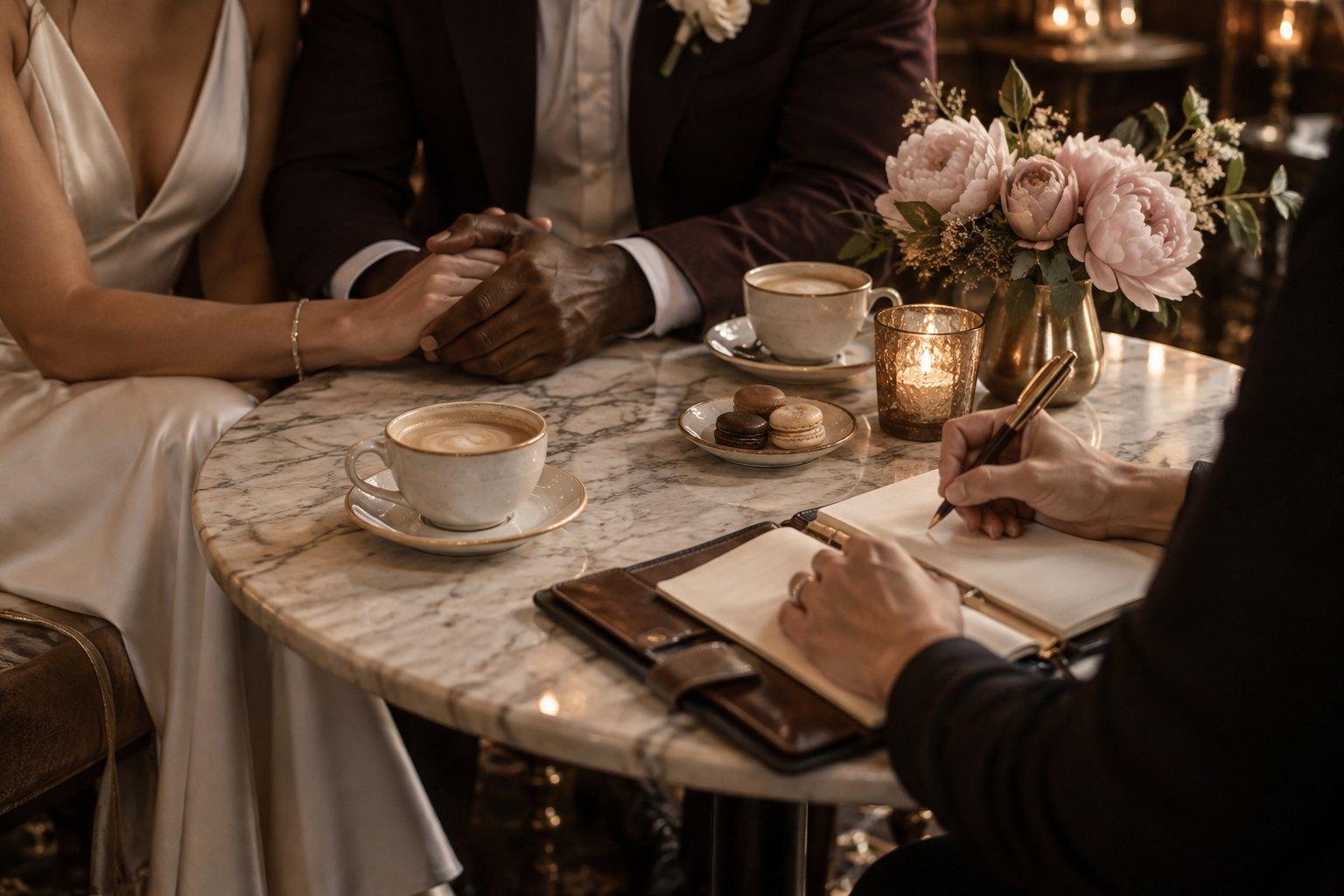
Notice the ratio: you should be talking far less than they are for the first half. Take notes — on paper or a tablet — and repeat key points back to show you’ve understood.
Questions they’ll ask you (be ready)
Couples will interview you too. Have clear, confident answers to:
- How many weddings do you take on at a time, and who’ll be our main contact?
- What exactly is included in your service, and what costs extra?
- How do you work with suppliers — do you have a preferred list?
- What happens on the wedding day itself, and how long will you be there?
- What’s your process if something goes wrong?
Be honest if you’re new. Couples respond far better to “I’m building my portfolio and every wedding gets my full attention” than to inflated claims. Your training, your process and your enthusiasm are real selling points.
After the meeting: follow up fast
Send a thank-you email within a day, summarising what you heard — their vision, priorities and any concerns — and confirming when your proposal will arrive. That summary does two jobs: it proves you listened, and it gives you a written record to build the proposal from.
If it’s not a good fit — mismatched budget, values or communication style — it’s fine to say so kindly and, where you can, refer them to someone better suited. Not every enquiry should become a client.
Finally, review your own notes while the meeting is fresh. Jot down your first impressions — the moments they lit up, the topics that caused tension between them, any red flags around budget or expectations. Those notes will shape a proposal that sounds like it was written for them, because it was. Over time, look back across your consults and notice which questions consistently give you the most useful answers. Keep refining your list until it feels completely natural.
Turning great questions into a great business
Asking the right questions is a skill — and like any skill, it’s faster to learn with a framework. Client consultations, proposals, contracts and budget conversations are core parts of the Certificate in Wedding Planning, studied 100% online at your own pace. For questionnaires, checklists and client-management tools you can adapt, see The Wedding Planner’s Handbook by Jac Bowie. And if you’d like ready-to-use client forms, browse our wedding planner templates.
Frequently asked questions
What questions should a wedding planner ask a new client?
Ask about the couple’s story and vision, overall budget and who’s contributing, guest count and date, cultural or family traditions, top three priorities, non-negotiables, and how they like to communicate and make decisions.
How long should a first wedding consultation last?
Most first consults run about an hour. That’s enough time to understand the couple’s vision and practicalities and explain your services without overwhelming them.
Should I discuss budget in the first meeting?
Yes. Couples expect it, and knowing whether the budget is firm or flexible — and who’s contributing — prevents wasted time on venues and suppliers they can’t afford.
Should a first meeting be in person or online?
Either works. Video calls suit busy or long-distance couples, while in-person meetings can build rapport faster. Offer both and let the couple choose.
What should I send after the first client meeting?
Send a thank-you email within a day summarising their vision, priorities and concerns, and confirm when they’ll receive your proposal.
Want to run client meetings with total confidence — and turn more enquiries into bookings? Learn consultations, proposals and the full planning process with The Wedding Academy, online and at your own pace.