Dried wedding flowers are fresh blooms and grasses that have been air-dried, pressed or chemically preserved so they hold their shape and colour without water for months, sometimes years. Florists use them for bouquets, buttonholes, installations and keepsakes because they’re lightweight, prep-ahead friendly and survive heat and long days far better than fresh flowers.
If couples are asking you for pampas, bunny tails and bleached ruscus, you’re not alone. Dried wedding flowers have moved from niche boho trend to a staple request — and they come with their own handling rules, sourcing headaches and pricing logic. This guide covers what you need to know to offer them professionally.
Dried vs preserved flowers: what’s the difference?
Couples often use the words interchangeably, but they’re different products and you need to explain them clearly in consultations.
| Type | How it’s made | Look and feel | Best for |
|---|---|---|---|
| Air-dried | Hung upside down in a dark, dry, airy space until moisture is gone | Papery, slightly muted colour, brittle | Grasses, statice, strawflower, lavender, roses |
| Pressed | Flattened between absorbent paper under weight | Flat, delicate, two-dimensional | Keepsakes, invitations, framed pieces |
| Preserved | Sap replaced with a glycerine-based solution | Soft, supple, closer to fresh | Roses, hydrangea, eucalyptus, ruscus, fern |
| Bleached and dyed | Dried material bleached then sometimes coloured | Pale or vivid, uniform colour | Statement installations, modern palettes |
Preserved stems feel softer and photograph more like fresh flowers, while air-dried stems have that textural, papery quality many couples love. A lot of florists blend both — plus a few fresh focal blooms — for a hybrid design.
Why couples are choosing dried wedding flowers
- Keepsake value: the bouquet can be kept as decor after the wedding.
- Heat and travel tolerance: ideal for destination weddings, outdoor ceremonies and long days.
- Make-ahead flexibility: pieces can be created days or weeks in advance.
- Texture and colour: rust, terracotta, sand and burgundy palettes that are hard to find fresh.
- Availability: less dependent on what’s at the flower market that week.
Be honest about the trade-offs too. Dried stems are fragile, can shed and don’t have scent. Some couples want the romance of fresh petals — and that’s fine. Your job is to guide them to the right mix.
One more point worth raising early: dried doesn’t automatically mean more sustainable. Some stems are bleached, dyed or shipped long distances, so if eco credentials matter to the couple, ask suppliers about growing, treatment and transport, and favour locally grown and naturally dried material where you can.
Best dried and preserved flowers for weddings
Textural grasses and fillers
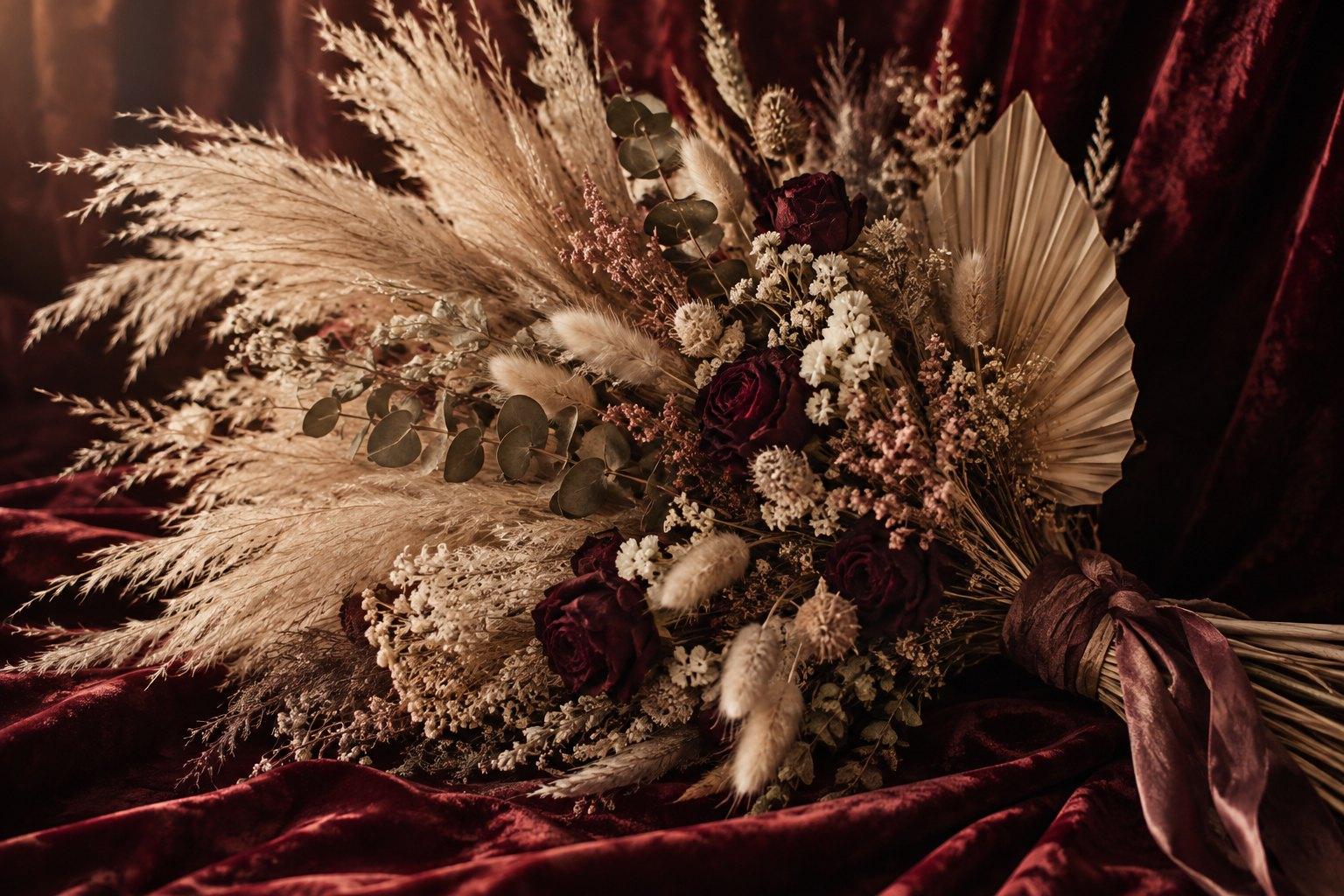
Pampas grass, bunny tails (lagurus), phalaris, oats, wheat and broom bloom give movement and softness. They’re the backbone of most dried designs.
Focal flowers
Preserved roses, dried peonies, preserved hydrangea, protea, banksia and strawflower work as focal points. Preserved roses in particular hold a full, rounded shape.
Foliage and structure
Preserved eucalyptus, ruscus, fern, palm spears and sun palms create structure and drama, especially in installations and arches. Bleached versions give a clean, modern look.
How to dry flowers yourself
Buying professionally dried and preserved stems gives you consistent quality, but air-drying your own is a useful skill — especially for keepsake work or when you want unusual varieties.
- Choose flowers at or just before their peak — fully blown blooms tend to shatter once dry.
- Strip lower leaves and bundle in small, loose bunches with an elastic band (stems shrink as they dry).
- Hang upside down in a dark, dry, well-ventilated space away from direct sunlight to slow fading.
- Leave until stems snap cleanly — typically one to three weeks depending on the flower and humidity.
- Store in boxes with tissue paper, away from humidity and light, until you’re ready to design.
Glycerine preservation is more involved and works best for foliage — commercially preserved stems are usually the practical choice for weddings.
Designing with dried wedding flowers
Dried materials behave differently in the hand. Stems are rigid, often hollow and can snap under pressure, so your technique has to adapt.
Bouquets
Hand-tie as you would fresh, but use a gentler grip and lighter binding. Reinforce weak stems with wire and tape before you start. Because there’s no water, you can wrap the stems in ribbon right up to the binding point for a polished finish.
Buttonholes, crowns and hair pieces
Dried stems are naturally lightweight — great for wearable flowers. Glue a few delicate elements with cold floral adhesive where wiring would crush them, then tape and finish.
Centrepieces and installations
Use chicken wire, foam-free pin holders or dry floral foam alternatives to hold stems. Large dried installations — arches, hanging clouds and ceiling pieces — are a big opportunity, because they can be built and tested in your studio well before the wedding date.
Sourcing, storage and handling tips
- Buy from reputable suppliers: quality varies hugely. Ask about origin and treatment.
- Check import rules: some countries restrict dried plant material and grasses. If you’re importing or travelling with stems, check with the relevant biosecurity or customs authority first.
- Mind humidity: moisture causes drooping and mould. Store in a cool, dry place.
- Shedding: pampas and grasses shed. A light mist of unscented hairspray or a floral sealant can help.
- Fire safety: dried material is flammable. Keep it well away from candles and check venue rules.
Consultation questions for dried wedding flower clients
A dried flower consultation needs a slightly different script from a fresh one. Couples have often fallen for a single image online, and that image may rely on bleached, dyed or imported stems that aren’t easy to get where you are. Ask questions that uncover what they really love — the texture, the colour, the keepsake idea or simply the practicality.
- Do you want an all-dried look, or a mix of dried, preserved and fresh?
- Is keeping the bouquet afterwards important to you?
- Which colours are non-negotiable, and which are flexible?
- Will the ceremony or reception be outdoors, in heat or in wind?
- Are there candles, fire pits or open flames near where the flowers will be?
- Does anyone in the wedding party have hay fever or allergies to grasses?
Those answers shape your recipe, your sourcing and your quote. They also show the couple that you understand the material — which is a big part of why they’ll book you over someone simply copying a mood board.
On the day: delivering and caring for dried designs
Dried designs are robust in heat but fragile in transit. Pack bouquets and buttonholes in boxes lined with tissue so nothing rubs, and transport larger installation pieces in sections so brittle stems don’t snap under their own weight. Bring spare stems, cold glue and tape for quick repairs on site — a snapped pampas plume is easy to replace if you’ve packed one.
Give the couple simple aftercare notes, too. Tell them to keep the bouquet out of direct sun, away from bathrooms and kitchens where humidity builds up, and to dust it gently with a soft brush or a hairdryer on a cool setting. It’s a small touch that protects your work long after the wedding and keeps your name attached to a beautiful keepsake.
How to price dried wedding flowers
Don’t assume dried means cheaper. Preserved and bleached stems can cost more than fresh, and dried work is time-consuming because of the extra wiring, gluing and gentle handling. Price on your stem costs plus labour, design time and overheads — exactly as you would for fresh.
There’s also an upsell opportunity. Offer keepsake bouquet services, framed pressed flowers or post-wedding decor arrangements. For recipes, pricing formulas and client worksheets across fresh and dried work, The Wedding Florist’s Handbook by Jac Bowie is a practical companion on the studio bench.
If you want to build these skills properly, our Certificate in Floral Design covers floral mechanics, bouquet construction, installations and the business side of running a wedding floristry studio. You could also explore the Certificate in Wedding Styling if you love designing whole tablescapes around textural palettes.
Frequently asked questions
How long do dried wedding flowers last?
Kept away from humidity, heat and direct sunlight, dried and preserved wedding flowers can last for months or even years. Colours fade gradually with light exposure.
Are dried wedding flowers cheaper than fresh?
Not necessarily. Preserved and bleached stems can be expensive, and dried designs often take extra labour for wiring and gentle handling, so price on materials plus time.
Can you mix dried and fresh flowers in a wedding bouquet?
Yes. Hybrid bouquets are popular. Wire or protect fresh stems that need water and place dried elements where they won’t be crushed.
How do you stop pampas grass shedding?
Gently shake out loose fluff, then apply a light mist of unscented hairspray or a floral sealant and allow it to dry before designing.
Where can I learn to work with dried and preserved flowers?
The Wedding Academy’s Certificate in Floral Design is studied fully online and covers floral mechanics, bouquets, installations and floristry business skills.
Want to design dried, preserved and fresh wedding flowers with confidence — and price them properly? Study online at your own pace with The Wedding Academy’s floral design course.