Last Updated: October 23, 2026
Quick Summary
The Wedding Academy is a strong Alamo School alternative for floral design, offering a 100% online, self-paced Certificate in Floral Design with lifetime access. It pairs arrangement technique with business training in budgeting, supplier management, and installation logistics, and is backed by more than 11,000 graduates.
- The Wedding Academy’s Certificate in Floral Design is 100% online and self-paced with lifetime access.
- The curriculum covers budgeting, supplier management, and installation logistics alongside design technique.
- FlowerSchool New York runs six weeks in person and costs $8,450.
- New York School of Flower Design workshops start from $295.
- Ask any provider for a sample lesson before you pay for the course.
Table of Contents
- Why Look for an Alamo School Alternative for Floral Design?
- Quick Comparison: Floral Design Programs at a Glance
- The Wedding Academy: Online Floral Design Courses With Business Training
- Floral Design Classes for Beginners: Where to Start With No Experience
- Floral Design Certification: What It’s Worth and Who Recognizes It
- Choosing a Wedding Floral Design Course by Career Goal
- Cost, Format, and Support: What the Alternatives Actually Deliver
- Frequently Asked Questions
Why Look for an Alamo School Alternative for Floral Design?
Most people searching for an Alamo School alternative for floral design are not looking for a worse option. They want the same career outcome without the commute, the fixed schedule, or the local-only credential.
At The Wedding Academy, we have watched this gap widen for over 20 years. Our Certificate in Floral Design sits inside a broader curriculum that also covers planning, styling, and business, which is why career changers keep asking us how it compares to a local college route.
The short answer: a campus program suits someone who wants daily hands-on repetition. An online floral design course suits someone keeping a full-time job while building a second income. Below, we compare five options across cost, format, and career support so you can pick on evidence rather than guesswork.
The right question is not “which school is best” but “which format fits the life I actually have.” A florist education that forces you to quit your job is a different purchase than one you complete at 9pm.
Quick Comparison: Floral Design Programs at a Glance
The table below summarizes what each one actually delivers.
| Program | Format | Indicative Cost | Best For |
|---|---|---|---|
| The Wedding Academy | 100% online, self-paced | See pricing page | Career changers wanting design plus business training |
| Floral Design Institute | Online and in-person | Contact for pricing | Formal industry certification |
| FlowerSchool New York | In-person, 6 weeks | $8,450 | Immersive high-end training |
| New York School of Flower Design | Short workshops | From $295 | Quick practical skill-building |
| American School of Flower Design | Regional in-person sessions | From $1,495 | Portfolio-building workshops |
If you want a wider field to compare, our roundup of the best online wedding floral design courses for 2026 covers more options side by side.
The Wedding Academy: Online Floral Design Courses With Business Training
Our Certificate in Floral Design is built for people who intend to earn from flowers, not just arrange them for friends. It runs entirely online and self-paced, with lifetime access, so you can study around a full-time job and revisit the material when a real client brief lands.
The curriculum pairs arrangement technique with the commercial layer most courses skip: budgeting, supplier management, and installation logistics. Certification is globally recognized, and the courses are developed with an International Advisory Board of working industry experts. More than 11,000 graduates have completed our programs since we were founded in 2004.
What the Certificate in Floral Design Covers
Design fundamentals come first: form, colour, proportion, and how to select flowers that hold up through a full wedding day.
Students also work through installation planning and client coordination. Kelsey Reiersen of Stone & Co.
If you want the business side in more depth, the Certificate in Wedding Business & Marketing covers pricing, positioning, and client acquisition. Readers starting from zero often pair it with our guide to starting a wedding business with no experience.
Floral Design Classes for Beginners: Where to Start With No Experience
Beginners should start with a structured introductory course rather than a single workshop. One workshop teaches you to make one arrangement. A beginner program teaches you why it worked, so you can repeat the result with different flowers and a different budget.
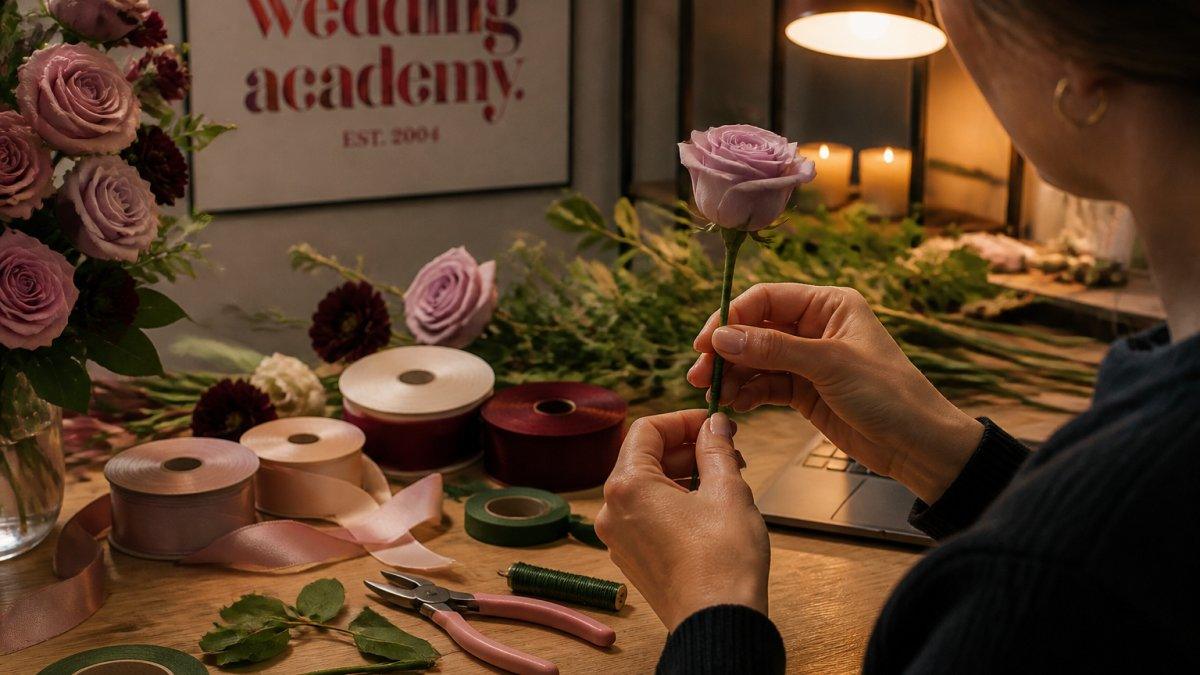
A common pattern among career changers is to over-invest in tools before understanding mechanics. Start with sharp snips, a good knife, twine, and a few reusable vessels. Add the rest once you know which techniques you actually use.
When comparing beginner programs, look for these concrete markers:
- Lesson count and pacing: A beginner course should include at least 6-8 distinct arrangements, each teaching a different mechanic (hand-tied, vase, foam-free grid, etc.).
- Demonstration style: Recorded demonstrations you can rewatch are more useful than live-only sessions when you are learning mechanics.
- Feedback loop: Check whether the provider offers written feedback on submitted work or a community forum where instructors answer questions.
- Materials list: A transparent materials list tells you whether the course assumes you have access to a flower market or teaches sourcing.
- Business preview: Even at beginner level, a module on pricing and client communication signals the course is built for earners, not just hobbyists.
A self-paced format lets you repeat a demonstration until the mechanics click, which is why many beginners pair a self-paced online course with occasional in-person workshops for feedback.
If you have no portfolio and no contacts, our guide to getting wedding industry work experience explains how to build both while you study.
Floral Design Certification: What It’s Worth and Who Recognizes It
A floral design certification is a formal qualification showing you completed structured training in design fundamentals, mechanics, and professional practice. Its value depends on two things: who issued it, and whether it covers the commercial skills clients pay for. Unlike licensed trades, floristry has no single mandatory licensing body in most regions, so a certificate functions as a credibility signal rather than a legal requirement. That makes the provider’s reputation and curriculum depth the deciding factors.
What employers and clients actually look for:
- Venues and planners care less about the certificate itself and more about whether you can deliver on the day. A qualification that includes installation planning and supplier management answers that question directly.
- Retail flower shops often value hands-on speed and consistency over formal credentials, but a certificate can shorten the learning curve and signal commitment.
- Wedding clients rarely ask to see a certificate, but they do ask for a portfolio. A certification program that includes practical assignments gives you portfolio pieces you can show.
A common pattern is that certificates carry more weight when the provider names its instructors, publishes its curriculum, and can show graduate outcomes. Before enrolling, ask for:
- A sample lesson or recorded demonstration.
- The full curriculum outline with lesson count and topics.
- Instructor credentials and industry experience.
- Graduate outcomes or testimonials that reference specific work.
What most guides miss is that the certificate is only as useful as the business skills attached to it. A qualification that teaches you to arrange but not to quote, source, or install leaves you unprepared for the work clients actually book. That is why career-focused programs increasingly pair design technique with pricing, supplier management, and client coordination.
Do not assume every online certificate carries equal weight. Before enrolling, check whether the provider names its instructors, publishes its curriculum, and can show graduate outcomes. A certificate nobody can verify is a PDF, not a credential.
If you are comparing programs, our breakdown of wedding design trends for 2026 shows which styles clients are requesting, which helps you judge whether a course covers the work you will actually be booked for.
Choosing a Wedding Floral Design Course by Career Goal
Match the course to the job you want, not the one that sounds most prestigious. A wedding floral design course should be judged on whether it prepares you for wedding-specific work: large installations, perishable logistics, and client expectations on a fixed date.
Here is how we would decide:
- You want to run your own floral business: prioritise business training, pricing modules, and lifetime access over prestige.
- You want to work in a high-end studio: an intensive in-person program with contact hours and industry mentors is worth the cost.
- You are testing the idea: start with a short workshop or a self-paced introductory course before committing to tuition.
- You need flexibility around a job: choose online, self-paced delivery with recorded demonstrations you can rewatch.
Current demand matters too. Our breakdown of wedding design trends for 2026 shows which styles clients are requesting, which helps you judge whether a course covers the work you will actually be booked for.
Cost, Format, and Support: What the Alternatives Actually Deliver
Tuition is only part of the cost. An in-person program adds travel, materials, and lost income if you take time off work.
Format drives support. In-person classes give immediate feedback on your mechanics. Online courses give you recorded demonstrations, written feedback, and the ability to revisit lessons. Neither is automatically better; they suit different learning styles.
Sustainability is worth checking in any curriculum. Mississippi State University Extension’s sustainable floral design curriculum teaches the three Rs of reduce, reuse, and recycle, and modern programs increasingly cover foam alternatives such as chicken wire, tape grids, and reusable mechanics.
One more consideration: research from North Carolina State University on consumer and florist preferences found that consumers highly value roses and care less for chrysanthemums, a mismatch worth knowing before you design to your own taste rather than your client’s.
Once trained, the next hurdle is finding clients. Our guide to marketing your wedding business online covers that step in detail.
Ask any provider for a sample lesson before you pay. A single recorded demonstration tells you more about teaching quality than a glossy brochure, and it shows whether the demonstrations are current.
Choosing a floral design program is really a decision about the career you want and the life you can fit around it. If you are ready to train without quitting your job, browse our floral design courses and start with the Certificate in Floral Design.
Frequently Asked Questions
What should I look for in an alternative to Alamo School for floral design?
Check four things before enrolling: whether the curriculum covers arrangement techniques and mechanics rather than theory alone, how the course is delivered (in person or online), what credential you finish with, and whether business training is included. A useful floral design course should teach flower selection, structure, and foam alternatives such as chicken wire or tape grids, plus how to price your work. Cost and schedule flexibility matter too, especially if you are keeping a full-time job while you retrain.
Are online floral design courses a good alternative to in-person classes?
They work well for learners who need flexibility. Online floral design courses let you study around a job, rewatch demonstrations of arrangement techniques, and practice at home with your own materials. In-person classes give you direct feedback on hand placement and mechanics. Many students combine both: a structured online certification for fundamentals and business skills, then local workshops for hands-on practice. If you are changing careers without quitting your current role, self-paced online study is usually the more practical route.
Do you have to go to college to be a floral designer?
No. Most working florists learn through vocational certificates, short courses, or studio workshops rather than a degree. A floral design certification from a recognized school signals competence to clients and venues, and it often takes weeks or months rather than years. What matters more than the qualification type is your portfolio and your ability to handle real events. Pairing a certificate with hands-on practice, such as arranging for friends’ weddings, builds the evidence clients actually ask for.
What can I use if I don’t have floral foam?
Several reusable mechanics work instead of foam. Chicken wire scrunched into a vessel holds stems in place, tape grids across the mouth of a vase create a stable pattern, and flower frogs grip stems at the base. For larger installations, natural armatures made from branches and preserved moss give structure without plastic foam. These methods are common in sustainable design teaching, and they let you reuse the same mechanics across multiple events rather than buying foam for every job.
How can I practice floral design at home while taking a course?
Buy small quantities of seasonal flowers and one type of filler, then repeat the same arrangement three ways to compare structure and balance. Photograph each attempt so you can see progress across a course. Practice the mechanics you learn, such as tape grids and water tubes, on cheap supermarket stems before using expensive blooms. Online demonstrations are easiest to follow when you pause after each step and copy it immediately, rather than watching the whole video first.