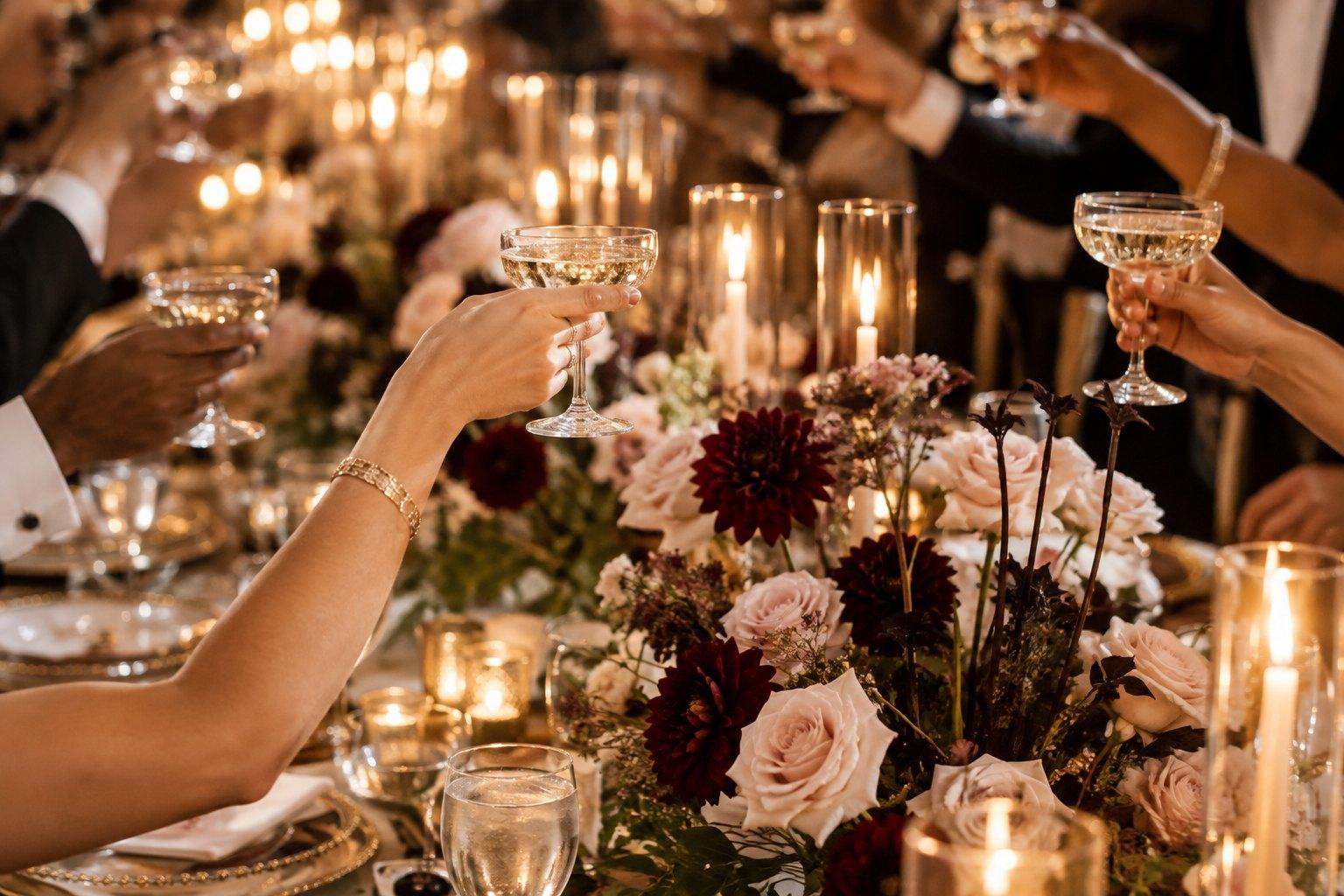
The traditional wedding speeches order is: the host or a parent of one partner speaks first, the couple (or one partner) replies, and the best person and maid or man of honour finish. Most planners schedule speeches during or between dinner courses and aim for each speech to run around three to five minutes, with all speeches together kept to roughly 20 to 30 minutes.
That’s the easy answer. The hard part is the reality: a best man with eleven pages of in-jokes, a microphone that cuts out, or a surprise speaker who wasn’t on the run sheet. This guide covers the traditional and modern wedding speeches order, the best moments to schedule them, and the practical tactics professional planners use to keep speeches warm, short and on time.
The traditional wedding speeches order
In many English-speaking countries, the classic running order looks like this:
- Father of the bride (or host) — welcomes guests, thanks everyone for coming, says a few words about the couple, and toasts them.
- The groom or the couple — thanks hosts, family, the wedding party and guests, and toasts the attendants.
- Best man — the much-anticipated speech, usually lighter in tone, ending with a toast to the couple.
Many weddings add a maid or matron of honour speech after the best man, and some include a speech from the other partner’s parent.
Modern wedding speeches order options
Today, couples are rewriting the script — and that’s a good thing. Common modern variations include:
- Both parents or both families giving a speech, or a joint speech from all parents.
- A joint speech from the couple, rather than one partner speaking on behalf of both.
- Both partners speaking individually.
- Speeches from the maid of honour and best man, or two best people for same-sex couples.
- A sibling, grandparent or close friend replacing a traditional role.
There’s no right answer — only what feels right for the couple and their families. Your job is to help them choose a sensible order and a manageable number of speakers.
| Speaker | Typical position | Suggested length |
|---|---|---|
| Host or parent | First | 3–5 minutes |
| Second parent or family member (optional) | Second | 3–5 minutes |
| Couple or partner | Middle | 4–6 minutes |
| Maid or man of honour | Near the end | 3–5 minutes |
| Best person | Last | 3–5 minutes |
How many speeches is too many?
As a rule of thumb, three to five speeches is a comfortable maximum. Beyond that, guest attention fades, dinner service is disrupted, and the dance floor opens late. If the couple wants more people to say a few words, suggest alternatives: a welcome toast at the rehearsal dinner, readings during the ceremony, or a video message montage.
When to schedule wedding speeches
There are three common approaches, each with pros and cons.
Speeches before dinner
Getting speeches done early means speakers can relax and enjoy their meal. It suits nervous speakers and keeps the evening flowing. The downside: hungry guests are less patient, so keep them tight.
Speeches between courses
The most popular option for planners. Speeches fill the natural gaps while the kitchen prepares the next course, and guests are fed and settled. Coordinate closely with the caterer so plates aren’t cleared or served mid-speech.
Speeches after dinner
Traditional, and guests are relaxed — but by then attention can wander, drinks have flowed and the evening has momentum towards dancing. If you go late, make sure speeches finish well before the first dance.
Whatever the couple chooses, lock it into the run sheet and share the exact timing with the MC, caterer, venue, photographer, videographer and band or DJ.
How planners keep wedding speeches on track
This is where experience shows. Planners rarely write the speeches, but they absolutely shape how they land.
Brief every speaker in advance
Send each speaker a short note a few weeks before the wedding covering:
- Their place in the order and approximate start time
- The suggested length (be specific — “around four minutes” works better than “keep it short”)
- Who will introduce them and where they’ll stand
- Whether there’s a microphone and lectern
- A gentle reminder that inside jokes and stories about exes rarely land well with mixed audiences
Appoint a confident MC
A good MC (master of ceremonies) introduces speakers, manages transitions, keeps energy up and can tactfully wrap things up if a speech overruns. It might be a professional, a band leader or DJ, or a confident friend. Brief them thoroughly with names, pronunciations and timings.
Do a sound check
Test the microphone at the exact spot where speakers will stand, with the room full of noise in mind. Have a backup mic and fresh batteries. Many speech disasters are really audio disasters.
Gather speakers before their turn
Five minutes before speeches begin, quietly let each speaker know. Make sure they have their notes, a drink for the toast and know where to go. Nervous speakers appreciate the warning.
Coordinate with suppliers
Tell the caterer when to pause service and when to resume. Let the photographer and videographer know when to get into position. Ask the venue to ensure glasses are filled for toasts before speeches start.
Have a plan for overruns
If a speech runs long, don’t interrupt mid-story. Instead, adjust later in the timeline — trim the gap before the cake cutting or move the first dance slightly. Build buffer time into the run sheet so a long speech doesn’t derail the night.
Helping speakers write a speech that lands
You’re not a speechwriter, but a few gentle pointers in your speaker briefing can transform the result. Many planners share a simple structure:
- Open warmly. Introduce yourself and your connection to the couple — not every guest will know.
- Tell one or two stories, not ten. Choose moments that reveal who the couple are, and that the whole room will understand.
- Say something sincere. The best speeches balance humour with genuine feeling.
- Thank the right people. Especially in the couple’s speech — hosts, families, the wedding party and suppliers who went above and beyond.
- End with a clear toast. Tell guests to stand and raise their glasses, so the moment has a clean finish.
Encourage speakers to practise aloud and time themselves. Reading at a nervous pace is usually faster than people expect — while laughter and pauses add time. Printed notes or cue cards are far more reliable than a phone screen that dims mid-sentence. If a speaker is particularly anxious, suggest they rehearse in front of one trusted person, not the whole wedding party.
Handling tricky speech situations
The surprise speaker
An uncle stands up uninvited, or a guest asks the DJ for the microphone. Agree with the couple beforehand whether unplanned speeches are welcome. If not, brief the MC and DJ not to hand over the microphone without your nod.
The speaker who’s had a few too many
Schedule speeches earlier in the evening if this is a concern. A quiet, kind word from the planner beforehand — and keeping the speech order tight — helps.
Sensitive family situations
Blended families, estranged parents or recent losses call for extra care. Talk privately with the couple about who speaks, how deceased loved ones are acknowledged, and whether any topics should be avoided. Brief speakers gently.
Language differences
If guests speak different languages, consider short bilingual speeches, printed translations or a bilingual MC. Keeping everyone included matters.
Building the speeches into your run sheet
A professional run sheet lists each speaker’s name, role, order, estimated start time and length, the person introducing them, and any audio or visual needs (a slideshow, music cue or toast). Include the caterer’s pause and resume points. When everyone works from the same document, the evening flows.
Print a pocket-sized speeches card for yourself and the MC as well: just the names, order, pronunciations and timings. On the night you won’t have time to scroll through a long document — a glance at a small card tells you exactly who’s next, how long they’ve got and what needs to happen the moment they sit down.
Run sheets, supplier coordination and reception timing are core skills taught in the Certificate in Wedding Planning, which you can study 100% online. For practical tools and checklists to support your planning, see The Wedding Planner’s Handbook by Jac Bowie. Ready to explore other study options? Visit our wedding courses hub.
Frequently asked questions
What is the traditional order of wedding speeches?
Traditionally the host or father of the bride speaks first, followed by the groom or the couple, then the best man. Many weddings also include a maid of honour speech and speeches from other family members.
How long should a wedding speech be?
Most planners suggest around three to five minutes per speaker, with all speeches combined kept to roughly 20 to 30 minutes.
When should wedding speeches happen?
Speeches are commonly held before dinner, between courses or after dinner. Between courses is popular because guests are settled and it fits naturally with catering service.
Who introduces the speakers at a wedding?
Usually an MC, which may be a professional host, the band leader or DJ, or a confident friend or family member briefed by the planner.
How can planners stop speeches running too long?
Brief speakers early with a specific time guide, appoint a strong MC, gather speakers before their turn and build buffer time into the run sheet.
Want to run receptions where every speech, toast and transition lands perfectly? Learn professional run sheets and wedding-day coordination with The Wedding Academy — online, at your own pace.