

Ask any established wedding supplier where their bookings come from and you will hear a version of the same answer: other suppliers. Not the algorithm, not the directory listing, not the expensive ad. The photographer who mentioned them, the venue coordinator who handed over a card, the florist who said “you should talk to her”.
That is the referral network, and it is the single most valuable marketing asset in the wedding industry — because a recommendation from a trusted supplier arrives pre-qualified, at the exact moment the couple is making decisions, with none of the price scepticism a cold enquiry brings.
The problem is that most new suppliers try to build one backwards. They collect contacts, post in groups, ask for referrals from people who have never seen them work, and wonder why nothing happens. Here is how it actually gets built.
Why supplier referrals convert better than any ad
A couple choosing a wedding planner is making a high-trust decision with almost no way to judge quality in advance. They cannot test you. They cannot see you work before they pay. So they outsource the judgement to someone they already trust.
When a venue coordinator says “we love working with her”, three things happen at once: the trust problem disappears, the comparison shopping stops, and price becomes a secondary question. That is why a referred enquiry is a different animal from a cold one — it usually arrives ready to book rather than ready to compare.
- It arrives at the decision moment, not the daydreaming moment
- It comes with borrowed credibility you did not have to build
- It filters for fit — suppliers refer couples who suit your style
- It costs nothing but relationship and reliability
- It compounds: one good wedding creates several referrers at once
Who belongs in your referral circle
Not every supplier is equally useful, and it has nothing to do with how big their following is. The best referrers are the ones who talk to couples before they need you.
| Supplier | Why they matter | When they meet the couple |
|---|---|---|
| Venues | They hold the recommended supplier list and see every wedding | Very early — often first |
| Photographers | Booked early, trusted enormously, talk to couples all year | Early |
| Celebrants | Personal, trusted, and involved in the ceremony detail | Early to mid |
| Florists and stylists | Overlap with your work and hear the whole vision | Mid |
| Hire companies | See who runs an organised install and who does not | Mid to late |
| Hair, make-up and bridal boutiques | Long, chatty appointments where recommendations happen naturally | Early to late |
| Caterers and bar teams | Care deeply about run sheets and organised planners | Mid |
Start with venues and photographers. If you can only build two relationships this year, build those.

How to build the network from a standing start
1. Be specific about who you are
Nobody refers a generalist. “I plan weddings” is unmemorable. “I run relaxed, tightly organised weddings for couples who hate fuss, mostly in coastal venues” is something a photographer can repeat word for word. Your positioning is what makes you referable.
2. Give first, and give something real
The fastest way into a supplier’s good books is to make them look good. Tag them properly with real commentary about what they did. Write them a thoughtful review. Send them the images you took of their work. Recommend them to a couple who did not book you. Generosity is remembered far longer than a polite message asking for work.
3. Meet people in person where you can
Open days, venue showcases, industry breakfasts, styled shoots, association meet-ups. An hour face to face does more than six months of commenting. If in-person is genuinely impossible, a video call beats a message, and a message beats a like.
4. Be the easiest supplier on site
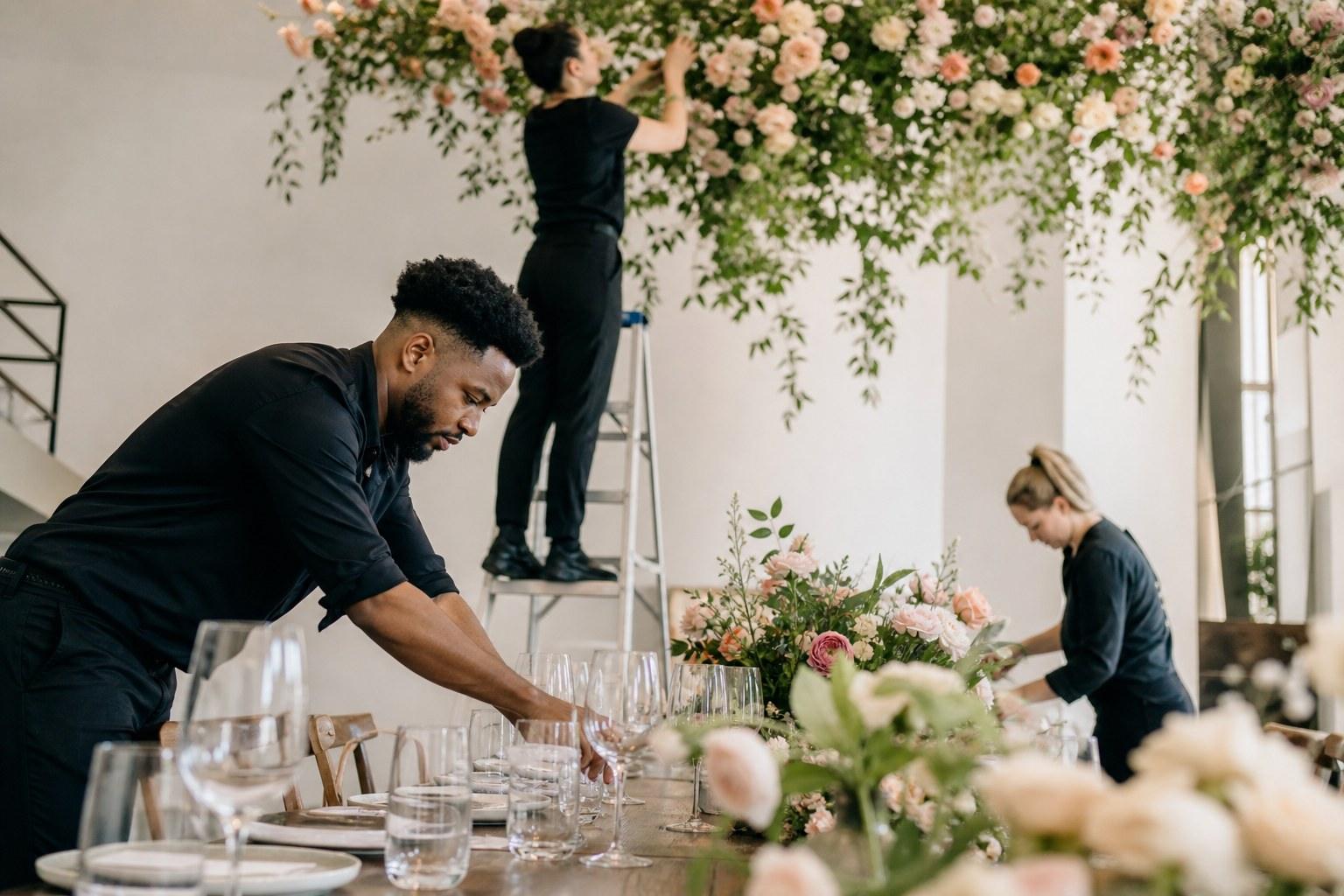
This is the whole game. Referrals are earned on wedding days, not in DMs. Arrive when you said you would, know the run sheet, keep your area tidy, feed and water your team, respect the venue’s rules, never publicly blame another supplier, and stay to help when something goes wrong that is not your job.
5. Follow up while it is fresh
The week after a wedding is the most valuable week of the year for your network. Thank the suppliers who made your day easier — specifically, not generically. Share images with credit. Ask the venue if you can be added to their supplier list now that they have seen you work.
The styled shoot shortcut — done properly
A collaborative styled shoot puts you in a room with a photographer, a florist, a stylist, a venue and a hire company, all producing work together. Done well it gives you portfolio images and five relationships in a single day.
Done badly it annoys everyone. So:
- Have an actual concept, written down, with a mood board — not “something moody”.
- Agree image usage and credit rules before anyone commits.
- Be clear about who pays for what and who owns the leftovers.
- Do the unglamorous jobs: schedule, permits, food, clean-up.
- Deliver on your promises afterwards — publish, credit and share on time.
The suppliers who organise shoots well get invited to everything afterwards. The ones who over-promise and disappear do not get a second one.
Keeping the network alive
A referral network decays if you only appear when you need something. Maintenance is light but it has to be consistent.
- Keep a simple list of your key suppliers, what they specialise in and when you last spoke
- Send referrals out deliberately — track who you have sent work to, not just who sent you work
- Check in seasonally with something useful: a date you have free, a venue update, a lead that suits them
- Say no gracefully when a referral is not a fit, and pass it to someone who is
- Never bad-mouth a supplier to a couple. It always travels, and it always costs you
Turning referrals into a booking system
Referrals still need to land somewhere that converts. If a photographer sends a couple to your website and it is a slow gallery with no clear next step, the trust they lent you leaks away.
- Make it obvious what you do, where you work and who you are for, within seconds
- Give one clear next action — enquire, book a call, download the guide
- Reply to referred enquiries fast, and mention the referrer by name
- Tell the referrer what happened. People refer again when they see the loop close
- Ask referred clients how they found you, so you know which relationships are actually working
Marketing a wedding business is a learnable system: positioning, portfolio, enquiry handling and the supplier relationships that feed all three. That is exactly what the Certificate in Wedding Business & Marketing covers. If you are still building the craft alongside the business, the Certificate in Wedding Planning is the natural starting point, and the Advanced Certificate pulls planning, styling and business together for people scaling up.
Build the circle before you need it. The suppliers who send you work next year are the ones you are being decent to right now.
Ready to build a wedding business that gets recommended?
Learn positioning, marketing, enquiry conversion and supplier relationships with globally recognised online certification you can study at your own pace.
Frequently asked questions
How do wedding planners get referrals from venues?
By being easy to work with on site, not by asking early. Venues refer the suppliers who leave the space clean, hit the timings, and never create work for the venue’s staff. Introduce yourself properly, do one job impeccably, and then ask whether they keep a recommended supplier list.
Should I pay for wedding referrals?
Referral fees and commissions exist in the industry, but they change the relationship and in some markets they must be disclosed to the couple. A reciprocal, unpaid referral relationship built on genuine trust is more durable and far less complicated. If you do pay or receive a fee, be transparent about it.
How many supplier relationships do I actually need?
Fewer than you think. A small circle of suppliers who genuinely know your work will send you more than a hundred acquaintances who once liked your post. Depth beats reach in referral networks.
What if I am brand new and have nothing to refer back?
Give what you do have: a genuine review, an introduction to someone else, useful information about a venue, sharing their work with real commentary, or your time on a styled shoot. New suppliers who are generous and reliable get remembered.
How do I ask another supplier for a referral without being awkward?
Do not ask for a referral. Ask a question you actually want answered — how they work, what their ideal couple looks like, what makes a planner easy for them to work with. Referrals follow relationships; they do not replace them.



