
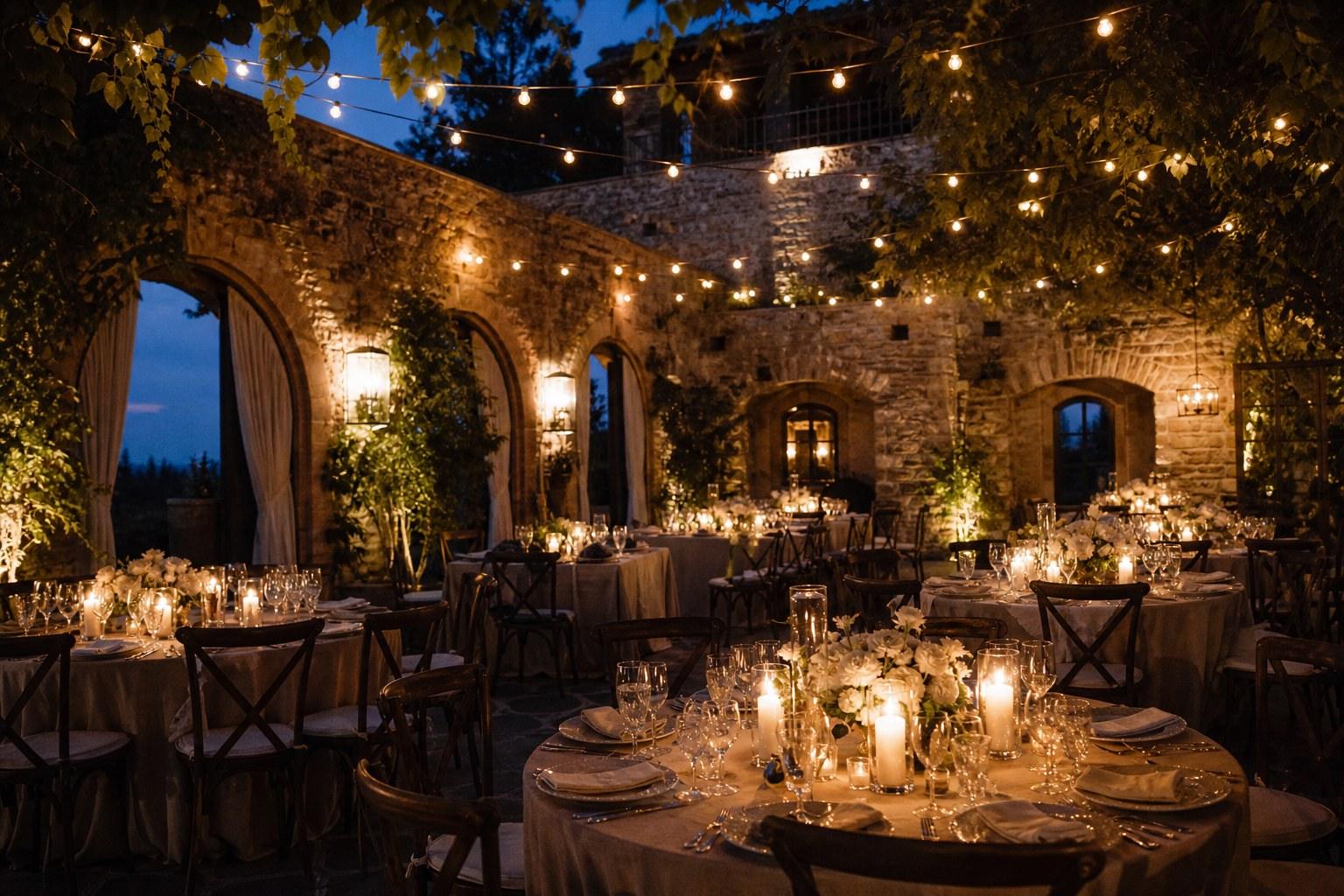
Here’s the uncomfortable truth about wedding styling: you can spend the entire décor budget on flowers, linen and signage, and if the room is lit like a conference centre at 9pm, none of it will read. Lighting is the cheapest, fastest, most dramatic lever a stylist has — and it’s the one most people leave to the venue.
Wedding lighting design isn’t about buying more fairy lights. It’s about deciding what the room should feel like, then controlling where light lands, how warm it is, and what it hides. Get it right and a beige function room turns into somewhere people don’t want to leave.
This is how to plan lighting like a stylist — the layers, the practical kit, the mistakes, and how to talk about it with venues and couples so it actually gets budgeted.
Start with the feeling, not the fixtures
Before you price a single uplight, answer three questions with the couple:
- What time of day does each part of the event happen? A 3pm ceremony in a glass atrium is a shading problem. A 6pm winter ceremony is a lighting problem.
- What should the room feel like at 8pm? Candlelit and intimate? Glamorous and high-contrast? Garden party glow?
- What do we want to disappear? Fire exits, ugly carpet, a beige wall, an air-conditioning unit, the pull-down projector screen.
That third question is where the professionals separate from the amateurs. Light is subtractive as much as additive: you choose what’s visible. Darkness is a design material.
We build this way of seeing a room in the Certificate in Wedding Styling — because styling is composition, not shopping.
The four layers of wedding lighting design
Think in layers, the way a photographer or a theatre designer does. Every good room has all four.
1. Ambient light — the base level of the room
This is the overall brightness: house lights, dimmed chandeliers, festoon strung overhead, daylight through windows. Your first job is almost always to bring it down. Ask the venue what can be dimmed independently and whether anything is on a single switch — house lighting you can’t zone is the number one thing that flattens a beautiful reception.
2. Feature light — what you want people to look at
Uplights on architecture, pinspots on centrepieces and the cake, a wash on the ceremony backdrop, a glow behind a floral installation. Feature light creates the hierarchy in the room: eyes go where the light is brightest. If everything is equally lit, nothing is special.
3. Decorative light — the fixtures that are part of the styling
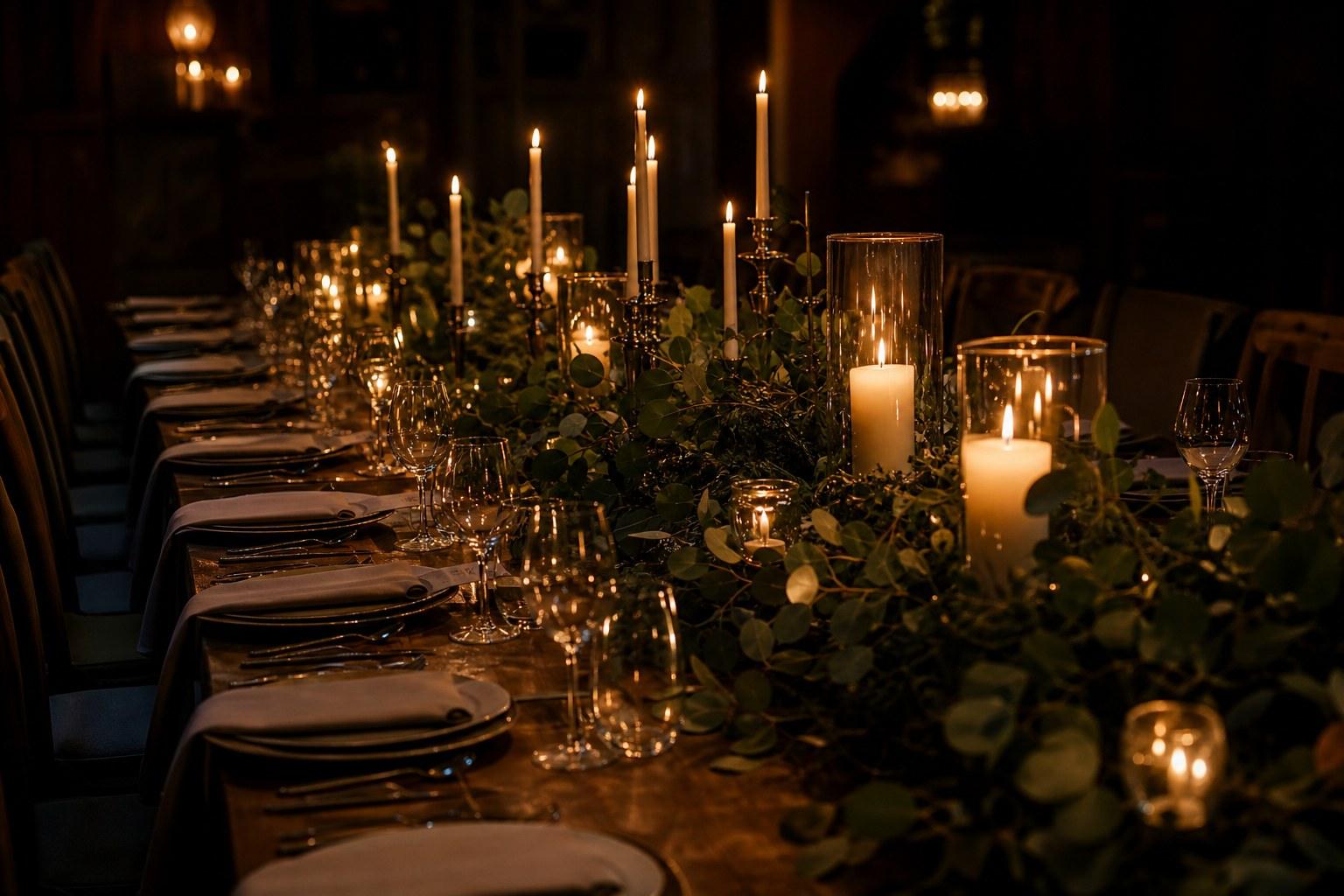
Candles, tapers in bud vases, hurricanes, pillar clusters, lanterns lining an aisle, festoon over a courtyard, a rented chandelier over a long table. These read in photographs as texture and warmth. They’re also what guests describe afterwards when they say the room felt magical.
4. Working light — the light nobody is supposed to notice
Bar, buffet, service doors, stairs, the accessible path to the bathrooms, a lit seating chart guests can actually read. Get this wrong and your gorgeous dark room becomes a hazard and a service bottleneck. Light the tasks, not the whole room.
Colour temperature: the detail that makes or breaks the photos
Warm light flatters skin, timber, brass, candlelight and cream linen. Cool light makes skin look grey and food look unappetising. For weddings you almost always want warm — in the region of candle to soft-white warmth — and, critically, you want it consistent.
Mixed colour temperature is the most common lighting error at real weddings: cool-white venue downlights, warm festoon, a blue-tinged LED uplight and a fluorescent kitchen doorway all fighting in the same frame. The photographer can correct one colour of light. They cannot correct four.
- Ask the venue what their house globes are, and whether they can be dimmed or swapped.
- Choose one warm target and match every rented fixture to it.
- Be deliberate about coloured light. Deep amber on stone can be beautiful; magenta wash across a bridal party rarely is.
- Kill the cool-white spill from kitchens, corridors and back-of-house wherever you can — a closed door is free.
How to light the four key wedding spaces
The ceremony
Outdoors in daylight, lighting is shade management — check where the sun will be at ceremony time, and avoid a setup where the couple squints or half the aisle is in harsh sun. Indoors or after dark, light the couple’s faces first, the backdrop second, and the aisle path third so guests can walk safely. Never place a bright light directly behind the couple unless you want silhouettes.
Cocktail hour
This space works on pools of light: bar, food stations, a couple of lit clusters people can gather around. Leave the edges softer and darker — it makes a half-full space feel intimate instead of empty.
The reception
Tables want a soft downward glow plus candle warmth at eye level. Pinspots on centrepieces are one of the highest-impact rentals in the industry: they make flowers glow and drop the surrounding room away. Then plan the transition — house lights down as speeches end, dance floor lighting up as the first dance starts. Lighting is how you signal a change of energy without announcing it.
The dance floor
Coordinate with the DJ or band early — their kit is part of your design whether you planned for it or not. Agree what stays off during dinner, what colour their effects run, and where their trussing sits in your sightlines. A single conversation prevents the sad sight of laser-green dots across a candlelit tablescape.
The practical checklist stylists actually need
Lighting is where styling meets engineering. Walk the venue with this list:
- Power. Where are the outlets, how many circuits, and what’s already plugged into them? Bar fridges, band gear and your lighting can’t all share one overloaded circuit.
- Zoning and dimming. Which lights are on which switch, and who physically controls them on the night? Get a name.
- Rigging. Can anything be hung? What’s the load limit, and does the venue require a licensed rigger?
- Open flame rules. Many venues restrict real candles or require enclosed flames. Ask in writing, and price quality LED tapers as a backup.
- Cable safety. Gaffer tape, cable ramps, nothing crossing a walkway untaped. This is a trip hazard and an insurance issue.
- Bump-in and bump-out time. Lighting takes longer to install than linen and longer to pack down than anything else. Book the hours.
- Weather plan. Outdoor fixtures need to be rated for it, and festoon in wind needs proper tensioning.
When a job needs trussing, dimmer boards or serious rigging, hire a professional lighting supplier and coordinate them. Knowing your limit — and having the vendor relationships to cover it — is a mark of a senior stylist, not a weakness. Building that supplier network is part of what we cover in the Certificate in Wedding Business & Marketing.
How to sell lighting to couples who think it’s optional
Couples don’t picture lighting when they picture their wedding — they picture flowers. So show, don’t explain. Keep two reference images of the same style of room: one under standard house lighting, one properly lit. The difference sells itself in about four seconds.
Then frame it in outcomes: every photograph they’ll keep forever is a photograph of light. Lighting protects the money they’ve already spent on flowers, dress, venue and photographer. Positioned that way, it stops being an add-on and becomes insurance.
Practical tip for proposals: quote lighting as a design line item with its own labour hours, not as a vague “extras” figure. It’s skilled work, it takes real time on site, and pricing it properly is how stylists stay profitable — something we go deep on in the Advanced Certificate in Wedding Planning, Styling and Business.
Wedding lighting design FAQs
What is wedding lighting design?
It’s the deliberate planning of every light source at a wedding — ambient, feature, decorative and working light — so the space looks intentional, photographs well and supports the run of the event. It covers brightness, colour temperature, placement, dimming and safety, not just decorative fixtures.
What lighting makes the biggest difference at a wedding reception?
Dimming the house lights, then adding warm decorative candlelight at eye level and pinspots on centrepieces. That combination changes the mood of a room more than any other single move.
Do I need a professional lighting supplier?
For candles, battery fixtures, festoon on existing hooks and simple uplights, a skilled stylist can handle it. Bring in a specialist for rigging, hanging installations, dimmer control, large marquees or anything requiring electrical work or load certification.
Can you use real candles at a wedding venue?
Sometimes — many venues restrict open flame or require candles to be enclosed. Always confirm in writing before you design around them, and have quality LED alternatives ready.
How do you light an outdoor wedding after dark?
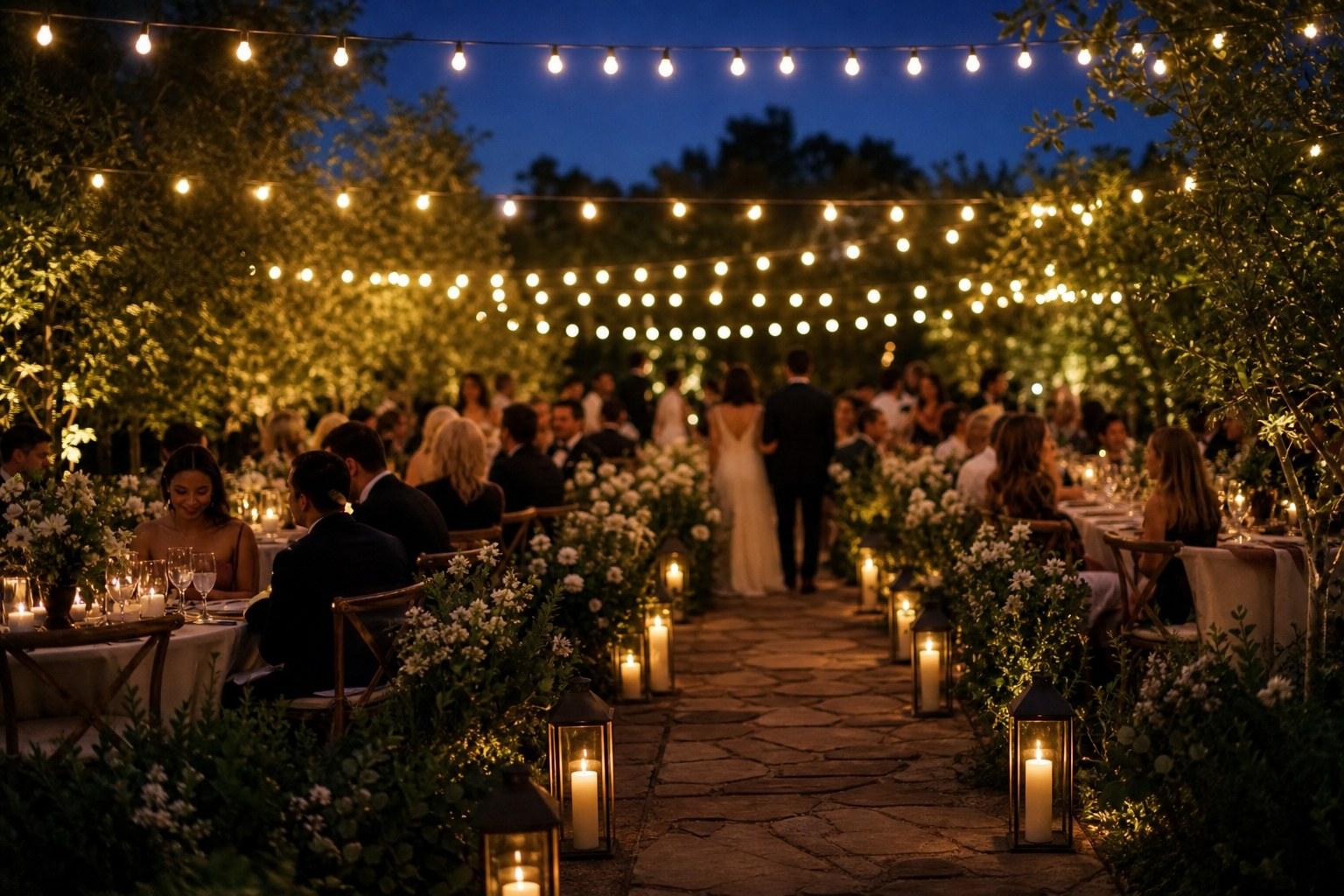
Layer it: overhead festoon or string for ambient glow, weather-rated fixtures on trees or structures as features, lanterns or ground lighting on paths for safety, and candles on tables for warmth. Confirm power access and a wet-weather plan before you commit to the design.



