
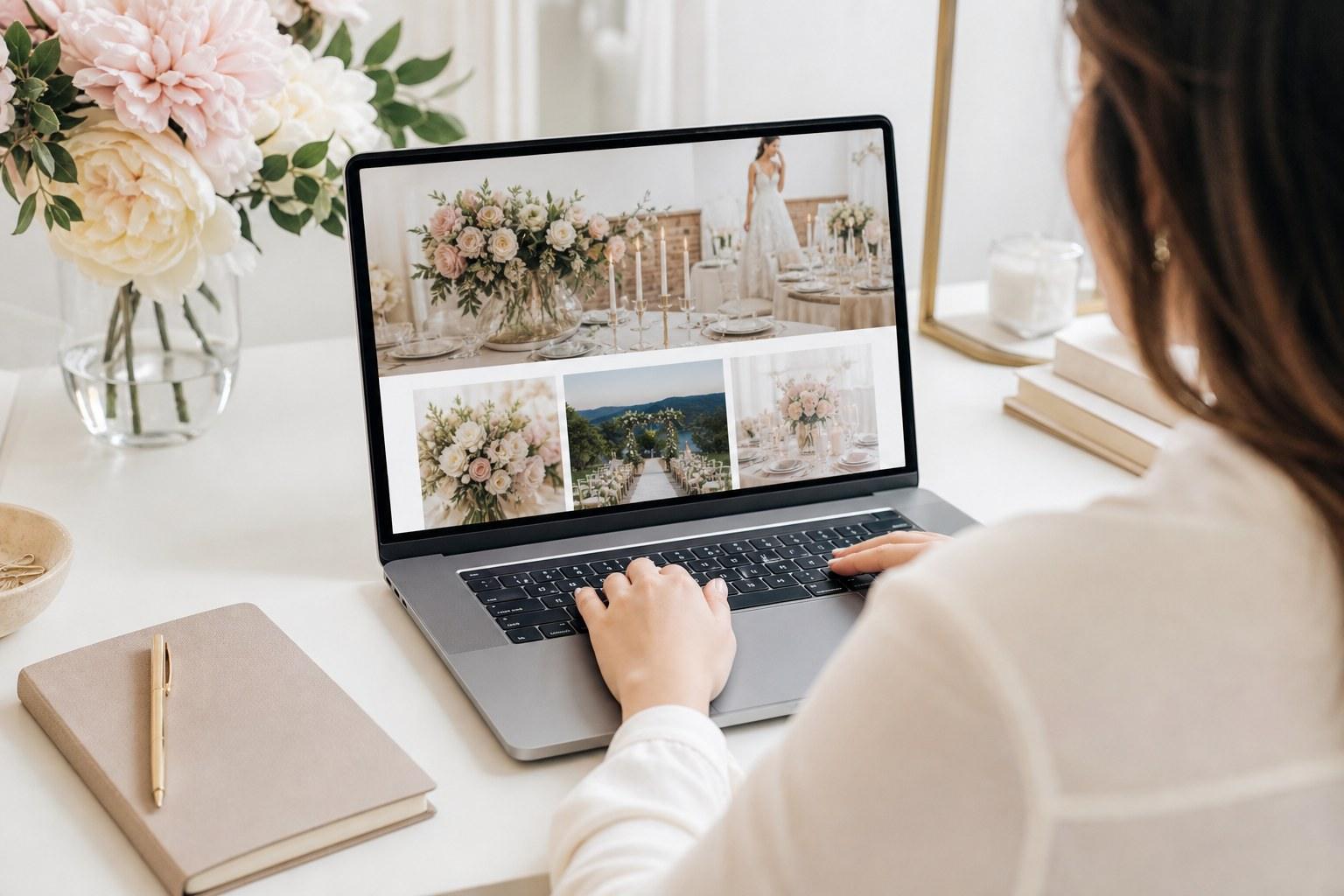
Most wedding businesses don’t have a website problem. They have a “seventeen pretty pages and no enquiries” problem. Couples land, scroll, admire the photos — and leave without ever telling you their date.
A wedding business website is not a portfolio. It’s a booking machine with a portfolio bolted to the side. Its whole job is to take a stranger who found you on Instagram or Google at 11pm and move them, in one sitting, from “ooh, nice” to “I’ve sent the form.”
So let’s talk about the pages that actually book couples — what goes on each one, in what order, and which of your current pages are quietly costing you work. 💍
What a wedding business website is actually for
Before you argue about fonts, get clear on the one job. Your site has to do four things, in this order:
- Confirm they’re in the right place. What you do, who you do it for, where you work — visible without scrolling.
- Make them feel something. Real images of real work, in your actual style.
- Answer the objections. Process, inclusions, availability, how you charge.
- Make enquiring stupidly easy. One obvious next step, repeated on every page.
Everything else — the blog, the press logos, the “our philosophy” essay — is support material. If a page doesn’t push one of those four jobs forward, it’s decoration.

The five pages every wedding business website needs
You don’t need twenty pages. You need five that work hard, and the discipline to stop adding more until those five convert.
1. The home page — clarity before beauty
Your hero section needs a sentence a stranger can read in three seconds: what you are, who you serve, where. “Wedding planner for relaxed coastal weddings in South West WA” beats “creating unforgettable moments” every single time. Poetry is lovely. Poetry does not tell a bride whether you travel to her venue.
Under the hero: a short “who this is for” block, three to six of your strongest images, a plain-English summary of your services, one piece of proof, and a call to action. That’s the whole page. Resist the urge to explain your entire life story above the fold.
2. The services page — kill the guesswork
This is where most enquiries are won or lost. Couples are trying to work out two things: is this the level of help I need, and can I afford it? Give them named packages, clear inclusions, and an honest statement about investment. If you don’t publish exact figures, publish a starting point or a range with context — “most couples invest in the mid-range package” is infinitely better than silence.
Silence doesn’t create intrigue. It creates a bounce to the competitor who told them something. Every price question you dodge on the page becomes a tyre-kicker email you have to answer manually.
3. The portfolio — fewer weddings, told properly
Three fully documented weddings beat thirty galleries of near-identical centrepieces. Give each one a short story: the couple, the venue, the brief, the problem you solved, what you actually did. Couples are not judging your photography — they’re judging whether you can handle their day.
Only show the work you want more of. If you never want to style another balloon arch, remove the balloon arch. Your portfolio is a shopping menu; people order from it.
4. The about page — the second most visited page you own
Couples hire a human. Show your face — a real photo, not a silhouette in a field. Say how you work, what you’re like on a stressful morning, why you got into this, and what kind of couple you’re brilliant for. Then, crucially, put an enquiry button at the bottom. Loads of people read about pages last and enquire from them, and half the industry sends those readers to a dead end.
5. The contact page — one form, few fields, no friction
Ask only for what you need to reply usefully: names, email, wedding date, venue or region, guest numbers, what help they’re after, and one open box. That’s it. Every extra field is a chance for them to give up. Put your response time in writing (“I reply within two business days”) and add an automatic confirmation email so nobody sits there wondering if it sent.
This is the exact structure we build out inside the Certificate in Wedding Business & Marketing — because a beautiful site with a broken enquiry path is just an expensive hobby.
Wedding business website page checklist
| Page | Its one job | Must include | Common mistake |
|---|---|---|---|
| Home | Confirm they’re in the right place | Who / what / where in the hero, best images, one CTA | Vague slogan, no location, slow full-screen video |
| Services | Match the couple to a package | Named packages, inclusions, investment guidance | Hiding all pricing information |
| Portfolio | Prove you can handle their day | Full stories, credits, only the work you want more of | Endless unlabelled galleries |
| About | Make you hireable as a human | Real photo, working style, ideal couple, CTA | Third-person waffle and no next step |
| Contact | Capture a usable enquiry | Short form, date, venue, budget-fit question, auto-reply | Twenty fields, or only an email address |
How to write website copy that books couples
Write like you talk to a couple over coffee. Second person, short sentences, no industry jargon. “Bespoke curation of your love story” means nothing. “I’ll build your run sheet, brief your suppliers and run the day so your mum can actually sit down” means everything.
Three habits that lift enquiries without redesigning anything:
- Lead with their problem, not your process. They don’t want a planner. They want to stop feeling behind.
- Name your ideal couple out loud. Being specific repels the wrong enquiries — that’s a feature, not a risk.
- End every page with one action. Same words, same button, every time. Choice paralysis kills conversion.
And read it aloud. If you’d never say a sentence to a real bride’s face, delete it.
Wedding website SEO: how couples actually find you
Search is where the couples with a date and a budget live. They’re not typing “luxury bespoke storytelling” — they’re typing “wedding planner Byron Bay” and “florist for small wedding Melbourne”. So your pages have to use the words they use.
Put your location in your titles
Your service and home page titles should carry your service plus your region. One line of plain text in the right place does more for local search than a year of hashtag experiments.
Build venue and location pages
A page per venue you’ve genuinely worked at — what the space is like, logistics you learned, images from that day — is some of the highest-intent content a wedding supplier can own. Couples search their venue name constantly. Be there when they do.
Blog for questions, not for algorithms
Write the answers you give on every consult call: how far out to book, what a coordinator actually does on the day, wet-weather plans. Each post is a search entry point and a shortcut you can send to clients later. Two useful posts a month, forever, beats twelve in one panicked weekend.
Fix the boring technical stuff
Compress your images — wedding sites are notorious for enormous files. Check every page on your phone, because that’s where most couples browse. Make sure your site loads over HTTPS, that your business name, region and contact details are consistent everywhere, and that nothing important is trapped inside an image with no alt text.
The enquiry path: what happens after they click send
Your website’s job doesn’t end at the form. The gap between enquiry and reply is where bookings evaporate — couples email several suppliers in one sitting, and the fast, clear, warm reply usually wins.
Build the path deliberately: form submitted → instant confirmation with what happens next → your personal reply with availability and a call link → a simple proposal → contract and deposit. Same sequence every time, mostly templated, personalised at the top and bottom. That’s how you stop losing work to the person who replied first.
Also: check your own form. Send yourself a test enquiry today. A shocking number of wedding businesses discover their form has been silently failing for months, or landing in spam. If you also style or plan, the Certificate in Wedding Planning and Certificate in Wedding Styling pair neatly with the business side — skills to deliver, systems to sell.
Do you need a website if you have Instagram?
Yes. Social is rented ground — the reach changes, the account can vanish, and nobody can search your feed for “wedding stylist near me”. Your site is the one asset you own, the one place you control the story, the pricing and the enquiry form.
Treat social as the front door and your wedding business website as the room where the decision happens. One drives attention; the other converts it. Getting that hand-off right is the core of the Certificate in Wedding Business & Marketing.
Wedding business website FAQs
How many pages should a wedding business website have?
Five core pages — home, services, portfolio, about and contact — will carry a new wedding business comfortably. Add venue pages, location pages and a blog once those five are converting, not before.
Should I put my prices on my wedding business website?
Give couples something to work with, even if it’s a starting point or a range rather than a full price list. Total silence on investment filters nobody and simply moves the conversation to a supplier who was clearer.
What should be on a wedding planner’s contact form?
Names, email, wedding date, venue or region, approximate guest numbers, the kind of help they want, and one free-text box. Keep it short, state your reply time, and send an automatic confirmation so they know it landed.
Do I need a designer, or can I build it myself?
A well-chosen template you can update yourself usually beats a custom build you’re afraid to touch. Get the structure and words right first — those are what book couples. Bring in a designer when the site is earning enough to justify it.
How often should I update my wedding business website?
Refresh your portfolio each season with your newest and most on-brand weddings, review services and inclusions at least once a year, and test your enquiry form monthly. Small, regular upkeep beats a total rebuild every three years.
Build the website — and the business behind it
A wedding business website works when the offer is clear, the copy sounds like you, the portfolio shows the work you want, and the enquiry path is fast. That’s it. No redesign required — just decisions.
If you’d rather learn the marketing, packaging and enquiry systems properly instead of guessing, come and do it with us. Enrol in the Certificate in Wedding Business & Marketing and build a site that books.



