
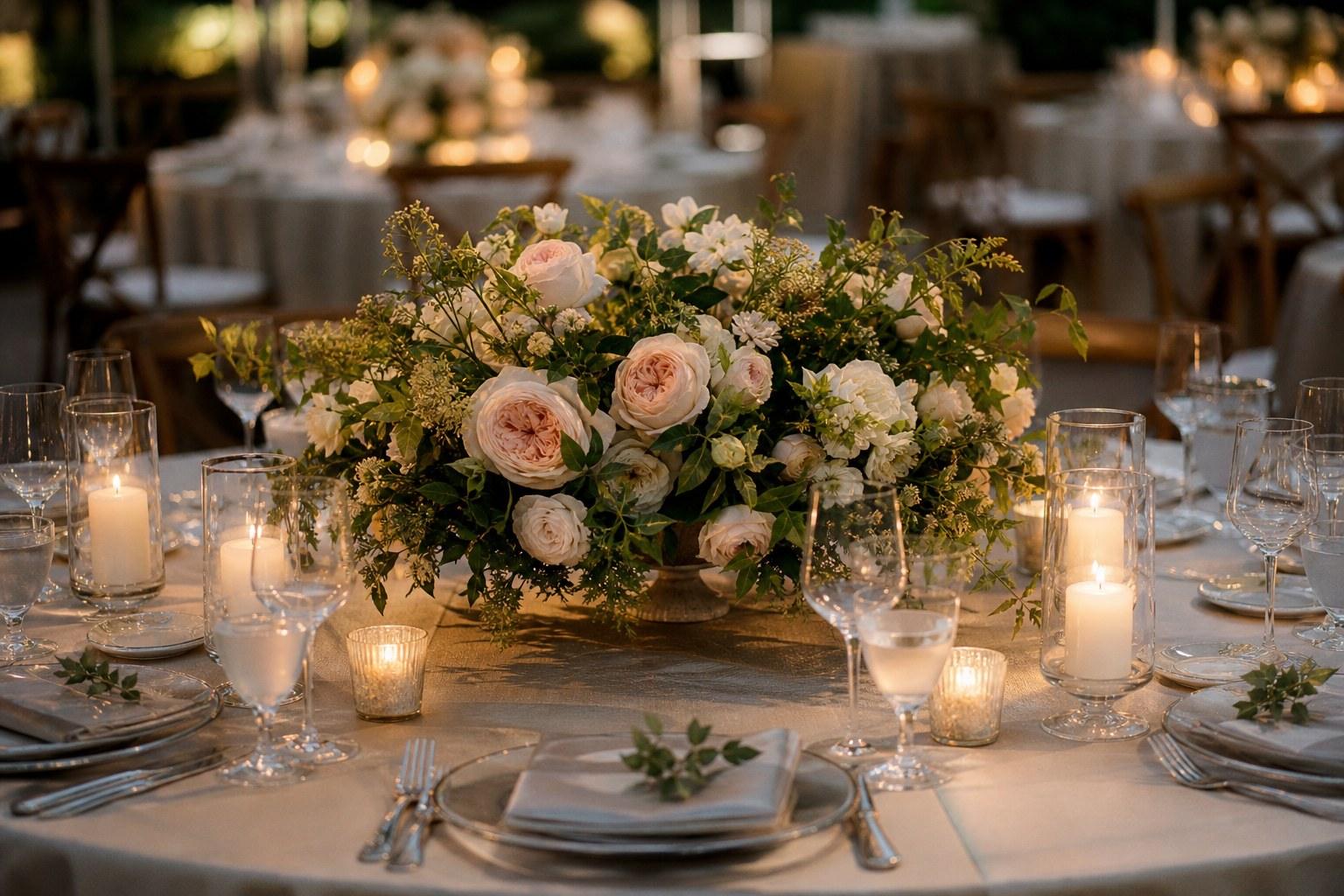
Centrepieces are where most florists quietly lose money — and where most weddings quietly lose their atmosphere. They’re repeated fifteen, twenty, thirty times across a room, so every design decision you make gets multiplied: every stem, every minute of labour, every vessel you have to collect at midnight.
Which makes wedding centrepieces the single best place to learn floral design properly. Get them right and the room feels considered from the doorway. Get them wrong and you’ve built thirty small arrangements that block sightlines, wobble on the table and eat your margin alive.
Here’s how to design table flowers that actually work — for the couple, for the room, for the photographer and for you.
Start with the table, not the flowers
Every good centrepiece starts as a measuring exercise. Before you sketch anything, get the facts from the venue and the stylist:
- Table shape and size — round, long trestle, square, or a mix
- How many guests per table, and how much usable surface is left after plates, glassware and cutlery
- Whether service is plated, shared-plate or grazing — shared platters eat the middle of the table
- What else is going on the table: candles, menus, name cards, favours, bud vases, a runner
- Ceiling height and lighting — a dark barn and a bright marquee want completely different designs
- Who is setting up, when the room is released, and when it has to be cleared
Shared-plate service is the one that catches people out. If the caterer is landing bowls down the centre of a long table, your beautiful continuous garland has nowhere to live — and someone will move it mid-service, badly. Ask early, design around it, and put the answer in writing.
Low or tall wedding centrepieces? How to choose
The classic rule is that guests should be able to see and talk across the table — so keep arrangements below roughly eye level when seated, or lift them clearly above it on a stand. The dead zone in between is where conversation goes to die.
Low centrepieces
Lush, intimate and forgiving. They suit round tables, low ceilings and couples who want the room to feel warm rather than grand. They’re also easier to transport and less likely to be knocked over by an enthusiastic uncle. The trade-off: you need more of them across a long table, and they can disappear visually in a very large or very dark room.
Tall centrepieces
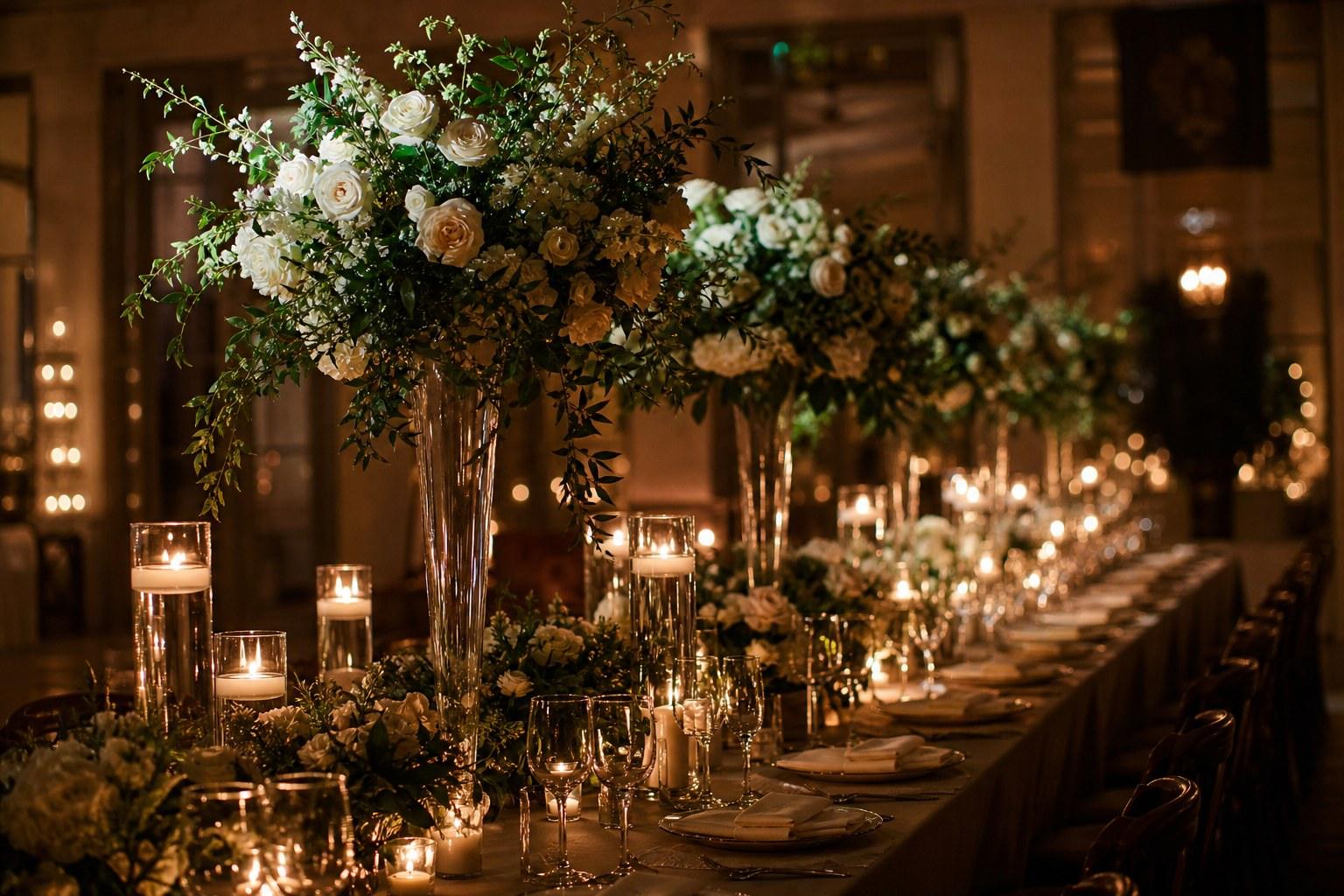
Tall arrangements on stands, candelabra or footed vessels give height, drama and a strong photographic layer at the top of the frame. They work beautifully in rooms with height to fill. The trade-offs are real though: stability, wind if you’re outdoors, transport, and the risk of guests peering around a stem all night. Test the sightline yourself — sit at the table before you sign it off.
Mixed heights
Alternating tall and low across a room is often the smartest answer. You get drama in the photographs and comfort at most tables, and you can put the low designs where sightlines matter most — near the top table, near speeches, near elderly guests.
Wedding centrepiece styles and what each one demands
| Style | Best for | Watch out for |
|---|---|---|
| Low compote or footed bowl | Round tables, garden and romantic looks | Needs enough stems to look full from every angle — it’s seen in 360° |
| Tall stand or candelabra | High-ceilinged rooms, formal and dramatic looks | Stability, transport, sightlines, and rigging time on the day |
| Runner or garland | Long trestle tables, editorial and modern looks | Labour-heavy; conflicts with shared-plate service and candle placement |
| Bud vase cluster | Smaller budgets, mixed-height tables, relaxed weddings | Lots of small vessels to fill, transport, set and collect |
| Potted or living plants | Sustainable briefs, gifting to guests, longer venue dressing | Weight, soil mess, and matching pot finishes across the room |
| Candles plus minimal florals | Tight budgets, atmospheric evening receptions | Venue open-flame rules — always check before you promise it |
None of these are “better”. They’re different trades between money, labour, drama and risk. Naming that trade-off out loud in a consultation is what makes you sound like a professional rather than a hobbyist with a bucket of roses. It’s the exact skill we drill in the Certificate in Floral Design — design decisions with reasons attached.
How to design table flowers that hold up all night
1. Build a mechanic you trust
Chicken wire, a reusable pin frog, a taped grid across the vessel mouth — whatever you use, it has to hold stems at angle without slumping when the room warms up. Foam-free mechanics are now the default expectation on a lot of briefs, so learn them properly rather than treating them as a compromise. Water volume matters too: a shallow vessel with a big head of thirsty flowers will wilt before the mains land.
2. Work in layers, not in one pass
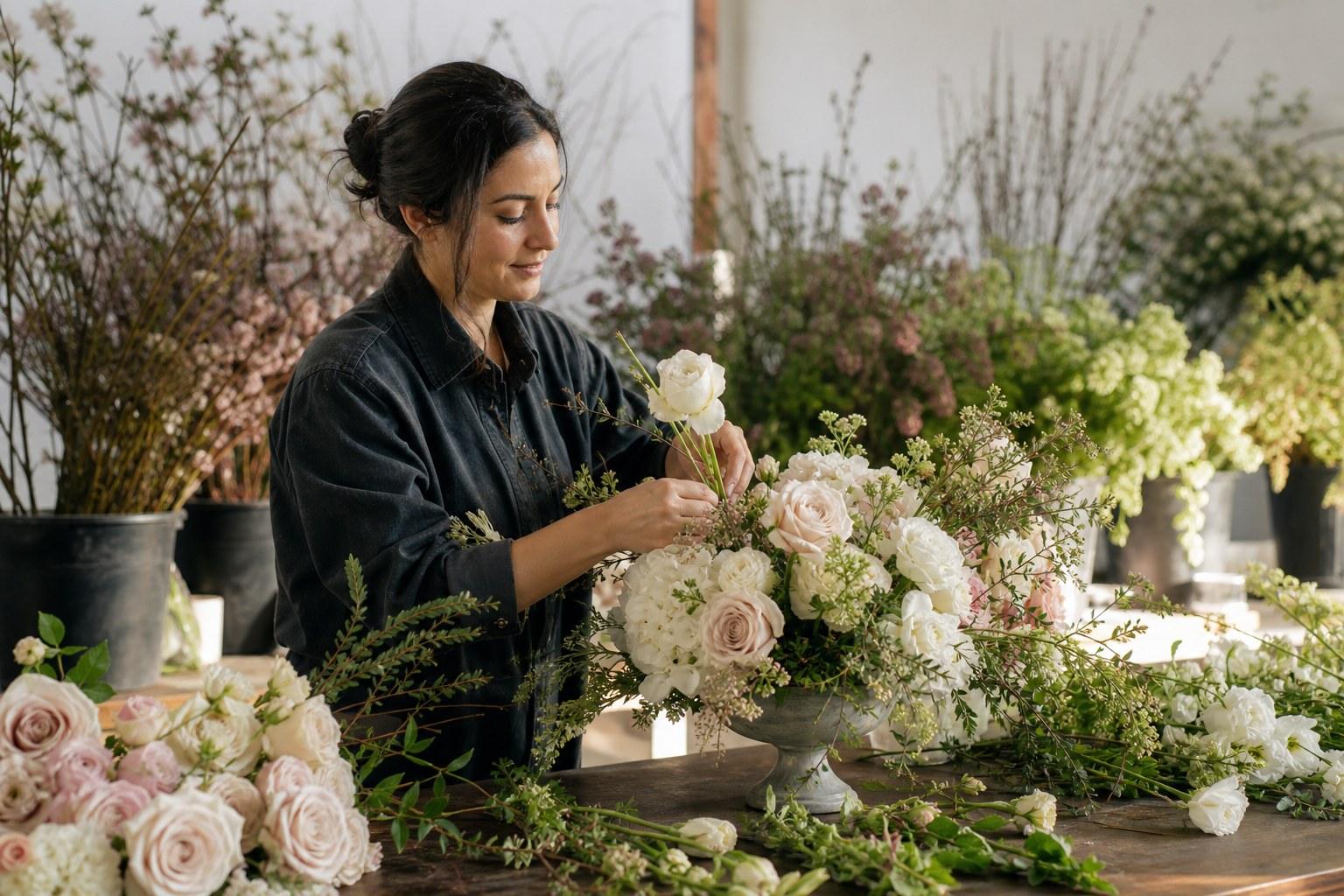
Foliage and structure first, to set the shape and the width. Then your focal blooms, placed at slightly different depths so the arrangement has a front and a back to the eye even when it’s viewed from all sides. Then secondary flowers to fill the gaps, then your texture and movement — the airy, wispy things that stop it looking like a supermarket bunch in a bowl.
3. Design for 360 degrees
A centrepiece has no back. Turn the vessel constantly as you build, and check it at seated eye level rather than looking down at your bench. What reads as lush from above can look thin and gappy from a chair.
4. Respect the negative space
The gaps are part of the design. Cramming every hole makes an arrangement look tight and cheap, oddly enough — the loose, garden-gathered look that couples ask for comes from confident spacing and asymmetry, not from more stems.
5. Prototype before you scale
Always build one sample before the wedding week. Photograph it, time yourself, count the stems. That single prototype tells you your real per-table stem count, your real labour minutes and whether the design survives being carried across a car park. Guessing at any of those is how florists end up working for nothing.
Making wedding centrepieces profitable, not just pretty
Repetition is the whole story. A design that takes you an extra eight minutes to build is fine once and brutal across twenty tables. When you’re quoting, price three things separately in your own workings: flowers and consumables, your build time, and the logistics — delivery, install, collection, breakages and the vessels themselves.
Vessels deserve their own line of thinking. Hiring out your own stock is a genuine revenue stream, but only if you have a system for counting them out, counting them back, and charging for what doesn’t return. Write the replacement cost into the contract before the wedding, not after the missing compotes turn up in someone’s boot.
And when a couple’s budget won’t stretch to full centrepieces on every table, don’t shrink the design everywhere — that just makes the whole room look underfed. Concentrate the flowers on fewer statement tables and use candlelight and greenery elsewhere. Contrast reads as intentional; uniform thinness reads as a shortfall.
If pricing is the part that makes you queasy, that’s normal and it’s learnable. The Certificate in Floral Design covers the design craft and the commercial reality together, and the Certificate in Wedding Business & Marketing goes deeper on quoting, packaging and getting in front of the right couples.
Install day: the bit nobody photographs
Centrepieces are usually the last thing in and the first thing to go wrong. Protect yourself with a boring, repeatable install routine:
- Transport them built and watered where you can, in crates that stop vessels sliding. Non-slip matting is cheap; re-making an arrangement in a service corridor is not.
- Arrive after the tables are dressed. Linen and glassware first, flowers last — otherwise venue staff move your work for you.
- Top up water on site and wipe every vessel. Fingerprints and drips show in every photograph.
- Place, then walk the room. Check spacing from the doorway, from the top table and from a seated chair.
- Agree the collection plan in advance — who stacks the vessels, where they live overnight, who is picking up and when.
Leave the venue a written note of what’s yours and what the couple keeps. It takes two minutes and saves an entire awkward Monday phone call.
Working with the stylist and the photographer
Your centrepieces don’t live alone. They sit inside a tablescape someone else designed and a lighting plan someone else rigged. Share your palette and your heights with the stylist early so the linen, candles and stationery aren’t fighting your flowers — and so nobody double-books the middle of the table. If you also style tables yourself, the Certificate in Wedding Styling is the natural companion to floral training.
With the photographer, all you really want is five minutes of the finished room before guests come in. Ask for it politely, weeks ahead, and be genuinely ready when they are. Those frames are your portfolio, your Instagram grid and your next three enquiries — a phone snap taken over someone’s shoulder mid-reception is none of those things.
Wedding centrepieces FAQs
How tall should wedding centrepieces be?
Either clearly below seated eye level or clearly above it. Low designs should sit under the sightline so guests can talk across the table; tall designs should lift the flowers well above head height on a stand or candelabra so people look under them, not around them. Anything stuck in between blocks conversation.
How many flowers do you need for a wedding centrepiece?
There’s no universal number — it depends on vessel size, bloom size and how lush the brief is. That’s why you build a prototype and count the stems in it. Once you have a real count for that specific design, multiply by table numbers and add a wastage allowance for damaged or unusable stems.
What are the cheapest wedding centrepiece options?
Candlelight with a small amount of seasonal foliage, bud vase clusters, or concentrating fuller arrangements on a few key tables. Seasonal and locally grown flowers almost always stretch further than imported blooms, and simple repeated vessels cut both your buying and your build time.
Can you make wedding centrepieces the day before?
Usually yes, and most professional florists do. Build them the day before, keep them in a cool, dark space out of direct sun and away from ripening fruit, and make sure they’re fully hydrated. Very delicate blooms may need to go in last, on the morning of the wedding.
Do wedding centrepieces need to match the bridal bouquet?
They need to belong to the same story, not be identical. Share the palette and a couple of signature flowers, then let the centrepieces be their own thing — bouquets are designed to be carried and photographed close up, while table flowers are designed to be seen from every seat in the room.
Learn to design centrepieces that sell
Table flowers are the most repeated, most photographed, most quietly technical thing a wedding florist makes. Learn the mechanics, learn the maths, prototype everything — and you’ll design rooms people remember and quote work that pays you properly. 💐



