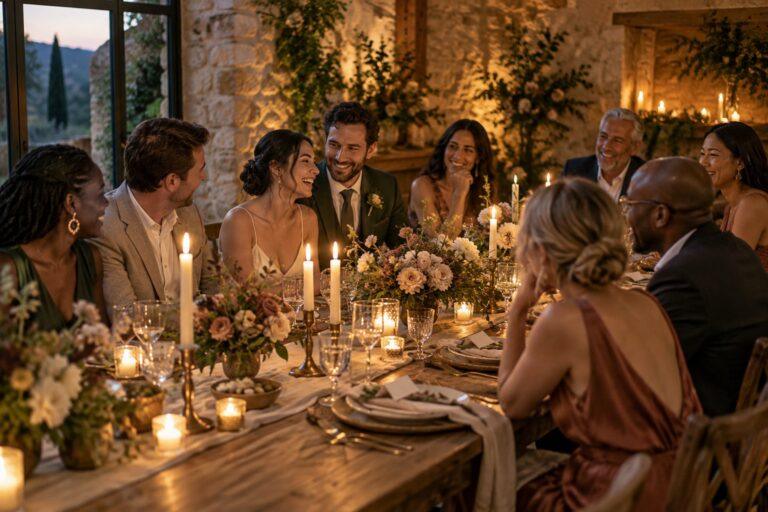
Every guest looks at it. Every photographer shoots through it. And it sits behind the moments couples frame and hang on the wall — the vows, the rings, the kiss.
That’s why wedding arch styling deserves more thought than “pop some flowers on a frame.” The arch is the set for the main event. Get it wrong and you’ve built a beautiful structure that blocks the view, fights the venue or tips over mid-vows.
Here’s how professional stylists think about arch shapes, florals, fabric, scale and the practical stuff nobody puts on Pinterest.
Why wedding arch styling matters more than you think
The ceremony arch frames the most photographed minutes of the day. Photographers typically shoot straight up the aisle, from the side for the ring exchange, and from behind the couple towards the guests. Your arch needs to work from all three angles — not just the front-on view you sketched.
Then there are sightlines. Guests in the back rows should see the couple, not a wall of greenery. The celebrant or officiant needs to stand somewhere that makes sense without disappearing into the florals. And whatever sits behind the arch — a view, a stone wall, a car park — is in every shot.
Before you choose a single stem, stand where the photographer will stand and look. That one habit fixes more arch mistakes than any trend report.
Wedding arch shapes and what each one says
Shape is the first styling decision, and it sets the tone before a flower goes anywhere.
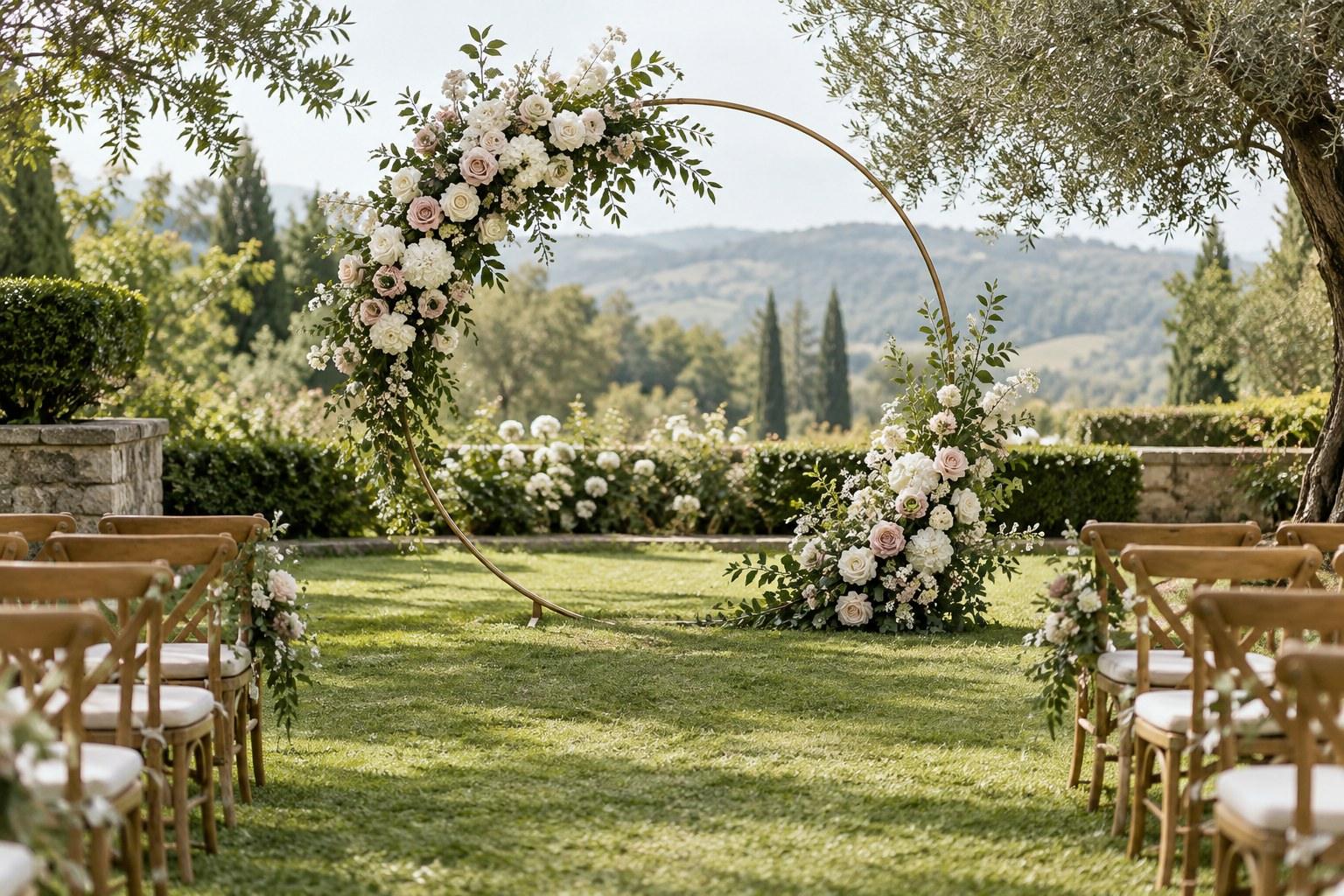
Round or circle arches
The circle is soft, romantic and modern all at once. It frames the couple like a portrait, which is exactly why photographers love it. Just resist covering the whole ring, or it becomes a giant wreath.
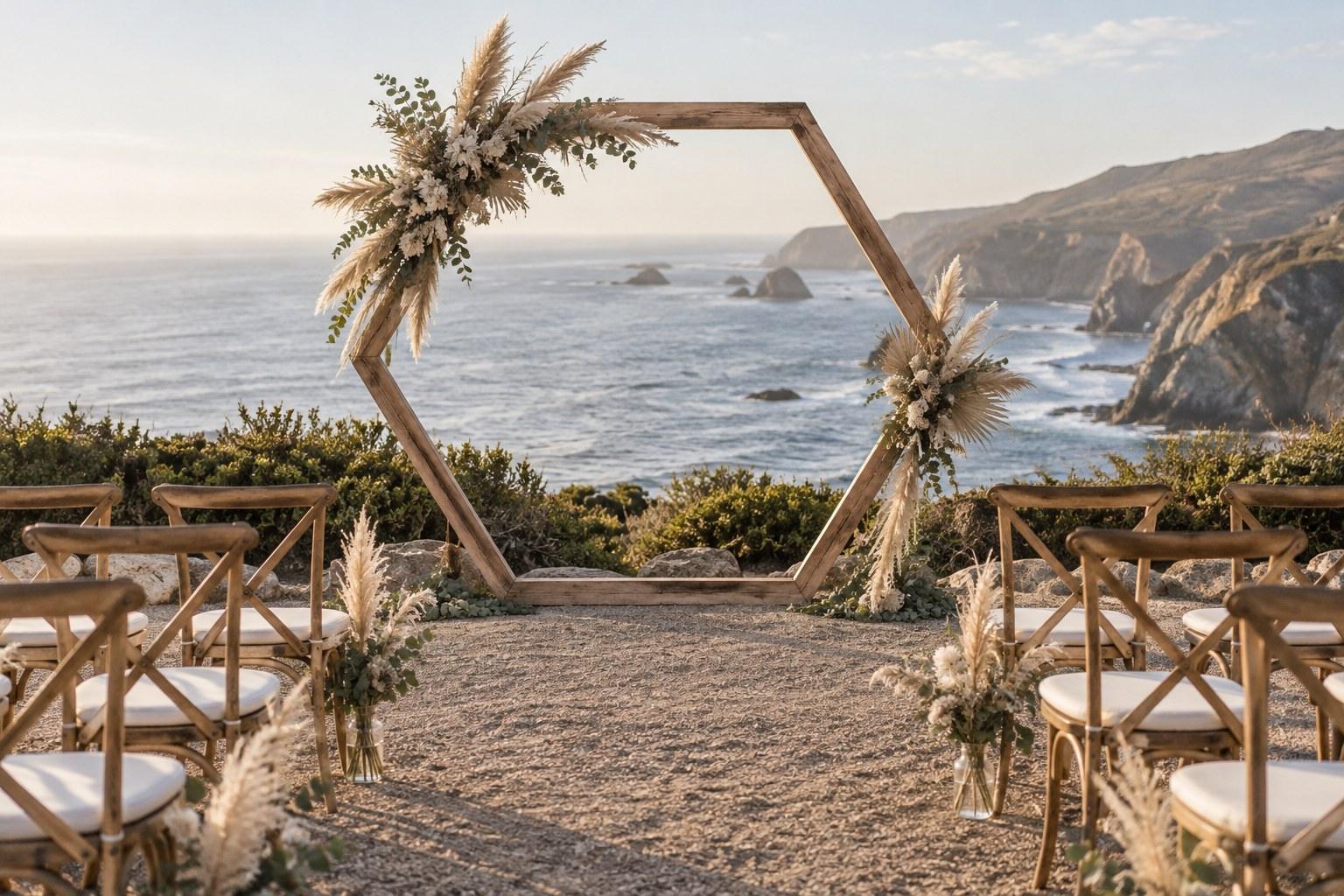
Hexagon arches
Geometric, slightly boho, very at home on a beach, clifftop or in a modern venue. The angles are the design, so keep florals light — a corner cluster, some dried texture.
Rectangular and square frames
The most versatile shape you can own. A rectangle reads as clean and architectural, and it’s the best canvas for full floral headers, layered fabric or a hanging installation. Watch proportions: too wide and short looks squat; too tall and narrow, and the couple looks lost.
Triangle and A-frame arches
Natural, woodland, a little Scandi. Lovely with fabric draped from the apex — but anchor the legs well.
Asymmetric and half-moon arches
These are the editorial option. One side carries the drama, the other stays open, and the negative space becomes part of the design.
Chuppahs, mandaps and four-post structures
Some ceremony structures aren’t décor first — they carry real cultural or religious meaning. A chuppah in a Jewish ceremony or a mandap in a Hindu ceremony has its own significance and traditions. Your job is to ask the couple (and, where relevant, their officiant or family) what matters, follow their tradition, and style within it. Never treat it as just another backdrop shape.
Freestanding floral pillars and no-arch options
Not every ceremony needs an arch. Floral pillars on either side of the couple, or a low “ground meadow” of flowers and grasses spilling along the front, frame the moment without blocking a spectacular view. When the venue already has the backdrop, the most confident choice is often to get out of its way.
Choosing arch materials: timber, metal, acrylic or branches
- Timber — warm and natural, suits rustic, boho and garden weddings. Heavier, so plan transport and setup crew accordingly.
- Metal — slim, strong and modern. Brass or gold tones feel luxe; black reads graphic and minimal. Great for round and geometric shapes.
- Acrylic — clear and contemporary, lets the view show through. Fingerprints and scratches show in photos, so handle with gloves and pack carefully.
- Natural branches — organic and one-of-a-kind. Check they’re sound and secured, and think about whether they’ll shed or wilt on the day.
Match the material to the venue first and the mood board second.
Wedding arch florals: full, asymmetric or minimal
Florals carry most of the visual weight — and most of the budget conversation. Three broad approaches:
- Full installations — the frame disappears under flowers and foliage. High impact, high labour, and heavy. Best when the arch is the centrepiece of the whole event.
- Asymmetric installations — one or two generous clusters placed off-centre. It frames the couple without swallowing them.
- Minimal accents — a single bloom cluster, some dried grasses, a trailing vine. Lets the shape and setting speak.
Working with the florist on your arch
Unless you’re also the florist, the arch is a collaboration — and it goes smoothly when you talk mechanics early. Agree on how the florals attach (cages, chicken wire, water tubes, zip ties), how much weight the frame can safely carry, and whether the couple wants foam-free mechanics. Ask rather than assume.
Then settle the most important logistics question: who installs and who bumps out? Write it down. If you want to understand the floral side well enough to brief a florist confidently — or design installations yourself — the Certificate in Floral Design is built for exactly that.
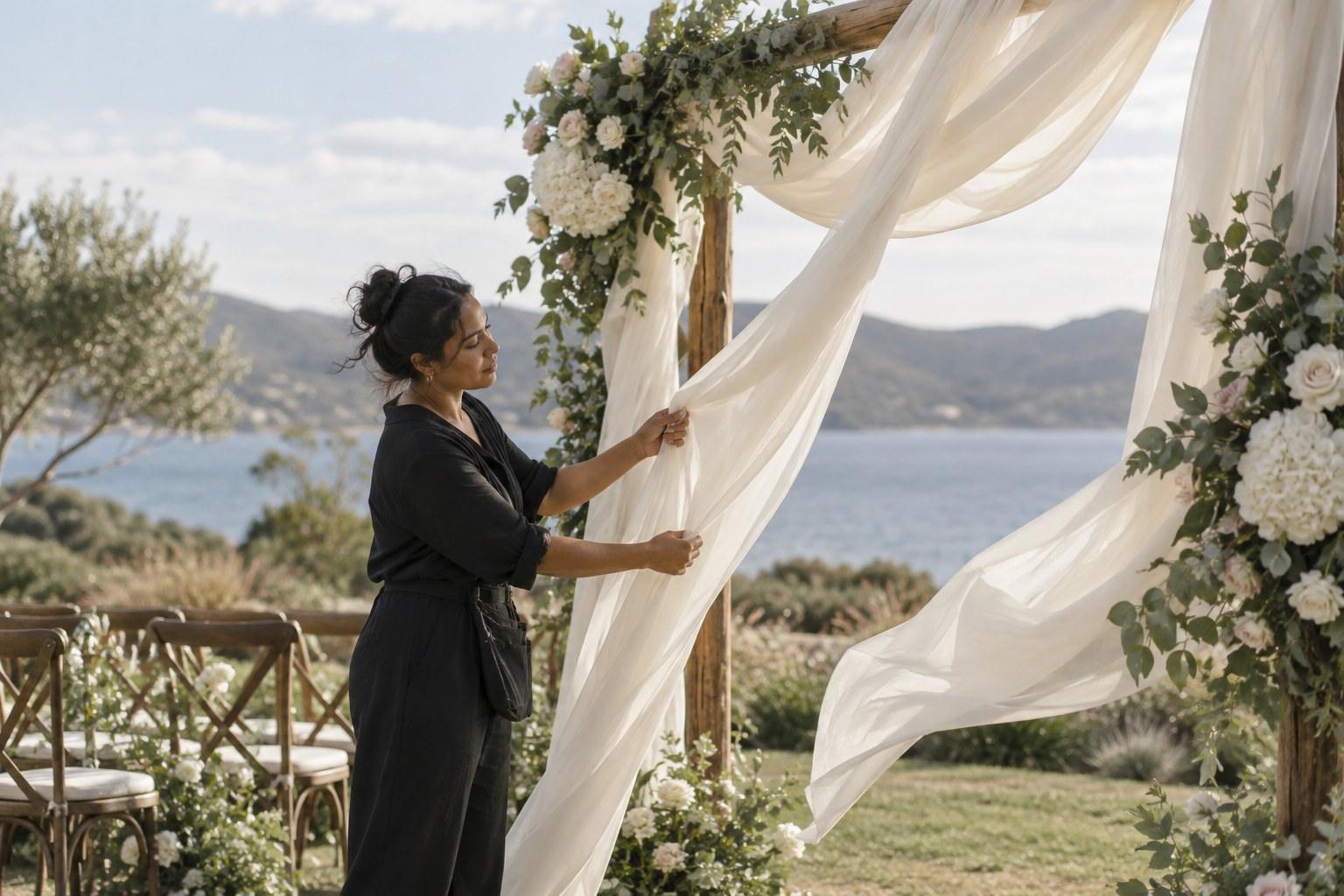
Fabric draping on a wedding arch
Fabric softens a structure and adds movement — but the choice changes everything:
- Chiffon — floaty, sheer and romantic. Looks dreamy in a breeze and terrible in a gale. Weight the ends or secure them discreetly.
- Linen — relaxed, natural texture with more body. Lovely for garden, coastal and rustic styling.
- Velvet — rich and heavy, with a formal or moody feel. Better indoors or in sheltered spots; it’s heavy on the frame.
Colour matters more than people expect. Fabric sits right behind the couple’s faces, so think about how it reads against skin tones, the wedding attire and the light. Bright white can blow out in direct sun; ivory and soft neutrals are usually kinder. And the same fabric reads differently against blue sky, grey stone or green hedge.
This is the kind of colour-and-composition thinking we work through in the Certificate in Wedding Styling — the arch, aisle and chairs have to read as one scene.
Scale and placement: getting the ceremony backdrop right
A gorgeous arch in the wrong spot is still the wrong arch. Before you finalise the design, check:
- Venue size and ceiling height — a tall arch in a low-ceilinged room feels cramped; a small arch in a vast ballroom disappears.
- Guest seating — how deep is the seating, and will back rows see the couple over the florals?
- The celebrant’s spot — leave room for the officiant to stand comfortably, with space for a microphone stand or small table if needed.
- What’s in the photo — check the backdrop from the aisle, both sides and behind the couple.
- Light direction — avoid harsh light straight in the couple’s faces. Ask the photographer.
The Wedding Stylist’s Handbook is a handy companion here to keep open while you plan layouts and briefs.
Outdoor wedding arch practicalities: wind, weights and safety
Outdoor arches are where styling meets engineering. A few non-negotiables:
- Anchoring — sandbags or weights on hard surfaces, stakes or ground pegs on grass. Hide them with greenery.
- Uneven ground — level the base before anything goes on it.
- Wind — keep top-heavy installations balanced, secure fabric properly, and have a plan to strip back loose elements if conditions change.
- Safety — guests and children will lean on, brush past and pose against the arch. It must be stable enough to handle it.
- Venue rules — many venues restrict what can be staked into lawns, attached to structures or left on site. Check before you design, not on the day.
Wedding arch styling ideas by shape
| Arch shape | Style it suits | Styling tip |
|---|---|---|
| Round / circle | Romantic, garden, modern-classic | Go asymmetric with florals — two clusters at roughly ten and four o’clock let the circle read as a frame instead of a wreath |
| Hexagon | Boho, coastal, geometric modern | Keep florals minimal and textural; the clean lines are the feature, so don’t bury the angles |
| Rectangle / square frame | Minimalist, industrial, black-tie | Use it as a canvas for fabric or a full floral header; check proportions against ceiling height |
| Triangle / A-frame | Rustic, woodland, Scandi-inspired | Draping works beautifully from the apex; anchor the legs firmly as the shape can rack in wind |
| Asymmetric / half-moon | Editorial, sculptural, fashion-led | Let one heavy floral moment sit on the open side and leave negative space for the couple |
| Four-post (chuppah, mandap-style) | Ceremonies where the structure carries cultural or religious meaning | Follow the couple’s tradition and their officiant’s guidance first; style within it, never over it |
| Floral pillars or ground meadow | Venues with a strong backdrop, or couples who want an open view | Build height in staggered clusters so the couple is framed without blocking the view behind them |
Repurposing the arch at the reception
The arch doesn’t have to retire after the ceremony. Move it behind the head or sweetheart table, use it to frame the cake, or turn it into a photo moment near the bar.
But a move needs a plan: who carries it, how long it takes, whether the florals will survive the trip, and whether it fits through the doorways in between. Build that into the run sheet with a named person responsible.
Bump-in and bump-out timing for ceremony arches
Arch installs take longer than you think. Confirm venue access times, then work backwards: structure anchored, fabric on, florals in, a final check from the photographer’s angles — done well before guests arrive.
Bump-out matters just as much. Know who removes the arch, when the venue needs it gone, and what happens to hired items and the florals.
If you want to build this into a confident, professional styling practice — from concept boards to installation — the Certificate in Wedding Styling gives you the process, and the Advanced Certificate in Wedding Planning, Styling and Business takes you further into running it as a business.
Wedding arch styling FAQs
What is the best shape for a wedding arch?
There’s no single best shape — choose the one that suits the venue’s architecture, the couple’s style and the view behind them.
How do you stop a wedding arch from blowing over outdoors?
Anchor it properly. Use sandbags or purpose-made weights on hard surfaces, stakes or pegs in soft ground, and level the base before anything goes on it. Balance the weight, check venue rules on staking, and strip back loose fabric if wind picks up.
Can you reuse the ceremony arch at the reception?
Yes, and it’s one of the smartest ways to stretch a styling budget. Use it behind the head table, around the cake or as a photo moment — and plan the move in the run sheet.
Who installs the flowers on a wedding arch — the stylist or the florist?
It depends on how the job is contracted, so agree it in writing early. Often the stylist sets the structure and fabric while the florist builds the florals. Confirm who installs, who bumps out and who owns hired items.
What fabric is best for draping a wedding arch?
Chiffon gives a soft, floaty look and moves beautifully but catches wind. Linen feels relaxed and natural and has a little more body. Velvet adds richness and weight for formal or indoor ceremonies.
Ready to style ceremonies that photograph beautifully from every angle? Start your styling certification today. ✨