Last Updated: October 26, 2026
Quick Summary
Yes, you can learn wedding styling from scratch through structured courses, deliberate practice, and small real-world projects. Styling is a craft built on repeatable decisions about colour, scale, light, and layout rather than inherited talent. A clear path runs from learning fundamentals to styled shoots, a portfolio, and small paid work.
- Follow a beginner roadmap: learn fundamentals, practise on free projects, photograph everything, then take a course.
- Run a four-week starter curriculum covering observation, replication, variation, and presentation before paying for a course.
- The five core design principles are balance, proportion, rhythm, contrast, and focal point.
- Build a portfolio before your first paid client by styling tablescapes and partnering on styled shoots.
- The Wedding Academy offers 100% online, self-paced certificate courses with lifetime access.
Table of Contents
- Can You Learn Wedding Styling From Scratch? Yes, Here’s How
- How to Become a Wedding Stylist Without a Design Degree
- The Core Wedding Stylist Skills You Actually Need
- Styling Fundamentals: Design Principles That Decide a Room
- What a Wedding Styling Course Teaches You (and What It Doesn’t)
- Building a Wedding Styling Portfolio Before Your First Paid Client
- Styling, Planning, Coordination, and Floral Design: What’s the Difference
- Choosing Your Wedding Styling Course and Getting Started
- Frequently Asked Questions
Can You Learn Wedding Styling From Scratch? Yes, Here’s How
Yes, you can learn wedding styling from scratch. Wedding styling can be learned through structured courses, deliberate practice, and small real-world projects.
Wedding styling is a craft: taught, practised, and refined, not inherited at birth.
Styling is not pure creativity. It is a set of repeatable decisions about colour, scale, light, and layout. Learn the decisions, and the creativity follows.
How to Become a Wedding Stylist Without a Design Degree
Becoming a wedding stylist without a degree follows a clear path: learn the fundamentals, practise on styled shoots, build a portfolio, then take on small paid work. Formal training can provide structure, but the sequence stays the same.
Here is a beginner roadmap:
- Study the fundamentals. Colour, proportion, texture, and light. This is the grammar of styling.
- Learn the tools. Mood boards, floor plans, sample kits, and rental sourcing.
- Practise on free projects. Style a table, a ceremony arch, or a dessert display for friends.
- Photograph everything. Good photos turn practice into portfolio pieces.
- Take a course or certificate. Structured learning fills the gaps self-teaching leaves.
- Shadow a working stylist. Real weddings teach logistics no course can simulate.
- Price and market your service. Learn the business side before you need it.
If you want the wider picture of entering the industry cold, our guide on starting a wedding business with no experience covers the business setup that sits around the styling work.
The Core Wedding Stylist Skills You Actually Need
Wedding stylist skills split into three groups: design skill, practical skill, and people skill.
Design skills: the decisions you can rehearse
Design skill is not a personality trait. It is a set of repeatable decisions about colour, scale, texture, light, and layout, built by making them repeatedly and comparing the results.
- Building a cohesive style concept from a couple’s brief. Practise by writing a one-page brief from a real wedding you find online, then listing five design decisions that would satisfy it. Repeat weekly with a different wedding.
- Choosing colour palettes that hold up under venue lighting. Daylight, tungsten, and LED uplighting shift the same palette in different directions. Collect fabric and paper swatches, then photograph them under three light sources before committing.
- Balancing scale, texture, and negative space. Style the same table three times with one variable changed each time, height, texture, or empty space. Photograph all three and note which reads best from six feet away, which is roughly how guests see it.
A useful beginner exercise: take one table and style it three ways using only these principles. Change the focal point each time. Photograph all three. The differences will teach you more than any lecture.
Practical skills: the part that decides whether you get rehired
Practical skill matters alongside design. A beautiful mood board is not enough if the installation runs late or the rentals arrive damaged.
- Reading a floor plan and translating it into a real layout. Take a venue’s floor plan and mark sightlines, power outlets, fire exits, and service routes before placing a single table.
- Sourcing rental items and managing delivery schedules. Build a sample kit of linens, chargers, candle holders, and ribbon in neutral tones so you can test combinations without ordering. Track every rental with a delivery window, return deadline, and damage-deposit note.
- Installing a tablescape or arch on site, on time. Time yourself. Practise the sequence at home until the order of operations is automatic.
Photograph your practice setups from the guest’s eye level, not from above. Clients and photographers judge a room from standing height, and a layout that looks balanced in a top-down photo can feel flat in person.
People skills: the multiplier on everything else
People skills are part of a stylist’s work. Treat them as a separate training track.
- Running a consultation and extracting what a client actually wants. Practise with a friend: ask them to describe their dream wedding without using the words “rustic,” “modern,” or “elegant.”
- Presenting a design brief with confidence. Rehearse a five-minute walkthrough of a mood board, explaining why each choice serves the brief. Record yourself and watch for hedging language.
- Coordinating with florists, venues, and planners. Shadow or assist on a real wedding before you lead one. The vendor team operates on shared timing.
Styling is not a solo art project. You are one part of a vendor team, and your work only lands if the florals, lighting, and linens agree. Explain a design decision clearly.
A four-week starter curriculum
If you want structure, run this loop for four weeks before spending money on a course:
- Week one, observation. Collect 20 wedding images you love and annotate each with the design principle doing the work (balance, proportion, rhythm, contrast, focal point).
- Week two, replication. Recreate one of those looks at home with what you already own. Photograph it and note what you could not replicate and why.
- Week three, variation. Style the same setup three ways by changing only the focal point, then only the palette.
- Week four, presentation. Write a one-page brief for your favourite result and present it to a friend in five minutes.
For current examples, our roundup of wedding design trends shows how palettes and layouts are shifting this season.
Styling Fundamentals: Design Principles That Decide a Room
Design principles decide whether a room feels intentional or accidental.
Balance is visual weight.
Proportion is scale relative to the space. A small centrepiece on a long table disappears.
Rhythm is repetition with variation. Matching candle heights create calm. Mixed heights create energy.
Contrast is difference that reads clearly: dark against light, rough against smooth, tall against low.
Focal point is where the eye lands first.
A useful beginner exercise: take one table and style it three ways using only these principles. Change the focal point each time. Photograph all three. The differences will teach you more than any lecture.
What a Wedding Styling Course Teaches You (and What It Doesn’t)
A wedding styling course can provide structure around the design process and business basics. It does not replace hands-on practice.
Course features to consider:
- A repeatable design process, from brief to installation
- Feedback on your work from people who have styled real weddings
- A qualification that signals commitment to venues and clients
At The Wedding Academy, our self-paced certificate courses cover styling and floral design. One graduate, Kelsey Reiersen of Stone & Co. Events, said her course provided “in-depth knowledge for planning and designing a variety of events.”
Building a Wedding Styling Portfolio Before Your First Paid Client
A wedding styling portfolio is a collection of styled work that proves you can deliver a finished look. You can build one before your first paying client, and you should.
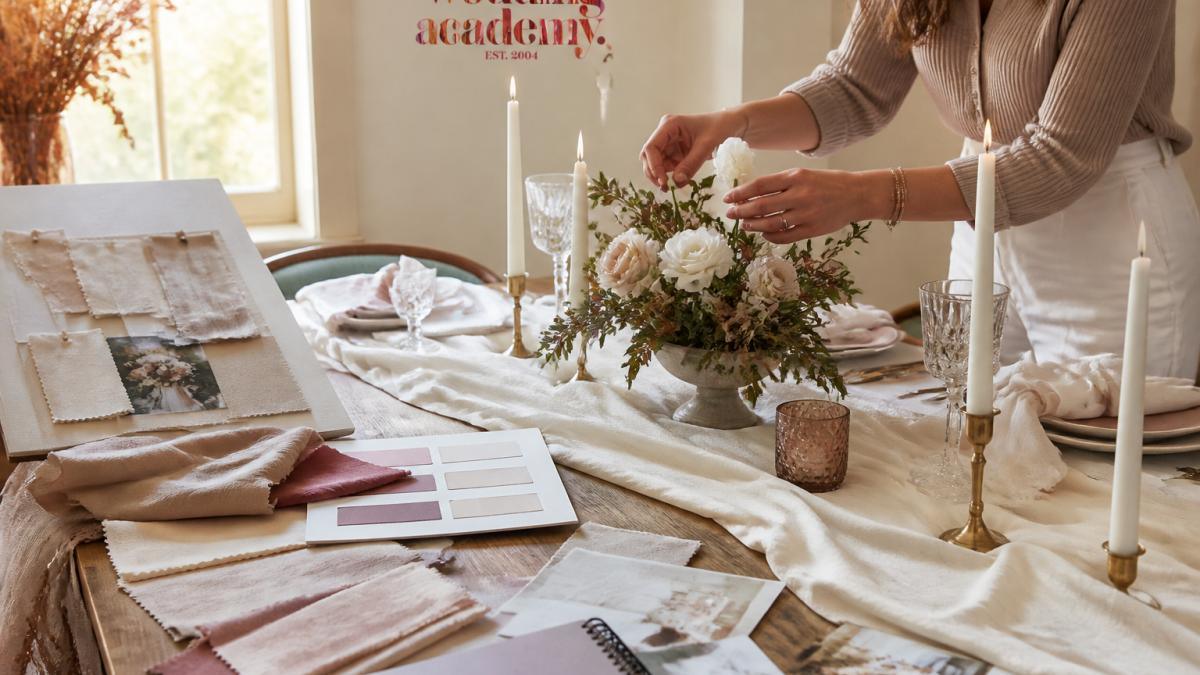
Here is how to build it from zero:
- Style three tablescapes at home and photograph them properly
- Offer free styling for one friend’s engagement shoot
- Partner with a local florist on a styled shoot
A styled shoot can be one way to build a portfolio.
Our step-by-step guide on building a wedding planning portfolio from scratch adapts directly to styling work. And if you need real industry exposure first, here is how to get wedding industry work experience.
Styling, Planning, Coordination, and Floral Design: What’s the Difference
These four roles overlap on the day but start from different questions. Styling asks “how should this look?” Planning asks “how will this happen?” Coordination asks “is it happening on schedule?” Floral design asks “what living material makes it work?”
| Role | Core Question | Main Output | Works Closely With |
|---|---|---|---|
| Stylist | How should it look? | Design brief, styled spaces | Florist, venue, photographer |
| Planner | How will it happen? | Timeline, budget, vendor plan | All vendors |
| Coordinator | Is it on schedule? | Day-of run sheet | Venue, vendors, couple |
| Floral designer | What living material works? | Bouquets, installations | Stylist, venue |
A stylist can work without a planner, but the two roles feed each other. The planner builds the timeline; the stylist builds the look. On smaller weddings, one person often does both.
Best for: couples who want a cohesive visual result.
Skip if: the couple has a clear vision and only needs day-of logistics.
Knowing where your role ends protects you from scope creep, which is the fastest way to lose money on a styling job.
Choosing Your Wedding Styling Course and Getting Started
Possible routes into wedding styling include self-teaching, workshops, online certificates, and assisting or mentoring under a working stylist. The right choice depends on your budget, timeline, and how much feedback you need.
Route 1: Self-teaching
Self-teaching is one route into wedding styling. It involves repetition.
- What it costs: mostly materials and sample-kit spending, plus your time. Many beginners spend more on props than on education in the first year.
- What it gives you: genuine taste, a thick skin for trial and error, and a portfolio built entirely on your own decisions.
- What it lacks: feedback, industry context, and any signal to clients that you are trained.
A workable self-teaching plan is the four-week loop above, repeated with a new brief each month. Add one styled shoot per quarter with a photographer and florist to keep your portfolio moving.
Route 2: Short workshops and in-person classes
Short workshops may focus on a single skill.
- What it costs: typically a low-to-mid three-figure sum per workshop, plus travel.
- What it gives you: hands-on muscle memory and a first look at how professionals sequence a setup.
- What it lacks: a complete curriculum. A workshop teaches a technique, not a business.
Route 3: Structured online certificates
Structured online certificates are one possible route into wedding styling.
- What it costs: generally more than a workshop and less than a multi-month in-person program, with payment plans common.
- What it gives you: a repeatable design process, feedback on assignments, a qualification that signals commitment, and business grounding in pricing and supplier management.
- What it lacks: the physical rehearsal of installing under time pressure. You still have to practise on real setups.
When considering a certificate, review its curriculum and the business content it includes.
A certificate is a map, not the journey. No course can hand you muscle memory, your own visual taste, or a client list. Budget time for practice alongside any course you buy.
Route 4: Assisting and mentorship
Assisting a working stylist is one way to learn about logistics.
- What it costs: your time, usually on weekends and early mornings.
- What it gives you: real wedding experience, vendor relationships, and a reference from someone in the industry.
- What it lacks: structure. You learn what that stylist happens to be doing, which may not be a complete curriculum.
A comparison at a glance
| Route | Typical cost band | Time to first paid work | Best for |
|---|---|---|---|
| Self-teaching | Low (materials only) | Slowest | Budget-limited, self-directed learners |
| Short workshop | Low-to-mid three figures per class | Fast for one skill | Filling a specific gap |
| Online certificate | Mid range, payment plans common | Moderate | Beginners who want structure and a credential |
| Assisting/mentorship | Time, sometimes paid | Fast for logistics | Learners who want real-wedding exposure |
The Wedding Academy offers 100% online, self-paced certificate courses with lifetime access, developed with an international advisory board. Explore the Certificate in Wedding Styling and the Advanced Certificate in Wedding Planning, Styling and Business.
Getting started without quitting your job
You can study while keeping your job: The Wedding Academy’s courses are self-paced and 100% online. A realistic first 90 days looks like this:
- Days 1-30: complete the four-week observation and replication loop, and build a sample kit from what you already own.
- Days 31-60: enrol in one training route, book one styled shoot with a photographer and florist, and start a simple online portfolio.
- Days 61-90: assist on one real wedding, write a brief for each project you have completed, and set a starter price for small styling jobs.
Frequently Asked Questions
Can you learn wedding styling with no experience?
Yes. Wedding styling is a learned skill, not an inherited talent. The Wedding Academy offers self-paced certificate courses in styling. From there, practice on styled shoots and small events builds the confidence and judgement that clients pay for. The main requirement is consistent practice, not a design degree or a naturally artistic eye.
What skills do you need to become a wedding stylist?
The wedding stylist skills that matter most fall into three groups. Creative skills cover colour palettes, mood boards and spatial layout. Practical skills cover sourcing rentals, installation and on-the-day setup. Business skills cover consultation, quoting, supplier coordination and managing a timeline. The Wedding Academy’s curriculum covers planning, styling, floral design, and business marketing.
Do you need a qualification to become a wedding stylist?
The Wedding Academy offers globally recognized certification. Its courses are developed by industry experts and an international advisory board.
How long does it take to learn wedding styling?
The Wedding Academy’s courses are self-paced and 100% online, so you can study from home while keeping a full-time job. The time it takes to complete a course depends on your pace.