Last Updated: November 11, 2026
Quick Summary
The essential skills for professional wedding stylists split into creative and technical halves: visual concepts, colour theory and design instinct on one side, and fabric drape, flower behaviour and buildable design on the other. Client communication, portfolio building, on-site install logistics, project management and budget management complete the skill set.
- Convert each mood board element into a materials list with physical equivalent, quantity and supplier.
- Know that peonies bruise, hydrangeas wilt without water and tropical blooms hate cold rooms.
- Shoot the empty room, mid-install, details and finished space for a persuasive portfolio.
- Build install plans backwards from guest arrival with task, owner, start, finish and dependencies.
- Reuse a master timeline template with fixed milestones from concept at 9-12 months to final confirmations at 7 days.
Table of Contents
- The Core Creative and Technical Skills Every Wedding Stylist Needs
- Wedding Stylist Client Communication: Active Listening and Empathy
- Building a Wedding Stylist Portfolio That Wins Clients
- Wedding Décor Setup: On-Site Execution and Logistics
- Project Management and Timeline Development for Stylists
- Budget Management and Vendor Coordination
- Wedding Styling Business: Financial Planning and Career Pathways
- Advancing Your Skills with The Wedding Academy
- Frequently Asked Questions
The Core Creative and Technical Skills Every Wedding Stylist Needs
The essential skills for professional wedding stylists split into two halves most training never separates: the creative eye and the technical hand. The creative half is visual concepts, colour theory and design instinct. The technical half is knowing how fabric drapes, which flowers survive a summer ceremony, and how a mood board becomes a room.
Across two decades in the industry, the skills that matter most on the job are rarely the flashy ones.
Wedding styling is the practice of translating a couple’s emotional vision into a physical, buildable, budget-aware environment. That definition matters, because it forces you to think like a builder, not just a decorator.
Translating a Mood Board into a Physical Design
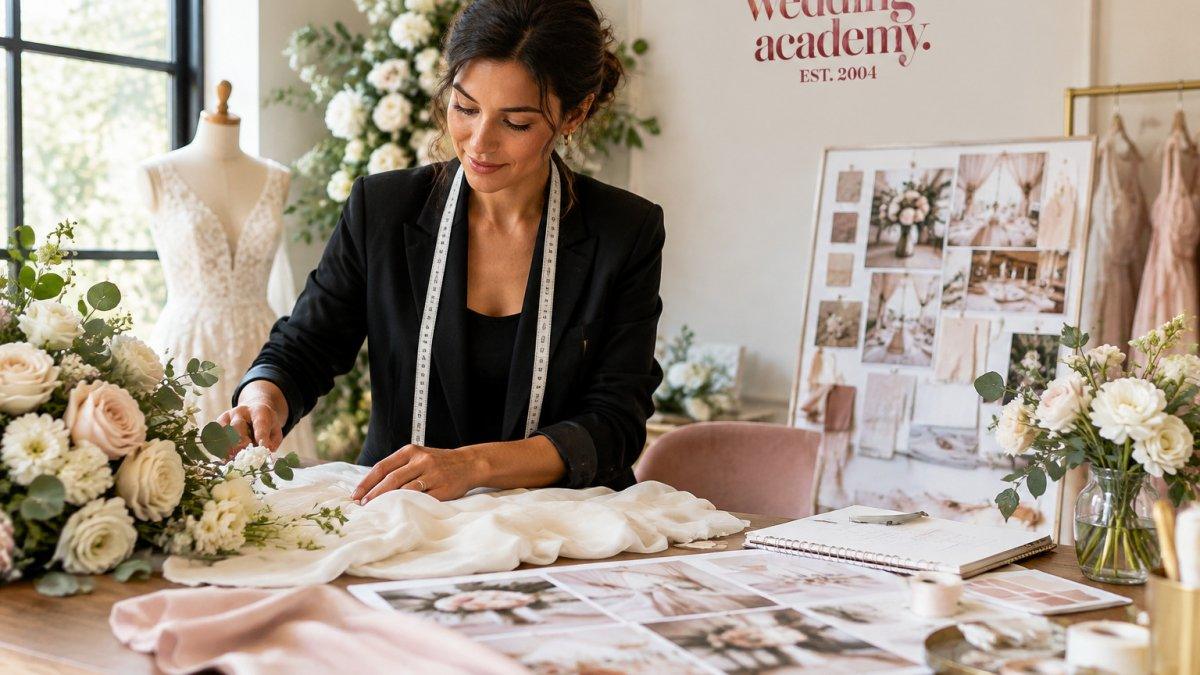
A mood board is not a design. It is a set of clues. The skill is converting those clues into materials, quantities and structures that survive contact with a real venue.
Start with three anchors: palette, texture and scale. A board showing soft sage and cream gives you the palette; linen swatches and raw-edged ribbon give you texture; wide venue shots give you scale. Get one wrong and the room feels off, even if every item is beautiful.
The translation step needs a materials list, not a vibe. For each board element, write the physical equivalent, the quantity needed and the supplier.
Stylists working with current couples also need trend literacy. Our guide to wedding design trends for 2026 is a useful reference when you are building boards for clients who want something of the moment rather than something timeless.
Floral and Textile Knowledge for Stylists
You do not need to be a florist, but you do need to know what flowers do under pressure. Peonies bruise. Hydrangeas wilt without water.
Textiles deserve the same attention. Know how satin catches light, how chiffon moves in wind, and how heavy velvet behaves on a table guests will lean on.
If you are starting from zero, read our piece on whether you can learn wedding styling from scratch.
Wedding Stylist Client Communication: Active Listening and Empathy
Client communication is where styling careers are won or lost. Couples rarely fire a stylist for a bad centrepiece.
Active listening means reflecting back what you heard before you design anything.
Empathy has a practical function too. Weddings carry family politics, budget anxiety and grief.
The Knot Worldwide’s 2026 Real Wedding Study found that personality is a top deciding factor when couples choose guest-facing wedding professionals, alongside clear communication and responsiveness.
Our article on managing wedding client expectations goes deeper on setting boundaries, handling scope creep, and putting agreements in writing before the first sample is ordered.
Building a Wedding Stylist Portfolio That Wins Clients
A wedding stylist portfolio is a curated collection of styled shoots, real weddings and design concepts that demonstrates your visual range and ability to execute. It is a sales document, not a scrapbook, and one of the few places a new stylist can out-compete an established one.
Start with styled shoots, not paid work
Beginners often wait for paid work before building a portfolio, but styled shoots offer a way to start sooner. Gather a photographer, florist and cake maker who also need content, split the costs, and shoot two or three distinct concepts: one editorial, one intimate, one large-scale.
Document work as you go, not after the fact
The best portfolio images are captured during setup, not only after the room is finished. Shoot the empty room, the mid-install, the details and the finished space. A short before-and-after sequence is more persuasive than a single hero image because it proves you can build, not just arrange. Keep a shot list for every install: wide, mid, detail, and one image showing scale against a person.
Present concepts, not just photographs
A portfolio that only shows finished rooms tells a couple what you have done. One that shows the brief, the mood board and the finished room tells them how you think. Add a short line under each set explaining the brief, the venue constraints and how you solved them.
Use digital tools to build a shareable lookbook
Simple layout tools let you build a shareable lookbook, and a clean PDF beats a link to a messy drive folder every time. Mood-board and floor-plan tools also let you present a concept before you have built it. A short, well-labelled PDF with a cover, a concept page, three to six project spreads and a contact page is enough to start.
Show range without overstating experience
Be honest about what is a styled shoot and what is a real wedding. Couples respect transparency, and misrepresenting a shoot as a client wedding is the fastest way to lose trust when they ask a follow-up question. Label each project clearly and let the work carry the pitch.
Measure what the portfolio is doing
A portfolio is a sales tool, so track it like one. Note which projects couples mention in enquiries, which pages they linger on in a shared PDF, and which concepts lead to bookings. That same habit of refining a portfolio around the work that resonates can sharpen how you present your professional identity, a principle shared by LUV + CO.
Wedding Décor Setup: On-Site Execution and Logistics
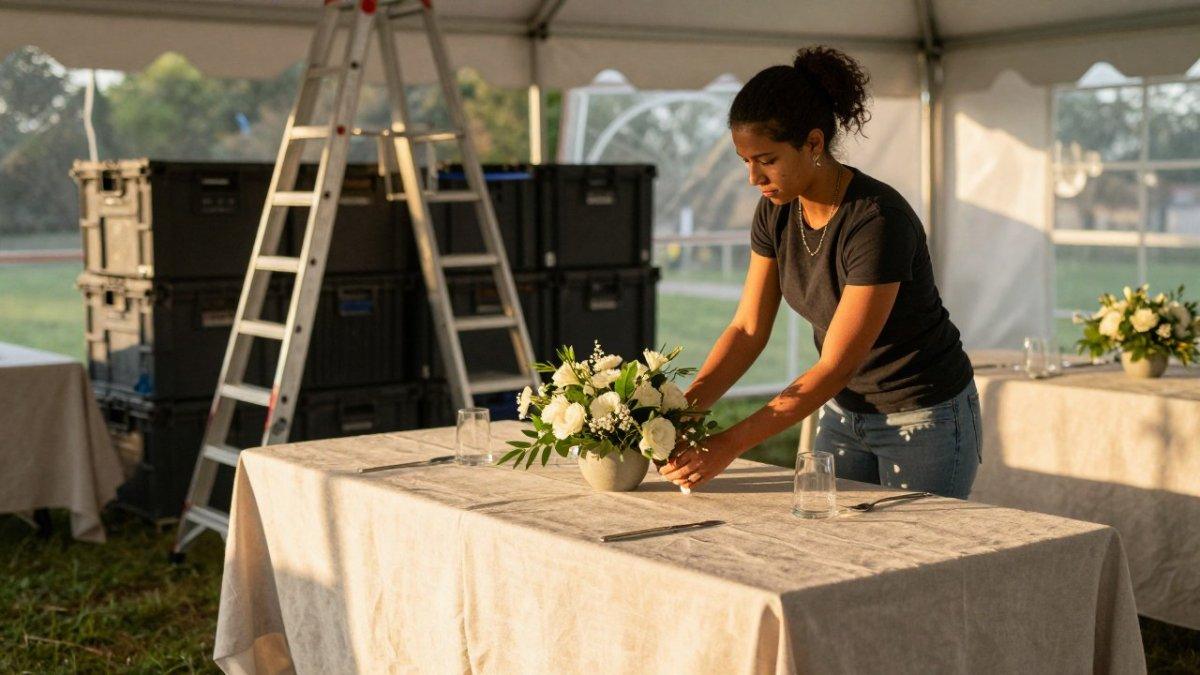
On-site execution is the part of styling nobody photographs and everybody remembers when it goes wrong. It is also the clearest line between a stylist and a planner: planners coordinate people, stylists build rooms.
Build the install plan backwards from guest arrival
Work from the moment the first guest can see the space, not from when you arrive. Ceremony décor must be finished and cleared from sightlines before doors open. Reception styling often waits until the ceremony space converts, compressing your window.
A workable install plan has five columns: task, owner, start time, finish time and dependencies. Dependencies are what beginners miss. You cannot lay linen until tables are placed, and you cannot place tables until the floor plan is marked. Sequencing errors cost more time than slow work.
Answer the access questions in writing
Before the wedding week, confirm in writing:
- What time do you get access to the venue, and is that time guaranteed or best-effort?
- Who unlocks, and who do you call if they do not answer?
- Where do crates, ladders and spare stock live during the event, out of guest sightlines?
Watch out: the most common install failure is assuming venue access times are flexible. They rarely are, and a lost hour cannot be recovered by working faster. Confirm access in writing and have a named contact on the day.
Direct the setup team, don’t do everything yourself
Stylists who build a team need to brief it before the day, not during it. A one-page setup brief with a simple floor plan, a photo reference for each zone, and named owners per zone prevents the most common team failure: everyone doing the visible task and nobody doing the invisible one.
Plan the contingency before you need it
Outdoor ceremonies need a weather call time and a wet-weather layout agreed with the venue in advance. Indoor rooms need a plan for late supplier deliveries and damaged stock. Keep a contingency kit on site: spare linen, cable ties, touch-up paint, stain remover, scissors, a steamer and a basic tool kit. The kit costs little against the cost of a visible fix on the day.
Pack-down is part of the skill
Strike the room in reverse order of install, and label crates by zone so hire stock returns correctly. Photograph each zone before you touch it, for your portfolio and for damage disputes with hire companies. A clean, on-time pack-down protects your deposit, your venue relationship and your referral rate.
Project Management and Timeline Development for Stylists
Project management turns a creative business into a reliable one. Wedding stylists run six to eighteen projects at once, each with its own deadline chain.
Build a master timeline template with fixed milestones and reuse it. A workable structure looks like this:
| Stage | Timing Before Wedding | What Must Be Locked |
|---|---|---|
| Concept and mood board | 9-12 months | Palette, style direction, budget split |
| Supplier bookings | 7-9 months | Florist, hire company, lighting |
| Design sign-off | 4-5 months | Final layout, quantities, contracts |
| Order confirmation | 8-10 weeks | Stock, lead times, delivery slots |
| Install plan issued | 2-3 weeks | Access times, crew, run sheet |
| Final confirmations | 7 days | Venue, suppliers, contingency |
Timeline development is really risk management. Every milestone exists to catch a problem while it is still cheap to fix. A colour discontinued eight weeks out is a crisis; the same discovery five months out is a Tuesday.
Budget Management and Vendor Coordination
Budget management and vendor coordination are the same job seen from two angles. Every vendor conversation is a money conversation, and every money decision depends on a supplier’s lead time or minimum order.
Start every project with a written budget split across categories: florals, furniture hire, linen, lighting, stationery, labour. Give the couple the sheet and update it as quotes come in.
Vendor coordination runs on three habits. Confirm everything in writing. Confirm again one week out. And keep one master contact sheet with names, numbers and arrival times you can hand to the venue.
Contract negotiation belongs in your skill set too. Ask about delivery windows, damage waivers, breakdown responsibilities and cancellation terms before you sign.
Wedding Styling Business: Financial Planning and Career Pathways
The wedding styling business is a business first. Stylists who treat it as a creative hobby tend to price badly, work constantly, and quit within three years.
Financial planning starts with three numbers: your cost per wedding, your target profit margin and your annual revenue goal. Work backwards from those to a booking target and a price. If a wedding costs a set amount in materials, hire, transport and labour, your quote must cover that plus margin plus tax. Guessing is how stylists end up busy and broke.
Career pathways are more varied than most people assume. Some stylists stay solo and keep overheads low.
Sustainability and responsible sourcing are increasingly part of the commercial case, not just the ethical one.
Advancing Your Skills with The Wedding Academy
Formal training closes the gap between knowing what good styling looks like and being able to deliver it under pressure. That gap is where most career changers stall.
The Wedding Academy was founded in 2004 and has supported more than 11,000 graduates. Our Certificate in Wedding Styling covers design translation, install logistics and client work, while the Advanced Certificate in Wedding Planning, Styling and Business adds the financial and operational side.
Courses are developed by industry experts and an International Advisory Board, and the certification is globally recognised. If you want the formal route to becoming a certified wedding stylist, our guide on how to become a certified wedding stylist maps out the steps.
For stylists who want to specialise in flowers, we also compare the best online wedding floral design courses so you can match the training to the work you actually want.
Kelsey Reiersen of Stone & Co.
The skills are learnable, but they are not absorbed by watching other people’s weddings on a screen.
The Wedding Academy teaches the creative and commercial sides together: self-paced online courses, lifetime access, an International Advisory Board behind the curriculum, and a globally recognised certification at the end.
Frequently Asked Questions
What skills do you need to become a professional wedding stylist?
Professional wedding stylists combine creative and practical skills. On the creative side, you need colour theory, floral and textile knowledge, and the ability to translate a mood board into physical materials. Practically, you need strong organization, time management, and on-site problem-solving for wedding décor setup. Business skills like budget management, vendor coordination, and client communication are equally important. The Wedding Academy’s Certificate in Wedding Styling covers these areas through self-paced online learning.
How can you build a wedding stylist portfolio without paid clients?
Start with styled shoots: collaborate with photographers, florists, and venues to create portfolio-ready images of your work. Document every setup, including wedding décor setup details, and organize images by style or venue type. A wedding stylist portfolio should show your range and attention to detail. The Wedding Academy offers a global community of wedding professionals and mentors.
How important is client communication for a wedding stylist?
Wedding stylist client communication is central to the role. You need active listening and empathy to understand a couple’s vision, plus clear written and verbal skills to explain design choices and manage expectations. Good communication prevents costly misunderstandings during wedding décor setup and keeps vendor relationships smooth. The Wedding Academy’s courses cover client coordination, and its 11,000+ graduates include wedding professionals across the industry.
Do wedding stylists need formal certification to start a wedding styling business?
Certification is not always legally required, but it builds credibility with clients and venues. A globally recognized qualification from The Wedding Academy demonstrates you have trained in styling, floral design, and business management. The Academy’s Advanced Certificate in Wedding Planning, Styling and Business combines these areas, and its self-paced format lets you study while keeping a full-time job.