Last Updated: November 8, 2026
Quick Summary
Wedding styling can be a strong career for people who combine design taste with business discipline, but it is a poor fit for anyone who wants predictable hours or a steady salary. The global wedding services market was valued at $1.0 trillion in 2025 and is projected to reach $2.7 trillion by 2033.
- Wedding styling is design and visual execution, not logistics like wedding planning.
- Most stylists are self-employed and earn per booking, so there is no single salary figure.
- Start part-time: learn the craft, build a portfolio, and land paid bookings before quitting.
- Track your actual hours on your first five bookings to price installation labour properly.
- Most weddings cluster in warmer months, so build a cash buffer for quiet months.
Table of Contents
- What Wedding Styling Really Is (and What It Isn’t)
- The Case For Wedding Styling as a Career
- The Honest Downsides: Pressure, Seasonality and Long Hours
- Wedding Stylist Duties: What the Work Actually Involves
- How to Become a Wedding Stylist Without Quitting Your Job
- Wedding Stylist Salary and What Shapes Your Income
- Wedding Styling Portfolio Examples That Win Clients
- Build Your Styling Skills With a Recognised Qualification
- Frequently Asked Questions
What Wedding Styling Really Is (and What It Isn’t)
Wedding styling is the work of shaping how a wedding looks and feels, from the colour palette and mood board to the ceremony backdrop and table settings.
Here is the honest answer up front: wedding styling can be a strong career for people who combine design taste with business discipline.
The demand side looks healthy. According to Grand View Research’s wedding services market report, the global wedding services market was valued at $1.0 trillion in 2025 and is projected to reach $2.7 trillion by 2033, growing at a 12.8% CAGR.
At The Wedding Academy, we have supported people making this exact transition for over 20 years.
Styling, Planning and Bridal Styling: Three Different Jobs
These three roles get mixed up constantly, and the mix-up costs people money and time.
Wedding styling is the design and visual execution of the day. Stylists build design concepts, source decor and florals, and set the space on the day.
Wedding planning is logistics. Planners manage budgets, supplier coordination, timelines, contracts, and venue liaison.
Bridal styling is about the couple’s look: dresses, fittings, accessories, and hair and makeup coordination.
The overlap is real. If you are weighing adjacent roles, our guide to the key differences between a wedding planner and floral designer career sets out the paths side by side.
The Case For Wedding Styling as a Career
Three things make wedding styling genuinely attractive as a career choice.
First, demand for design work is rising. Vogue’s 2026 wedding trend report notes that couples are moving away from cookie-cutter styles and asking for customization, with planners pushed to stretch creative boundaries.
Second, the work is portfolio-friendly. Every wedding you style produces photographs you can show the next client.
Third, it suits a self-employed business model. You can start part-time, keep your current job, and grow a client base before you commit.
The pros, plainly:
- Creative work with visible results
- Strong visual portfolio that compounds over time
- Low barrier to a first paid gig compared with many design fields
The catch is that none of this happens without clients, contracts, and a pricing system.
The Honest Downsides: Pressure, Seasonality and Long Hours
Wedding styling is not a soft career, and anyone selling it as one is not being straight with you.
Seasonality drives income. Most weddings cluster in warmer months, so your calendar swings between intense weeks and quiet ones.
The hours are long and lumpy. Installation days start early and end late.
Pressure is constant. You are working with people’s once-in-a-lifetime day, and mistakes are public.
The emotional demands matter too. The Wedding Academy’s perspective on wedding careers and other industry educators stress that client expectations and problem-solving under pressure are central to the job, not side issues.
The cons, plainly:
- Seasonal demand and uneven cash flow
- Long installation days with early starts
- High client expectations and little room for error
Wedding Stylist Duties: What the Work Actually Involves
A wedding stylist’s duties run from first client consultation to final pack-down, blending design work with logistics and supplier management.
The day-to-day list looks like this:
- Client consultation: understand the couple’s vision, venue, and budget
- Design concept: build a mood board, colour palette, and styling brief
- Sourcing: hire or buy decor, props, linens, and florals
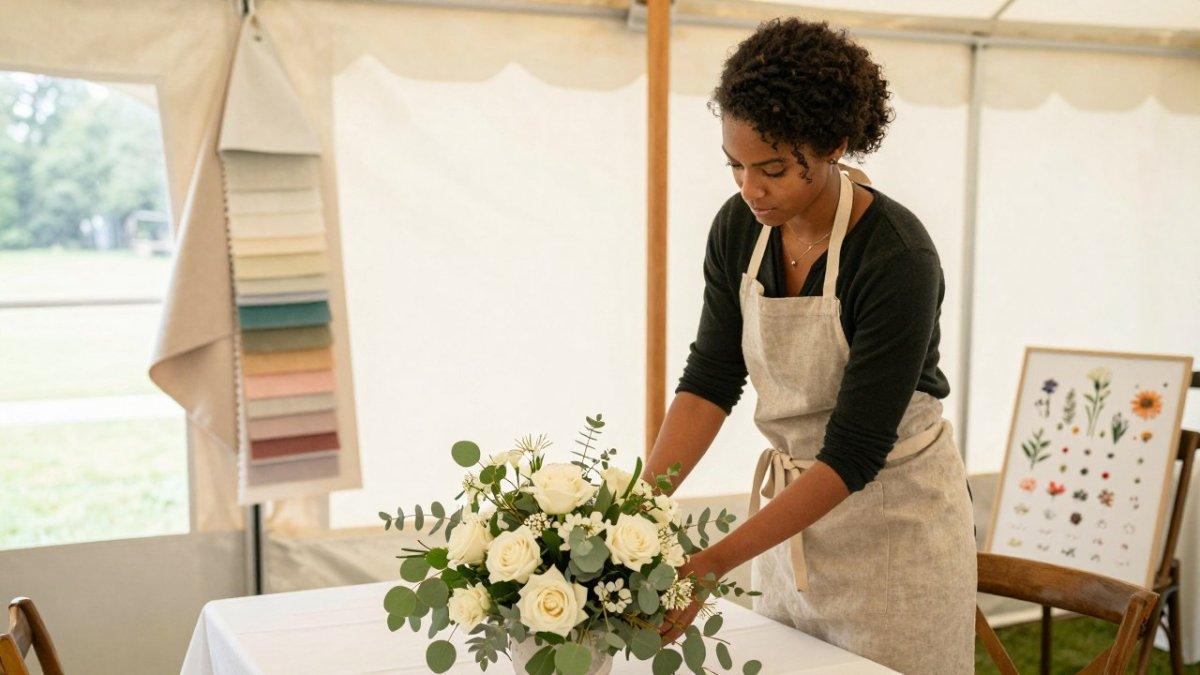
Notice how little of that is pure design. Vendor relationships, time management, and negotiation are what keep the business running.
How to Become a Wedding Stylist Without Quitting Your Job
You do not need to resign to start. The practical route is to build skills and experience while your salary covers the bills.
Here is the sequence we recommend:
- Learn the craft properly. A structured course beats scattered tutorials because it covers design, budgeting, and supplier management together.
- Build a portfolio on small jobs. Style a friend’s engagement party, a micro-wedding, or a styled shoot.
- Get industry work experience. Assist an established stylist or florist on real installs.
- Set up the business basics. Contracts, insurance, pricing, and a simple booking system.
- Market before you leap. Land two or three paid bookings before you cut your hours.
For the certification path, see our guide on how to become a certified wedding stylist. If you are starting from zero, can you learn wedding styling from scratch answers the question most career changers ask first. And for practical ways to get real experience, read how to get wedding industry work experience.
Our Certificate in Wedding Styling is self-paced and online, so you can study around a full-time job, with lifetime access to revisit the material.
| Stage | What You Do | Typical Timeframe |
|---|---|---|
| Learn | Complete a recognised styling course | 3-6 months part-time |
| Practise | Style 3-5 small events or shoots | 3-6 months |
| Assist | Work alongside an established stylist | Ongoing |
| Launch | Take first paid bookings part-time | 6-12 months in |
| Scale | Raise prices, add packages, go full-time | Year 2-3 |
Wedding Stylist Salary and What Shapes Your Income
There is no single wedding stylist salary figure, because most stylists are self-employed and earn per booking rather than per year. That is not a dodge, it is the single most important financial fact about the career.
For context on the wider industry, IBISWorld’s 2026 US employment statistics reports 55,974 people employed in the US wedding planning industry, with employment up 30.3%.
The Three Income Models Stylists Actually Use
Most stylists earn through one or a blend of three models. Knowing which one you are building changes your pricing and your calendar.
Per-booking flat fee. You quote a package price for a defined scope: design concept, sourcing, installation, and pack-down.
Hourly or day-rate consulting. Common for partial services, a mood board, a venue walkthrough, a styling brief the couple executes themselves.
What Shapes Your Take-Home Pay
- Number of bookings per season. A stylist doing 12-20 weddings a year at a mid-market package is in a very different position from one doing 40 smaller events.
- Average package price. Raising your average booking value by a modest amount usually beats adding more bookings, because installation labour does not scale linearly.
- Prop and floral costs passed through or absorbed. If you absorb material costs into a flat fee, a single expensive floral brief can wipe out the profit on that booking.
Watch out: Quoting a flat fee without separating design time from installation time is how stylists end up working for very little per hour. Track your actual hours on your first five bookings, most new stylists find installation and pack-down take longer than they budgeted.
Startup Costs and the Unpaid Work Nobody Mentions
Before your first paid booking, expect to spend on a portfolio shoot or two, basic props and samples, a simple website, contracts and insurance, and possibly a short course. None are optional if you want venues and couples to take you seriously.
Just as important is the unpaid work: enquiries that go nowhere, site visits, supplier calls, quoting, and admin.
Seasonality and Cash Flow
Most weddings cluster in warmer months, so income arrives in bursts and then drops. You need a cash buffer for quiet months, and you should invoice deposits and progress payments rather than a single payment after the event, stylists who rely on one final invoice often end up financing a wedding out of their own pocket for weeks.
On the money side, a business and marketing course pays for itself faster than most design courses. Our Certificate in Wedding Business & Marketing covers pricing, cost management, and profit planning, which is the part most new stylists underestimate.
Wedding Styling Portfolio Examples That Win Clients
A portfolio is not a photo album. It is evidence that you can deliver a design concept on budget, on time, and in a real venue. Couples and venues are judging whether you can be trusted with their day, not just your taste.
Three Portfolio Projects That Do Different Jobs
Most strong portfolios contain a small number of projects that each prove something different.
The styled shoot. A collaborative shoot with a photographer, florist, and venue, built around one clear design concept.
The micro-wedding or small real event. A real couple, a real budget, a real venue.
The before-and-after transformation. A venue or room shot before setup and after styling.
What Each Portfolio Entry Should Contain
- A clear design concept and mood board so the reader sees your thinking, not just the result
- Before-and-after venue shots showing the transformation
- Detail close-ups: table settings, signage, ceremony backdrops
Watch out: A portfolio of styled shoots with no real events signals that you have taste but no delivery record. Venues and couples learn to spot the difference, so add at least one real event as soon as you can.
Why This Converts
The case note is the part new stylists skip, and it is the part that converts.
Kelsey Reiersen of Stone & Co. Events, a Wedding Academy graduate, put it this way: enrolling was an essential part of starting her career as a wedding planner and stylist, and the course gave her in-depth knowledge for designing a range of events.
If you are starting with nothing, our step-by-step guide on how to build a wedding planning portfolio from scratch applies directly to styling work.
Build Your Styling Skills With a Recognised Qualification
Talent gets you started. A qualification and a business system keep you going.
The Wedding Academy has over 11,000 graduates across more than 20 years, with courses built by industry experts and an International Advisory Board. Our Certificate in Wedding Styling covers design concepts, mood boards, and installation.
Everything is online and self-paced, with lifetime access, so you can study while employed and start taking bookings when you are ready.
The gap between wanting to style weddings and earning from it comes down to three things: a portfolio, a pricing system, and a qualification clients trust. That is the gap The Wedding Academy was built to close. Our self-paced certificate courses in styling, floral design, and wedding business give you the practical skills, formal certification, and business grounding to take your first paid booking with confidence. Get started with The Wedding Academy and turn a creative interest into a working career.
Frequently Asked Questions
What does a wedding stylist do on a typical wedding day?
A wedding stylist arrives early to set up the design they planned months in advance: dressing tables, hanging installations, arranging florals and placing signage. They work from a styling brief and a floor plan, coordinate with the venue and florist, then return at the end to pack down. Wedding stylist duties also include the quieter work beforehand, such as client consultations, mood boards, sourcing props and managing a styling budget. Most of the job is preparation; the wedding day itself is the execution.
Can you make a good living from wedding styling?
Income varies widely because most stylists are self-employed and charge per project rather than by the hour. A wedding stylist salary depends on your location, how many weddings you take each season, your pricing structure and how much of the work you outsource. The wedding industry is a large and active market, which signals demand rather than guaranteed earnings. Build a pricing model that covers materials, travel, insurance and your own time before you commit.
Do you need a qualification to start a wedding styling business?
No licence is legally required in most markets, but formal training changes how clients and venues treat you. A recognised certificate gives you a structured grounding in design concepts, supplier management, budgeting and contracts, which are the areas new stylists most often get wrong. It also gives you something concrete to show couples who have never hired a stylist before. The Wedding Academy’s Certificate in Wedding Styling is one option for building design and delivery skills.
How long does it take to build a wedding styling business?
Wedding demand is seasonal in most regions, so your first year is usually a mix of styled shoots, discounted or assisted weddings and word-of-mouth referrals. Studying part-time while employed full-time is a common route: self-paced online courses let you keep your salary while you build skills, a portfolio and a client base before you go independent.