
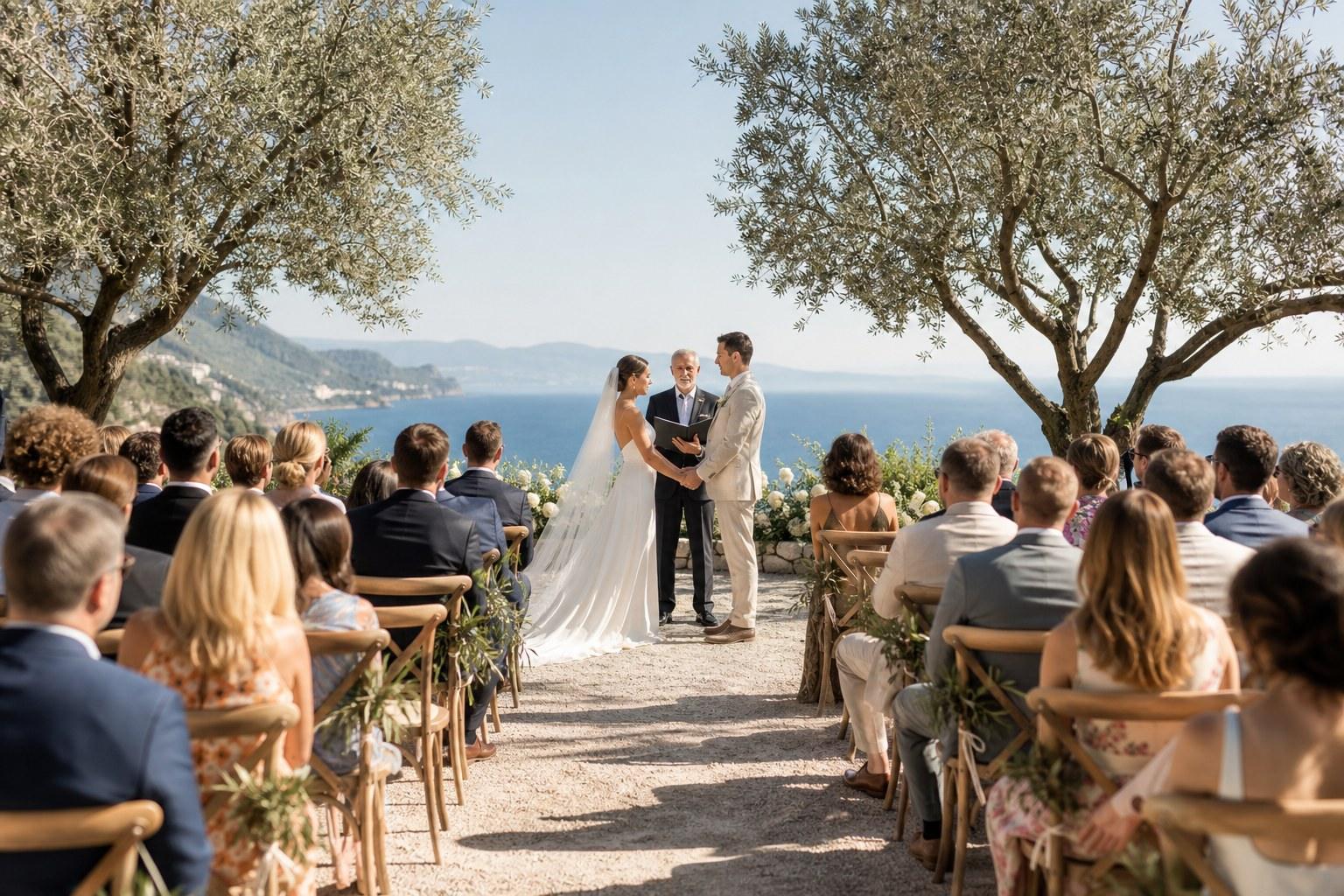
A destination wedding looks like a holiday in the brochure and behaves like a logistics contract in real life. Two countries, two currencies, suppliers you can’t drop in on, a guest list that has to book flights, and a couple who fell in love with a photo on Instagram and now want you to make the numbers work.
Which is exactly why a solid destination wedding budget is the single most valuable document you produce. Not the mood board. The budget. It’s the thing that decides whether the couple gets the wedding they pictured — and whether you get paid properly for the extra work a wedding abroad genuinely takes.
Here’s how to build one that holds up: what to include, how to price your own fee, how to handle currency and contracts, and how to have the honest conversations early so nobody discovers a problem three weeks out with non-refundable flights already booked.
Why a destination wedding budget works differently
A local wedding budget is mostly suppliers plus a venue. A destination wedding budget is that, plus a travel budget, plus a compliance budget, plus a contingency you actually need. The categories you’re used to don’t disappear — they just get extra layers underneath them.
Four things change the shape of the numbers:
- Travel and accommodation for the couple, often for key family, sometimes for suppliers you’re flying in — and always for you.
- Currency and payment friction: exchange rates move, international transfers carry fees, and some suppliers only take cash on the day.
- Legal and admin: residency requirements, document translation, certified copies, apostilles, celebrant or registrar fees — every country writes its own rules.
- Guest experience beyond the wedding day: welcome drinks, transfers, a farewell brunch. Destination weddings are rarely one event; they’re a weekend.
If your budget template only has one line for “venue” and one for “flowers”, it will break. Build a template specifically for weddings abroad and reuse it. That systems-first approach is the backbone of the Certificate in Intimate, Micro and Destination Weddings — because planning across borders rewards preparation and punishes improvisation.
How to plan a wedding abroad: start with three questions
Before you price anything, get answers to these. They determine everything downstream.
1. What is the total number the couple can spend — all in?
Not the wedding number. The total number, including their own flights, their accommodation, the legal paperwork, the extra days, the pre-wedding scouting trip if there is one. Couples routinely quote you a “budget” that turns out to be the venue and catering only. Ask the uncomfortable version of the question early and you’ll never have to renegotiate mid-plan.
2. Who is paying for what, on the guest side?
Are guests covering their own travel and rooms? Is the couple hosting transfers, a welcome event, a villa for the wedding party? The answer changes the guest list, the guest count, and the entire cost model. Write it down and put it in the couple’s invitation wording so guests can plan their own spend.
3. What is the non-negotiable, and what is decoration?
Every couple has one thing they will not trade — the view, the food, the photographer, the guest count. Find it. When the budget gets tight (and it will), you cut around the non-negotiable instead of arguing about it. That single conversation saves you weeks.

What to include in a destination wedding budget
Build your spreadsheet in categories, with a line for estimate, a line for quoted, a line for deposit paid and a line for balance due. Include a currency column. Here’s the structure that covers most weddings abroad.
| Budget category | Lines people forget | Why it bites |
|---|---|---|
| Venue and site | Site fee vs minimum spend, marquee or wet-weather plan, generator and power, staff meals | Outdoor venues abroad often need infrastructure a hotel would include |
| Food and beverage | Corkage, service charge, local taxes, tastings, supplier meals, welcome and farewell events | Service charges and tax can be quoted separately from the headline per-head price |
| Legal and documentation | Certified translations, apostilles, registrar or celebrant fees, residency days, courier costs | Requirements vary by country and change; timing errors are unfixable |
| Travel and logistics | Couple’s flights, guest transfers, supplier travel, excess baggage, hire cars, parking | Transfers for a whole guest group scale fast |
| Suppliers | Local vs flown-in, travel and accommodation for imported suppliers, translation or fixer fees | Flying a supplier in can double their effective cost |
| Styling and florals | Local seasonal availability, import restrictions, hire vs buy, breakage deposits | The Pinterest bloom may not exist in that country in that month |
| Planning fee | Your fee, your travel, your accommodation, your scouting trip, your on-site days | Under-pricing this is the classic destination planner mistake |
| Contingency | A dedicated percentage, plus a currency buffer | Weather, exchange rates and last-minute compliance costs all live here |
Two rules for the spreadsheet itself. First, every line gets an owner and a due date, not just a number — a budget with no payment calendar is just a wish list. Second, track estimated versus actual from day one, so the couple watches the gap close instead of being surprised by it.
How to price a wedding abroad without underselling yourself
Destination work takes more hours than local work — pricing it properly is a core part of the destination and micro wedding certification. More supplier research, more time-zone gymnastics, more contract reading, more translating, more reassurance. Your fee has to reflect that, and it has to be structured so the travel costs never come out of your margin.
Separate your fee from your expenses
Quote your planning fee as one number, and travel, accommodation, transfers, visas and on-site days as a clearly listed, pass-through expenses line. Couples accept expenses when they’re transparent. They resent them when they appear later as a surprise invoice.
Price the site visit properly
A scouting trip is work, not a perk. Decide whether it’s included, optional or billed separately, and say so in the proposal. If you’ve already worked the destination and don’t need one, that’s a genuine selling point — lead with it.
Bill in the currency you spend in
If your suppliers are paid in euros and you’re invoicing in another currency, you’re carrying exchange risk for free. State the invoicing currency in the contract, note who absorbs rate movement, and factor in transfer fees. Small clause, meaningful protection.
Charge for the days you’re actually on the ground
A destination wedding is rarely a one-day job. Set-up, rehearsal, welcome event, wedding day, pack-down, plus travel days either side. Count them, price them, and put the day rate in writing so extra days can be added without a renegotiation.
Contracts, deposits and payment logistics across borders
This is where destination weddings go wrong quietly. Read every supplier contract for the things that differ overseas: which law governs the agreement, what the cancellation terms are, whether deposits are refundable, whether the price is inclusive of local tax and service charge, and what happens if the couple’s guest count drops.
- Confirm the legal requirements first. Some countries require residency days, some require documents translated and legalised, some won’t recognise a symbolic ceremony as a marriage at all. Many couples handle the legal marriage at home and hold a symbolic ceremony abroad — check what the couple actually wants to be true.
- Build a payment calendar with every deposit and balance date, in local currency, with the transfer method noted. Give the couple a copy.
- Plan for cash. Some suppliers expect cash on the day. Decide who carries it, who counts it, and who signs for it — never leave that to the morning of.
- Insurance and contingency. Talk about travel and wedding insurance early, and document that you raised it. Weather, strikes and illness are not hypothetical when everyone has flown.
- Get everything in writing, in both languages if needed. A friendly verbal agreement across a language barrier is not a contract.

How to cut a destination wedding budget without wrecking the wedding
When the numbers don’t fit, resist the urge to shave every line by ten per cent. That produces a diluted wedding that nobody loves. Cut structurally instead.
- Reduce the guest count before anything else. Every head carries food, drink, seating, transfers and stationery. It’s the most powerful lever you have, and it usually makes the wedding better — smaller weddings abroad feel more intimate, not more modest.
- Move the date. Shoulder season, a weekday, or outside a local festival period can change venue and travel pricing completely.
- Go local with suppliers. Flying in your favourite florist is expensive; finding a brilliant local one is a skill worth developing.
- Design with what grows there. Seasonal, local, abundant. It looks intentional and it costs less than importing a look that doesn’t belong.
- Trim events, not quality. Two excellent gatherings beat four average ones.
- Simplify the format. Long shared tables, a family-style menu, one strong focal installation — fewer moving parts, more impact.
What you don’t cut: contingency, insurance, and the legal budget. Those exist precisely because a wedding abroad has more ways to go sideways.
Managing the couple’s expectations — and the guests’
Half of destination budget stress isn’t money; it’s mismatch. The couple imagined something, the guests assumed something else, and nobody said the numbers out loud. Your job is to make the invisible visible early.
Send guests clear cost expectations with the save-the-date: rough travel window, accommodation options at different price points, which events are hosted, what they’ll need to book themselves. Give them time. A destination guest list needs longer lead time than a local one, and every decline that arrives early is money the couple can redeploy.
With the couple, run a scheduled budget review — a standing call where you walk the spreadsheet line by line. Ten minutes a fortnight prevents the single worst conversation in this job: the one where you explain, late, that the money ran out.
Want the full toolkit — destination budget templates, supplier vetting, legal checklists and pricing structures? The Certificate in Intimate, Micro and Destination Weddings is built for exactly this work, and the Certificate in Wedding Business and Marketing covers how to package and sell it to the couples who are searching for it.
Destination wedding budget FAQs
What should a destination wedding budget include?
Everything a local budget includes, plus travel and accommodation for the couple and any flown-in suppliers, guest transfers, legal and document costs, currency and transfer fees, additional events like welcome drinks and farewell brunch, your planning fee and expenses, and a dedicated contingency line.
Is a destination wedding cheaper than a wedding at home?
Sometimes, sometimes not — it depends entirely on the destination, the season and the guest count. A smaller guest list abroad can cost less overall than a large wedding at home, but travel, extra events and legal costs can quickly close that gap. Never promise savings; model the actual numbers for the actual plan.
Who pays for guests’ travel at a destination wedding?
Usually the guests pay their own flights and accommodation, while the couple hosts the wedding itself and often transfers or a welcome event. There’s no single rule — what matters is that the couple decides early and communicates it clearly with the save-the-date so guests can budget.
How do you handle currency and exchange rates in a wedding budget?
Track every line in the currency it will be paid in, note the rate you used when you estimated, and add a buffer for movement. Specify the invoicing currency in your own contract, account for international transfer fees, and review the totals at each budget check-in.
How much should a planner charge for a destination wedding?
Price on the hours the wedding genuinely takes — including research, time-zone coordination, contract review and every on-the-ground day — then list travel and accommodation separately as pass-through expenses. Whether you charge a flat fee, a percentage or a day-rate structure, make the inclusions and the extra-day rate explicit in the contract.
Get the budget right and the rest of a destination wedding becomes what it should be — a beautiful weekend in a place everyone will remember, run by someone who never looked worried.



